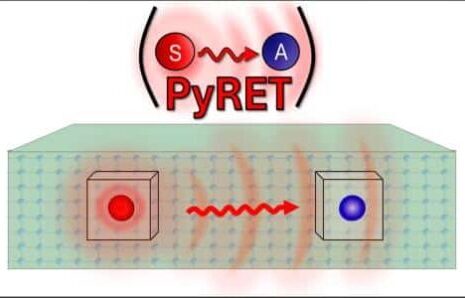
An open source simulation tool models energy transfer between atomic-scale defects in solid materials, helping researchers design more efficient quantum, electronic, and energy technologies.
Researchers at Argonne National Laboratory and the University of Chicago have developed an open source software package that predicts how energy is transferred between atomic-scale defects in solid materials. The tool enables scientists to model interactions that are difficult to observe experimentally, providing new insights into the behaviour of materials used in quantum technologies, optoelectronics, and advanced energy systems.
The software models the transfer of energy between atomic-scale defects in crystal lattices through first-principles computational techniques. Defects, whether intrinsic or extrinsic, have an immense effect on the optical, electronic, and magnetic properties of a particular material. With precise modeling of defect interactions, the computational framework makes it possible for researchers to assess the performance of a particular material before experimental validation.
As it is open source software, researchers can inspect the algorithms, reproduce the simulations, and modify the code to model other materials.
The software can be applied in a broad variety of semiconductors and insulators where the physics of defects is an important factor for the operation of these devices. Potential applications include quantum computers, light-emitting diodes, solar cells, and solid-state sensors, for which it is crucial to understand the mechanisms of energy transfer processes.
By developing an accessible software package for the simulation of defect interactions, the project helps to democratise the field of computational materials science and accelerate the development of novel functional materials. The programme shows how open source scientific software can assist in innovation and reduce costs associated with material evaluation.