




















































An open-source ham radio dashboard turns the ESP32 Cheap Yellow Display into a touchscreen station monitor for propagation, DX, POTA, and PSKReporter data.
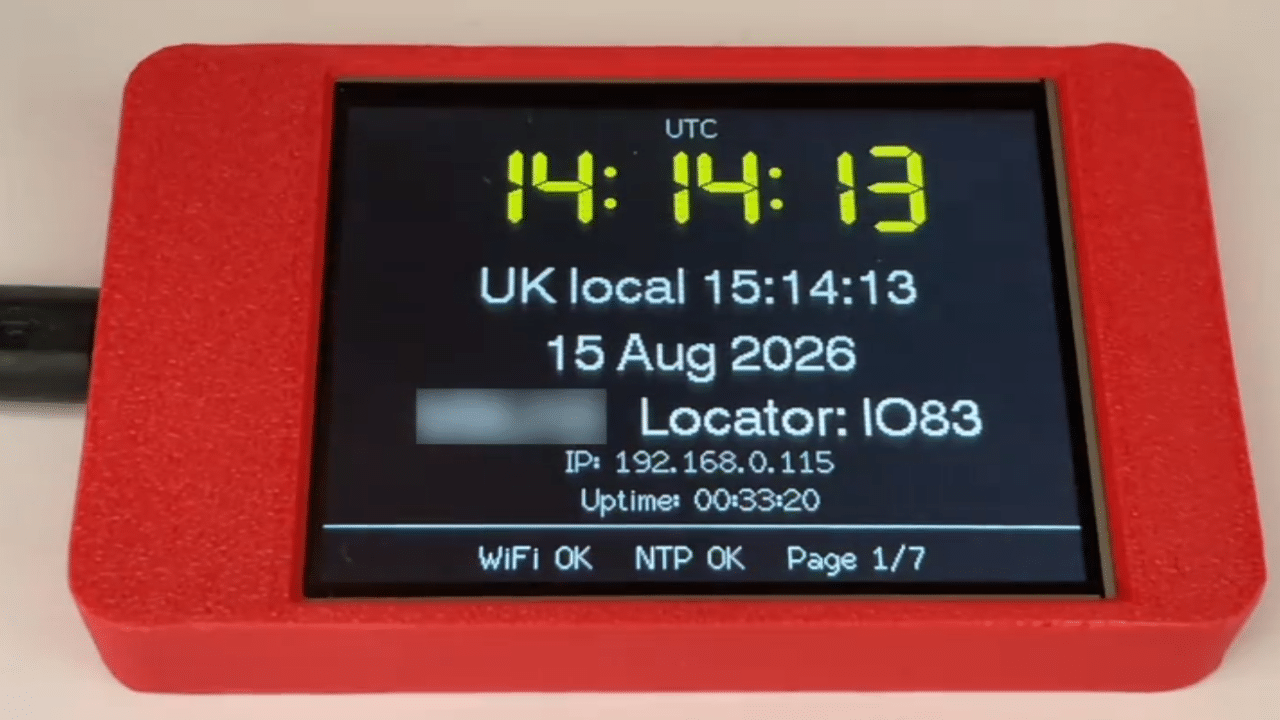
The CYD Ham Dashboard is an open-source project designed for the ESP32 Cheap Yellow Display (CYD), providing a HamClock-inspired interface for amateur radio operators. It supports the 2.8-inch ESP32-2432S028R with 320×240 resolution as well as a 4-inch CYD variant with a 480×320 ST7796S display. The interface is touch-controlled and provides UTC and local time, propagation information, maps, DX spots, and station configuration from the display.
The dashboard provides seven main pages covering a clock, HF propagation, VHF conditions, a Greyline map, PSKReporter reception reports, DX spots, and Parks on the Air (POTA) activator spots. The Greyline page calculates the day/night boundary using the configured Maidenhead locator and NTP time, while PSKReporter can plot reception reports for the configured callsign. DX information can be obtained from a JSON feed or a persistent Telnet connection to a DX Cluster, while POTA spots can be filtered by distance.
Hardware support is handled through separate PlatformIO environments, with tested configurations for 2.8-inch ILI9341 and ST7789 panels and the 4-inch ST7796S display. The project uses an ESP32-WROOM with an XPT2046 resistive touch controller. Display-specific pins and dimensions are kept in dedicated setup headers, allowing the same source tree to support different CYD variants without moving board-specific definitions into the application code.
For connectivity, the device provides a captive portal for initial Wi-Fi configuration and can expose a local web settings page once connected to the network. Users can configure the callsign, Maidenhead locator, timezone, data sources, refresh intervals, brightness, automatic page cycling, and night-time dimming. Settings are stored in the ESP32’s non-volatile preferences, while holding the BOOT button for five seconds performs a factory reset. The firmware does not require LVGL, an SD card, or an external filesystem.
The project is available on GitHub under the GPL-3.0 licence, with the source organised around connectivity, settings, display, propagation, Greyline calculations, PSKReporter, POTA, and DX spot handling. It can be flashed using release binaries or built with VS Code and PlatformIO, with a browser-based Web Flasher also provided. This makes the project a compact example of using an ESP32 and inexpensive touchscreen hardware as a dedicated open-source amateur radio information terminal.
For more information, click here.