

























































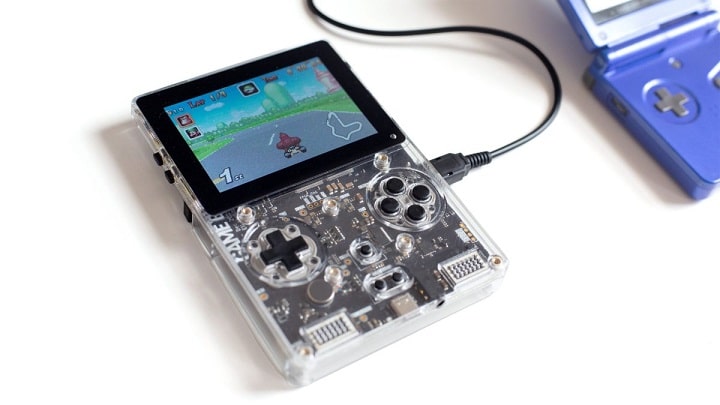
Game Bub debuts as the first fully open source FPGA handheld, supporting original Nintendo cartridges and doubling as an FPGA development board.
Game Bub has been unveiled as the first fully open source FPGA-based handheld console designed to support original Nintendo Game Boy, Game Boy Color, and Game Boy Advance cartridges with hardware-accurate emulation. Both its hardware design and software stack are released under GPLv3 and CC BY-SA licenses, making it a community-driven alternative to closed commercial emulators. Source code and documentation are openly available on GitHub.
The console’s emulation cores are custom-built for accuracy and compatibility, offering ultra-low input latency and support for original accessories. Integration with FlashGBX allows cartridge backup and restore, ROM loading, save management, and even extraction of images from the Game Boy Camera.
At its core, the device uses an AMD Artix-7 FPGA (XC7A35T-1CSG324C) paired with an Espressif ESP32-S3 for wireless connectivity, system functions, and AI/ML processing. A PMOD expansion header allows it to double as an FPGA development board for custom projects.
Game Bub includes a rumble motor, accelerometer, gyroscope, and real-time clock, ensuring compatibility with legacy games. It also supports multiplayer link cables, direct ROM loading, and wireless controllers via Bluetooth. With the optional Game Bub Dock, users gain HDMI output and USB ports for full-screen gameplay.
The handheld comes in a transparent 90s-style enclosure, with a limited purple edition available. It features a 4-inch 720×480 IPS LCD, stereo speakers, a headphone jack, and a 3,000 mAh battery delivering over 14 hours of playtime. Weighing only 250 g, it balances portability and durability.
Priced at $249 for the base version and $299 for the purple edition, Game Bub is available via Crowd Supply. The Dock retails at $59, with shipping set at $8 in the US and $18 worldwide. Deliveries begin on February 1, 2026.