



























































Japan has launched its first fully domestic quantum computer, powered by the open source OQTOPUS toolchain, securing both technological sovereignty and global collaboration in quantum research.
Japan has unveiled its first fully domestic quantum computer, marking a landmark achievement in the nation’s technology drive. The system, activated on July 28, 2025, at the University of Osaka’s Center for Quantum Information and Quantum Biology (QIQB), stands apart from earlier efforts by relying entirely on Japanese technologies.
At its core, the breakthrough is powered by OQTOPUS (Open Quantum Toolchain for Operators and Users), a homegrown open source software suite. OQTOPUS contains everything required to run quantum programs, including a core engine, cloud module and graphical user interface elements. Designed to integrate with a Quantum Processing Unit (QPU) and quantum control hardware, the open source backbone ensures the system is not only technologically advanced but also open, collaborative and extensible. This gives Japan’s ecosystem a strategic advantage over proprietary systems, while reinforcing its technological sovereignty.
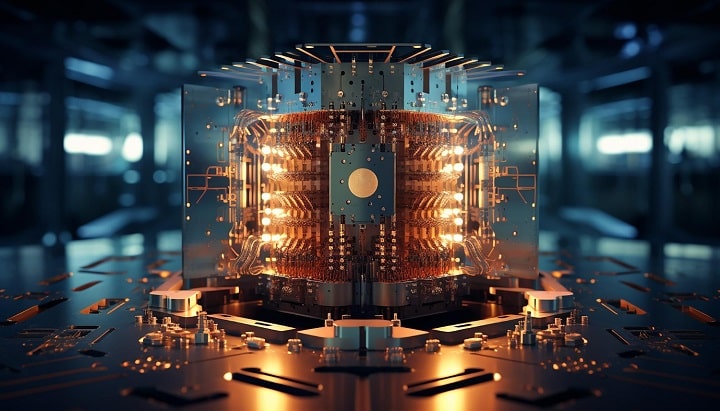
The machine’s hardware is equally significant. A superconducting qubits chip was developed by RIKEN, supported by components such as a chip package from Seiken, magnetic shield, infrared and bandpass filters, a low-noise amplifier and specialised cables. All elements are housed in a dilution refrigerator, enabling the ultra-low temperatures needed for superconducting quantum computing.
Looking ahead, quantum computers have the potential to outpace the world’s most powerful supercomputers, unlocking applications in drug discovery, traffic management and logistics optimisation. However, challenges remain, including high error rates in calculations. Current research is focused on Quantum Error Correction (QEC) to address this hurdle.
Japan’s domestic and open source quantum initiative positions the country at the forefront of a global shift towards accessible, transparent and collaborative quantum technologies.