



























































At its core, Kubernetes offers a powerful abstraction layer that simplifies the deployment and management of containerised applications. Enterprises cannot afford to ignore the scalability, security and cost-effectiveness it offers.
In today’s digital-first economy, enterprises are under relentless pressure to innovate faster, scale smarter, and operate more resiliently. But beyond the hype, what makes Kubernetes truly transformative for enterprise IT? Kubernetes addresses the urgent need for enterprises to innovate and scale in a digital-first economy, serving as a cornerstone of modern IT architecture. By decoupling applications from the underlying hardware and enabling declarative configuration, Kubernetes allows enterprises to standardise operations across diverse environments—whether on-premises, in the cloud, or across hybrid setups.
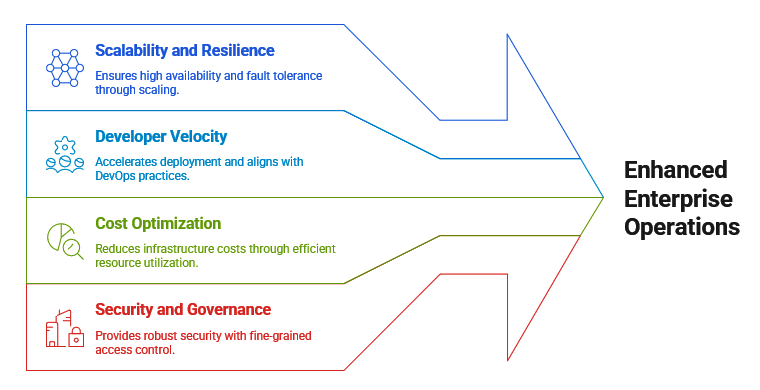
One of the most compelling reasons enterprises adopt Kubernetes is its ability to scale applications dynamically and reliably. In traditional environments, scaling often required manual intervention or complex scripts. Kubernetes automates this process through features like horizontal pod autoscaling and self-healing mechanisms, which ensure that applications remain available and performant even under fluctuating loads. This resilience is critical for enterprises that operate mission-critical systems and cannot afford downtime. Moreover, Kubernetes supports rolling updates and rollbacks, enabling teams to deploy new features with minimal risk and maximum control.
Another major driver is the acceleration of developer productivity. Kubernetes empowers development teams to build, test, and deploy applications independently. With Kubernetes, enterprises can implement continuous integration and continuous delivery (CI/CD) pipelines that automate the entire software life cycle. This not only reduces time-to-market but also enhances software quality through repeatable and testable deployment processes. The platform’s compatibility with a wide range of open source tools—such as Helm for package management, ArgoCD for GitOps, and Prometheus for monitoring—further amplifies its value by enabling modular, best-of-breed architectures.
Cost optimisation is another significant benefit. Kubernetes enables more efficient use of infrastructure resources by tightly packing workloads and scaling them based on actual demand. This elasticity helps enterprises avoid over-provisioning and reduce cloud spending. This flexibility is desirable to enterprises pursuing multi-cloud strategies or seeking to maintain control over their technology stack.
Security and governance are also enhanced through Kubernetes’ robust policy and access control mechanisms. Enterprises can define permissions using role-based access control (RBAC), enforce network segmentation with policies, and manage sensitive data through secrets management. When integrated with service meshes like Istio or security tools like Open Policy Agent (OPA), Kubernetes becomes a secure and compliant platform suitable for regulated industries such as finance, healthcare, and government.
In essence, Kubernetes is not just a tool—it’s a strategic enabler. It aligns with the enterprise goals of agility, scalability, and operational excellence, while fostering innovation through open source collaboration.
Where to use Kubernetes in the enterprise
Kubernetes has become a foundational technology for enterprises seeking to modernise their IT infrastructure and application delivery models. Its versatility allows it to be applied across a wide range of use cases, making it a strategic asset in various enterprise scenarios. One area where Kubernetes excels is in supporting microservices architectures. Enterprises that are transitioning from monolithic applications to microservices find Kubernetes particularly valuable because it provides built-in mechanisms for service discovery, load balancing, and rolling updates. These capabilities are essential for managing the complexity that comes with decomposing applications into smaller, independently deployable components.
Another critical area where Kubernetes shines is in hybrid and multi-cloud environments. Many enterprises operate across multiple cloud providers or maintain a mix of on-premises and cloud infrastructure. Kubernetes offers a consistent deployment and management experience across these environments, enabling organisations to avoid vendor lock-in and maintain flexibility in their infrastructure choices. Tools like Rancher, Anthos, and OpenShift enhance Kubernetes’ ability to manage clusters across diverse environments, making it easier for enterprises to implement governance, security, and compliance policies uniformly.
Kubernetes is also increasingly used in the realm of artificial intelligence and machine learning (AI/ML). Enterprises leveraging AI/ML workloads benefit from Kubernetes’ ability to orchestrate complex pipelines, manage GPU resources, and scale training jobs efficiently. By integrating with tools like Kubeflow and MLflow, Kubernetes becomes a powerful platform for managing the entire machine learning life cycle—from data preprocessing to model deployment. This is especially valuable in industries such as finance, healthcare, and retail, where AI-driven insights are becoming increasingly central to business strategy.
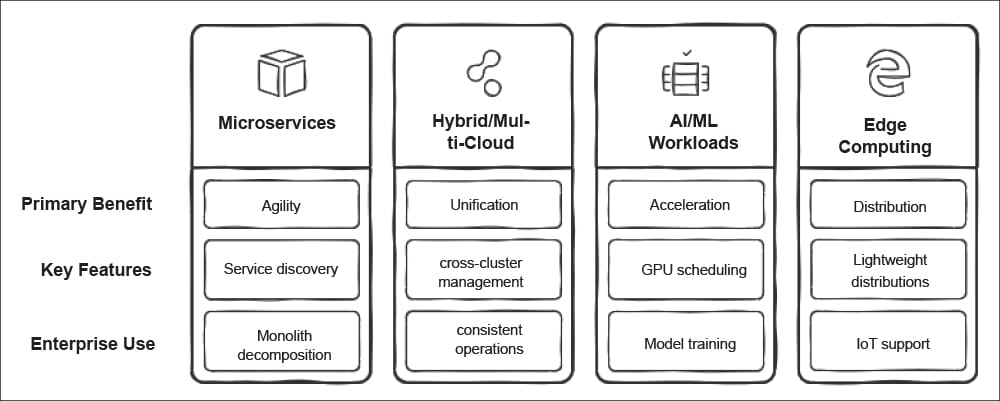
Edge computing is another emerging frontier for Kubernetes in the enterprise. With the rise of IoT and the need for real-time data processing at the edge, lightweight Kubernetes distributions such as K3s and MicroK8s are being deployed in remote locations. These setups enable enterprises to run containerised applications near where data is generated, thereby reducing latency and enhancing responsiveness. This is particularly useful in sectors like manufacturing, logistics, and telecommunications, where edge deployments can drive operational efficiency and innovation.
In addition to these use cases, Kubernetes is often used to standardise development and operations practices across teams. By providing a common platform for deploying and managing applications, Kubernetes helps enforce consistency in how software is built, tested, and released. This standardisation is crucial for large enterprises with distributed teams and complex regulatory requirements. It also facilitates the adoption of DevOps and GitOps practices, which rely on automation and version control to improve software delivery.
Ultimately, Kubernetes is not confined to a single niche within the enterprise. Its flexibility, extensibility, and strong ecosystem support make it suitable for a wide array of applications—from core business systems to cutting-edge innovations.
Table 1: Open source Kubernetes tools
|
Tool |
Category |
Description |
|
Helm |
Configuration |
A package manager for Kubernetes that simplifies defining, installing, and upgrading applications. |
|
ArgoCD |
CI/CD |
A declarative GitOps continuous delivery tool for Kubernetes. |
|
Tekton |
CI/CD |
A Kubernetes-native framework for creating CI/CD systems. |
|
Jenkins X |
CI/CD |
An integrated CI/CD solution built on Jenkins for cloud-native applications. |
|
Prometheus |
Observability |
Collects and stores metrics, supports alerting and visualisation. |
|
Grafana |
Observability |
Visualises metrics and logs with dashboards and alerts. |
|
Fluentd |
Observability |
Collects, unifies, and routes logs from various sources. |
|
Jaeger |
Observability |
Provides distributed tracing for monitoring microservices. |
|
Istio |
Service mesh |
Secures, connects, and observes microservices with traffic control and telemetry. |
|
Linkerd |
Service mesh |
A lightweight service mesh focused on simplicity and performance. |
|
Open Policy Agent (OPA) |
Security |
Enables policy-based control for Kubernetes and cloud-native environments. |
|
HashiCorp Vault |
Security |
Manages secrets and protects sensitive data. |
|
Kustomize |
Configuration |
Customises Kubernetes YAML configurations without templates. |
|
Kubeflow |
AI/ML |
Manages machine learning workflows on Kubernetes. |
|
Rancher |
Hybrid/Multi-cloud |
Manages Kubernetes clusters across any infrastructure. |
|
Anthos |
Hybrid/Multi-cloud |
Google Cloud’s platform for managing Kubernetes across hybrid and multi-cloud environments. |
|
OpenShift |
Hybrid/Multi-cloud |
Red Hat’s enterprise Kubernetes platform with developer and operational tools. |
|
K3s |
Edge computing |
A lightweight Kubernetes distribution for resource-constrained environments. |
|
MicroK8s |
Edge computing |
A minimal, single-package Kubernetes distribution for IoT and edge use cases. |
Architectural considerations
When adopting Kubernetes in the enterprise, architectural considerations play a pivotal role in ensuring the platform is scalable, secure, and aligned with organisational goals. At the heart of Kubernetes architecture is the separation between the control plane and the worker nodes. The control plane is responsible for maintaining the desired state of the cluster, managing scheduling, scaling, and health monitoring, while the worker nodes run the actual application workloads. In enterprise environments, it is common to deploy the control plane in a high-availability configuration across multiple zones or regions to ensure resilience and fault tolerance. This setup is especially critical for organisations that rely on Kubernetes to host customer-facing or mission-critical applications.
Another key architectural element is the integration of a service mesh, such as Istio or Linkerd. These tools provide advanced traffic management, observability, and security features that are essential in complex microservices environments. For example, service meshes enable fine-grained control over how services communicate, enforce policies, and collect telemetry data. This is particularly valuable in regulated industries where compliance and auditability are non-negotiable. By abstracting these concerns away from application code, service meshes help maintain clean separation of concerns and reduce the operational burden on development teams.
Enterprises must also consider how Kubernetes fits into their CI/CD pipelines. Kubernetes supports a wide range of open source tools that facilitate continuous integration and delivery, including ArgoCD, Tekton, and Jenkins X. These tools enable GitOps workflows, where the desired state of the system is defined in Git and automatically reconciled with the live environment. This approach not only improves deployment consistency and traceability but also aligns with modern DevOps practices. Architecting Kubernetes to support GitOps requires careful planning around repository structure, access control, and secrets management.
Observability is another cornerstone of Kubernetes architecture. Enterprises require comprehensive visibility into their clusters to ensure optimal performance, detect anomalies, and effectively troubleshoot issues. The de facto observability stack—comprising Prometheus for metrics, Grafana for visualisation, Fluentd for log aggregation, and Jaeger for distributed tracing—provides a robust foundation for monitoring Kubernetes environments. Integrating these tools into the architecture from the outset enables teams to manage system health and optimise resource usage proactively. Moreover, observability data can be leveraged to inform automated scaling and alerting systems, thereby enhancing operational efficiency.
Security and governance must be embedded into the Kubernetes architecture from day one. RBAC, network policies, and secrets management are native features that help enforce security boundaries and protect sensitive data. Enterprises often extend these capabilities with tools like Open Policy Agent (OPA) for policy enforcement and HashiCorp Vault for secure secrets storage. Designing a secure Kubernetes architecture involves not just configuring these tools correctly but also establishing processes for auditing, compliance, and incident response. In large organisations, this often means integrating Kubernetes with centralised identity providers as well as security information and event management (SIEM) systems.
Ultimately, architectural decisions in Kubernetes are not one-size-fits-all. They must be tailored to the enterprise’s specific needs, including workload characteristics, regulatory requirements, and organisational maturity. A well-architected Kubernetes environment provides a flexible, scalable, and secure foundation for modern application delivery.
Table 1 lists popular open source Kubernetes tools, categorised by their primary use in enterprise environments. The brief description and classification will help you understand where and how these tools fit into the Kubernetes ecosystem.
Kubernetes is more than a platform—it’s a paradigm shift. For enterprise architects, it offers a blueprint for building scalable, resilient, and cloud-native systems. When paired with open source tools and thoughtful governance, Kubernetes becomes a powerful enabler of digital transformation. The future of enterprise IT lies in composable, containerised, and community-driven ecosystems. Kubernetes is at the heart of this evolution. If you’re considering where to start, begin with a pilot workload, establish a platform team, and invest in training. The journey to Kubernetes maturity is iterative, but the payoff is transformative.
Disclaimer: This article expresses the views of the author and not of the organisation he works in.