
























































OpenAI has released two open-source language models — far smaller than its flagship AI — giving researchers, startups, and hobbyists a new playground for experimentation, customization, and private deployment.
OpenAI Cracks The Door With GPT OSSAfter years of criticism for keeping its most advanced AI models locked away, OpenAI has inched toward transparency with the release of two open-source language models under the GPT OSS banner. While far from its flagship GPT-4.1 or o3 models, the move signals a tentative shift in strategy for one of AI’s most closely watched companies.
The two models — weighing in at approximately 20 billion and 120 billion parameters — are targeted at developers, researchers, and hobbyists eager to experiment without licensing restrictions. The 120B variant packs considerably more capability but demands heavyweight infrastructure: an NVIDIA H100 GPU with 80GB of memory, hardware that can cost tens of thousands of dollars and is often difficult to source. The smaller 20B model is far more accessible, requiring only 16GB of memory and thus enabling experimentation on more modest setups.
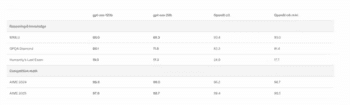
For AI practitioners, these models represent a compromise: open availability, but not cutting-edge performance. While they can’t match OpenAI’s proprietary offerings in reasoning, coding, or creative generation benchmarks, early tests show respectable results, particularly when fine-tuned for specialized applications. This makes GPT OSS appealing for small businesses seeking private on-premise deployments, or for academic projects where budget constraints and data sovereignty are top priorities.
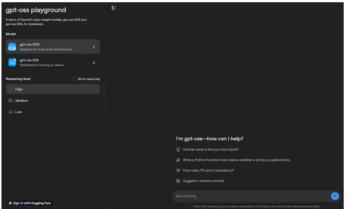
Importantly, the models arrive with a ready ecosystem. They are hosted on Hugging Face, with inference support already integrated into frameworks like llama.cpp and Ollama. OpenAI has also launched a web-based playground, allowing users to experiment instantly without local installation — a move likely aimed at lowering the barrier to entry for first-time users.
The release raises the question of whether competitive pressure from rivals such as Meta’s Llama models and Mistral’s Mixtral series influenced OpenAI’s decision. Open-source AI has been rapidly advancing, and by keeping all its most capable systems proprietary, OpenAI risked being sidelined in the grassroots innovation wave.
While GPT OSS will not dethrone proprietary large language models in raw capability, it marks an important symbolic and strategic gesture. For now, it’s a modest opening — but in a field where “open” has often been more branding than practice, even small steps may set the tone for a more transparent AI future.