



























































In today’s world, data is a company’s best asset, if used well. Also, data management and data security are no longer merely good business practices – they are critical to the success of an organisation.
We are in the age of data. Information is now a business’s most important asset; every click, every transaction, every sensor signal, every customer interaction, when captured and managed well, can turn into data. If we harness this data well, we can extract substantial insights to drive better business decisions. Data that is poorly managed can lead to inefficiency, lost opportunities and incorrect decision-making. Data that is not secure can lead to security breaches resulting in reputational damage, regulatory penalties and reduced customer confidence.
The urgency around data management and security has never been higher. IDC predicts that by 2025, the world will generate more than 175 zettabytes of data. Companies today are required to manage overwhelming amounts of structured and unstructured data, often in real time. Without good management systems this data can become a liability instead of an asset.
Reports of security breaches and cyber attacks continue to rise across all sectors. In India, there have been 2000+ cases of data theft reported in 2023, let alone the cases that were not reported. The average cost of a data breach globally is $4.45 million, according to IBM.
Governments around the world are trying to protect user data with the help of legislation. In India, the Digital Personal Data Protection Act (DPDP) has added an additional compliance burden on businesses. Similar legislation, such as the GDPR in Europe and the CCPA in California, is being complied with around the world.
How open source powers data management and security
Open source software is driving the silent but vast transformation in data management and security, as it gives end users transparency, flexibility, and innovation at scale.
An open source model enables an organisation to audit the code, check security protocols, and confirm compliance without having to rely on a black-box system, thus ensuring transparency. Trust is of paramount importance when the data is sensitive or there are regulatory requirements.
Open source also forces innovation at a pace faster than almost any other system. The community ensures features evolve quickly, bugs are rapidly fixed, and best methods are widely propagated. This is absolutely necessary in the data management business where the requirements are real-time analytics, pipeline automation, and scalable architectures.
In addition, open source is cost-effective. Open source-licensed tools protect startups from exorbitant licence fees and do not chain them to vendors.
Types of security threats: Internal, external, and emerging
|
Threat type |
Description |
Examples |
|
Internal threats |
These originate from within the organisation — either due to negligence or malicious intent. |
Accidental data leaks by employees; misconfigured databases; insider attacks or privilege misuse |
|
External threats |
These come from outside in the form of attackers looking to steal, corrupt, or extort data. |
Phishing attacks; ransomware; hacking and credential theft |
|
Emerging threats |
New, evolving dangers driven by technological changes and advanced attack methods. |
AI-driven deepfake attacks; supply chain attacks; exploits in IoT and smart devices |
Where data management and data security intersect
|
Aspect |
Data management |
Data security |
Intersection |
|
Data access |
Ensures users can retrieve the data they need. |
Controls who is allowed to access what data. |
Role-based access controls (RBAC) |
|
Data quality |
Focuses on data accuracy and integrity. |
Protects data from unauthorised alteration or corruption. |
Validations, auditing, and version control |
|
Storage and backup |
Manages storage, archiving, and data recovery. |
Secures backups, prevents data loss, and enables disaster recovery. |
Encrypted backups with retention policies |
|
Compliance and governance |
Implements policies for ethical and legal data use. |
Ensures adherence to security standards and legal obligations. |
Unified data governance framework |
Common misconceptions about data security
|
Myth |
Reality |
|
“We only need security once we’re hacked.” |
Security must be proactive, not reactive. Prevention is cheaper than recovery. |
|
“Managing data well automatically keeps it safe.” |
Good organisation doesn’t mean protection. Security tools must be layered in. |
|
“Only the IT department needs to worry about data.” |
Every department handles data and plays a role in protecting it. |
|
“Security slows down data access.” |
When properly implemented, security enhances trust without hurting efficiency. |
Understanding data management
Data management is the process of collecting, storing (schema), organising (structure), protecting (infrastructure), and using data effectively and efficiently to ensure the right data is made available to the right people, at the right time, and in the right format.
Data management is akin to a building’s foundation. Without a solid measurement framework, everything built on top of it, including analytics, AI, dashboards, and decisions, will be at risk of collapsing. Good data management leads to a valuable, credible, and usable asset leveraged to grow the business.
Role of data management in business operations
Effective data management enables companies to operate faster, smarter, and with greater precision.
Informed decision-making: Properly organised data supplies precise real-time information, which enables leaders to make the right business choices based on market trends and demand predictions. Decision-making relies on guesswork or outdated information when data is unclean and inaccessible.
Enhanced customer experience: Businesses that maintain properly organised customer data can deliver personalised services while resolving issues faster and creating deeper customer connections. A retail brand uses customer purchase history together with browsing trends to generate suitable product recommendations.
Data security
All businesses — from emerging startups to multinational corporations — must protect their data because it determines their success, public image and chances of survival.
Data security consists of the multiple components and methods that organisations use to prevent unauthorised access, damage, theft and loss of their digital information. The system protects important information including customer data, financial records, and operational data by maintaining its confidentiality and accuracy while restricting access to only approved users.
Organisations must now fulfill legal requirements that protect personal and sensitive data because data has become a highly regulated asset. Businesses that fail to meet compliance standards face substantial financial penalties and legal challenges, and suffer from diminished public confidence.
Key data protection laws include:
India: Under India’s Digital Personal Data Protection (DPDP) Act, 2023, businesses must safeguard user data and promptly report any security breaches.
Europe: Europe’s General Data Protection Regulation (GDPR) has mandatory data processing standards and provides users the right to request data deletion. It imposes heavy fines for non-compliance.
USA: CCPA, HIPAA, and other data management regulations in the US exist at sector levels to protect information, especially in healthcare services and consumer-focused industries.
The relationship between data management and data security
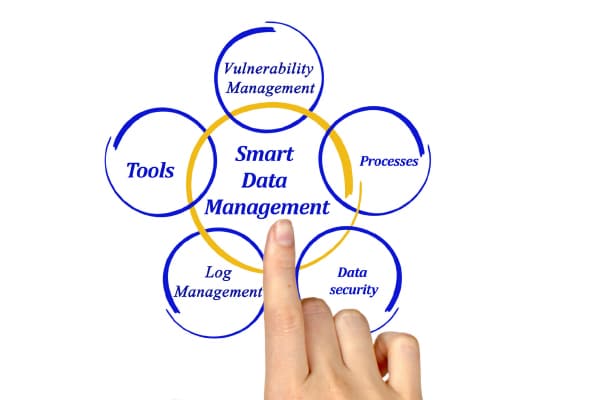
Even though data management and data security are frequently treated as distinct functions, they are two sides of the same coin. Data management, at its heart, ensures that data is accessible, accurate, and valuable. Data security ensures that data is secure, private, and protected. When we coordinate and integrate both disciplines, we establish a strong, trustworthy, and resilient data ecosystem.
Data as a strategic asset
Data has become more than a log of previous transactions or a document of customer information — it has become a fundamental business asset as important as capital, talent, or infrastructure. Organisations are shifting their position related to data by not asking “How much data do we have?, but rather, “What can we do with our data?” This is a fundamental shift in thinking from data as a passive consideration to data as a strategic enabler that will change the way companies work, compete, and grow.
Data-focused businesses have a natural competitive advantage. They identify and leverage upcoming trends faster, react to the demands of their customers with enhanced distinction, and optimise how they operate. The most successful companies today are the ones who can convert data to insights, and insights to action.
As an example, HDFC Bank in India has enhanced its data systems across departments to offer tailored and personalised banking products as well as quicker loan approvals, while making fraud detection more effective. It has created customer value through better and more trustworthy services, leading to customer loyalty in the long-term.
Potential data mishaps and the risks of ignoring them
|
Risk area |
Description |
Real-world impact |
|
Data breaches and cyber attacks |
Weak security measures lead to unauthorised access, data theft, or ransomware. |
Loss of sensitive data, legal action, and reputational damage (e.g., Air India security breach). |
|
Regulatory non-compliance |
Failure to meet legal data obligations under laws like DPDP, GDPR, etc. |
Heavy fines, legal notices, operational restrictions (e.g., Meta fined under GDPR). |
|
Loss of customer trust |
Insecure or misused data erodes public confidence and loyalty. |
Reduced user base, lower engagement, and drop in brand value. |
|
Inaccurate decision-making |
Poor data quality leads to flawed insights, forecasting errors, and bias. |
Wrong investments, ineffective campaigns, and strategic missteps. |
|
Operational inefficiency |
Disorganised or duplicated data wastes employee time and increases cost. |
Delayed reporting, repeated errors, manual correction workload. |
|
Internal data misuse |
Lack of governance allows unauthorised employee access or accidental leaks. |
Insider threats, data leaks, and employee misconduct. |
|
System downtime and data loss |
Inadequate backups or disaster recovery planning result in data unavailability. |
Interrupted services, revenue loss, and data recovery costs. |
Best data management practices for organisations
|
Best practice |
Description |
Actionable steps |
|
Build a data-first culture |
Promote data awareness and responsibility across all levels of the organisation. |
Conduct data literacy training; promote data-backed decisions; reward usage |
|
Balance accessibility with security |
Ensure data is available to the right people while staying protected from misuse. |
Implement role-based access control (RBAC); use multi-factor authentication (MFA); encrypt sensitive data |
|
Establish a governance framework |
Create policies, roles, and standards for consistent and compliant data handling. |
Assign data owners and stewards; standardise data formats and definitions; document policies clearly |
|
Automate data management tasks |
Reduce manual workload and human error through automation tools. |
Use ETL/ELT pipelines; automate data cleaning; schedule regular backups |
|
Stay compliant with regulations |
Ensure ongoing alignment with laws like DPDP, GDPR, and CCPA. |
Monitor legal updates; maintain audit trails; conduct privacy impact assessments |
|
Invest in the right tools and tech |
Adopt modern data platforms, analytics tools, and security systems. |
Use data lakes/warehouses; deploy DLP tools; implement a data catalogue |
|
Encourage cross-team collaboration |
Foster alignment between data, IT, security, and business teams. |
Hold governance meetings; share insights dashboards; form incident task forces |
Emerging technologies
AI and ML: Artificial intelligence together with machine learning has emerged as a groundbreaking force reshaping modern data ecosystems. These technologies thrive on data — the more they consume, the smarter they become. However, the quality of insights directly depends on the quality of data. The best AI models will generate inaccurate results when they process fragmented, outdated and biased data. AI requires solid data management and governance structures to give the best results.
Cloud platforms and data lakes: Cloud computing has transformed how organisations store data and access it. Platforms such as Microsoft Azure, AWS, and Google Cloud now provide scalable storage options, real-time data pipelines, and analytics built into the platform, without the impracticality of investing in large on-premises infrastructure.
More importantly, cloud platforms have enabled businesses to get started with data lakes. A data lake is a repository that can store all the structured and unstructured data you want for your organisation, at scale. Unlike a traditional database, it can store anything from sensor data and logs, to videos and social media feeds, making them optimal for AI workloads.
Zero trust architecture: With the growth of cyber threats and remote work models, standard perimeter-based security is insufficient. Enter zero trust architecture (ZTA), a model that follows the ‘never trust, always verify’ premise. When coupled with good governance of data, ZTA will make sure sensitive information is available and secure, regardless of how or where it is being used.
Blockchain and data integrity: While blockchain technology is frequently associated with cryptocurrencies, its recent applications around data integrity and transparency are generating excitement. Blockchain creates immutable, time-stamped records of transactions, making it a powerful way to track data provenance, prevent tampering, and improve accountability.
Automation and intelligent workflows: RPA (robotic process automation) and intelligent workflows will allow organisations to automate routine data tasks, such as data entry, reconciliation, and data validation. In tandem with task automation, human talent will be deployed for higher-value, analytical tasks and not routine transactions.
Intelligent automation means that instead of being reactive, data management will be proactive. Innovative automation technologies will continuously monitor data for an anomaly, raise a flag if data needs to be cleaned up, or signal a compliance risk in real-time.
In an interconnected world driven by data, data management and security are no longer optional considerations, but are critical to the organisation’s overall success. When data is managed well, it can be used as a source of reliable insights; when it is well-secured, it can be trusted by customers, partners, and regulators; and when both of these disciplines align, data becomes the game changer that leads to smarter decisions and faster innovation.