





























































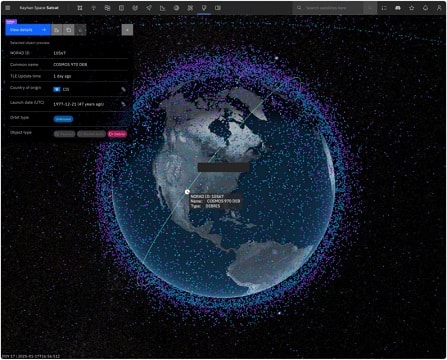
Kayhan Space has open sourced sgp4.gl, a high-performance satellite visualisation tool, to help researchers and developers manage growing orbital traffic with smoother, real-time rendering.
Kayhan Space has released sgp4.gl, a free browser-based software library that enables researchers and developers to visualise massive satellite catalogues in real-time without the performance issues that typically slow down orbital rendering. The release, announced on September 30, aims to democratise access to high-fidelity orbital visualisation tools.
The software is being offered openly because it is built on the Simplified General Perturbations 4 (SGP4) mathematical model, which is already open-source. A live demo is available on GitHub and at sgp4gl-demo.vercel.app, making it accessible to engineers, researchers, and students. Kayhan compares the move to when the Doom game engine was open sourced, giving developers a powerful foundation to build upon.
“This leads to sluggish animations, unresponsive applications and even overheating or battery drain on mobile devices,” said Hyun Seo, Chief Product Officer at Kayhan Space, describing the shortcomings of current 3D platforms. By tapping into graphics processing, sgp4.gl delivers smoother performance at scale—an increasingly important capability as Earth orbit becomes more crowded.
According to Seo, “sgp4.gl is about giving back to the community and improving the baseline experience for developers.” Unlike a hosted service, sgp4.gl is a building block that developers can directly integrate into their own tools.
The software stems from Kayhan’s high-fidelity propagator within its Satcat space traffic management platform, which is widely used by satellite operators, defence and intelligence agencies, ground station observers, financial analysts, consulting firms, researchers, and students.
“Because Satcat has become a hub for aggregated orbital data and advanced tools, we’ve seen growing demand across both government and commercial sectors,” Seo said. The sgp4.gl release is part of Kayhan’s broader effort to share its internal high-performance tools with the wider space community.