




















































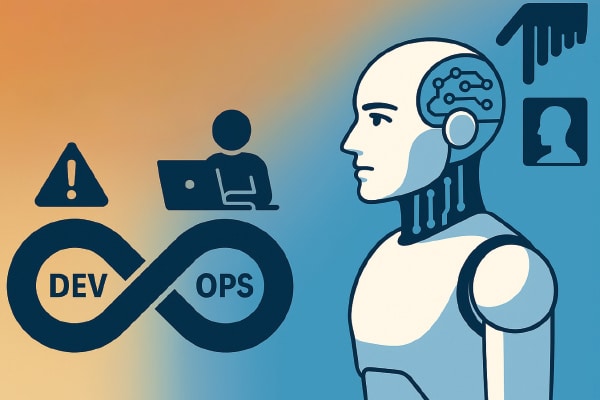
DevOps and genAI are together setting up a new paradigm that endangers conventional DevOps roles. But for those who embrace change, there is little to be worried about.
Generative AI is no longer limited to writing essays or creating art; it has now entered the backend—writing infrastructure as code, automating CI/CD pipelines, diagnosing incidents, and proposing fixes as they occur. Agentic AI systems are simulating SRE (site reliability engineering) roles and optimising observability tools, which leads to the big question: what happens to the traditional DevOps engineers, when machines are thinking—and acting—on their behalf?
Is generative AI going to assist or replace DevOps engineers? Are they becoming supervisors of AI, or are they being replaced by intelligent agents that never sleep and don’t misconfigure YAML?
With increasing automated tools for software delivery, deployment, and packaging, and increasing intelligence within existing pipelines, we know one thing: DevOps careers are at an inflection point. The future is being written, line by AI generated line. The one question that remains is: will you be in the loop?
For more than a decade, DevOps has driven modern software delivery, breaking down silos and increasing the pace of innovation. However, as generative AI enters the stage, this special practice is going through disruption as well. The very pipelines DevOps built are now being automated with AI that can self-heal, optimise, and deploy with no human action. As companies start transitioning their processes from manual tuning to autonomous operations, those in the DevOps profession are facing serious questions. The answer isn’t binary. It’s a call to adapt. The reality is that we must embrace the shifting ground underneath the DevOps role due to the growth of AI in operations.
Why the traditional DevOps role is under pressure
A traditional DevOps engineer operates within the overlap of development and operations, with responsibilities such as writing scripts, managing and maintaining CI/CD workflows, managing cloud infrastructure, and maintaining uptime of systems. Today’s realities require more than simply configuring an incident or managing manual change.
Companies are seeking to ship faster, recover sooner, and operate more efficiently. This means reducing human latency in areas such as log review, anomaly detection, and provisioning environments. And there is an unending supply of emerging genAI and automation solutions that effectively replace more repetitive or duplicable tasks with code that writes itself, environments that provision or scale automatically, and alerts that can triage themselves.
As a result, many usual DevOps tasks are being re-classified as automatable. DevOps engineer roles are becoming less about hands-on keyboard tasks, and more about quality assurance, optimising processes, or validating what the AI has completed. Many conventional jobs are becoming vacant for engineers who haven’t upskilled to data management or working with AI.
How genAI is reshaping operational responsibilities
Generative AI is fast becoming the decision-maker across many parts of the software delivery lifecycle. It is moving from the routine generation of Terraform configurations to discovering root causes of production issues and entering the world of decision-making and operational thinking.
For instance, when equipped with artificial intelligence-powered copilots, machines can:
- Proactively monitor performance metrics and automatically take remediations
- Automatically update CI/CD pipelines when there are changes to code or dependencies
- Identify usage patterns and make recommendations for infrastructure improvements
- Automatically generate compliance and audit documentation from system log files
These capabilities fundamentally change what it means to ‘operate’ a system. Yesterday’s DevOps engineer had to have hands-on knowledge of scripting, containerisation, and cloud provisioning. The AI-augmented operations engineer of today needs knowledge of prompt engineering, model interpretability, orchestration of APIs, and trust.
While there is uncertainty about the long-term implications of genAI on the DevOps profession, the reality is that the takeover is ongoing. GenAI is already changing how software is tested, delivered and managed. What needed pivot teams of engineers and elaborate scripts is now being accomplished by AI models in real time, with increasing precision and autonomy. GenAI isn’t just predicting outcomes—it’s actively reshaping how software is tested, deployed, and maintained.
Automation of CI/CD, testing, and infrastructure provisioning
Continuous integration and continuous deployment (CI/CD) pipelines are at the centre of a DevOps practice, and are often the most manual and risk-filled. In the past, engineers would spend hours writing YAML, scripting deployment logic, creating test suites, and provisioning infrastructure. GenAI, however, is changing the scope of possibilities at an incredible pace.
Currently, AI models can:
- Generate CI/CD pipeline configurations (e.g., for tools like Jenkins, GitHub Actions, or GitLab) from the codebase and understand the framework being used.
- Build and execute unit, integration, and regression tests by understanding code changes, and predicting edge cases.
- Provision and increasingly create new instances of cloud infrastructure homes (by using a tool like Terraform or Pulumi), based on consumption or performance requirements.
Tools such as Amazon CodeWhisperer, GitHub Copilot, and Google’s Duet AI are already being injected into CI/CD pipelines without the help of engineers, and allowing rapid iteration cycles. GenAI is not simply reducing manual workloads — it is also increasing reliability and reducing the chance of drift in configuration.
AI is replacing routine decision-making in pipelines
AI is now making decisions typically made by engineers. Modern DevOps is a continuum of micro-decisions — when to rollback a deployment, should a failed test case translate into stopping the build, and so on. GenAI models, trained on historical logs, incident reports, and specific system metrics are now ready to make these decisions for us.
Some of their real-world capabilities are:
- The dynamic rollback or promotion of builds using zoom-out anomaly detection tied to predicted user impact.
- Auto-remediation of failed deployments through patterns of previously successful fixes and configuration recommendations.
- Automatic alert prioritisation and auto suppression of chatter in observability tools.
- Auto root cause analysis of incidents using generative reasoning over logs and telemetry data.
Rise of agentic AI: The autonomous engineers
As genAI develops, a different kind of software worker is emerging – the autonomous agent. These agents aren’t just tools — they are goal-driven systems that can plan, execute and adapt complex workflows without human management.
Agents like AutoGPT and LangChain perform multi-step tasks without human intervention. They break goals into subtasks (e.g., build → test → deploy); use LLMs to interact with APIs, files, and logs; and can write, execute, and debug code independently.
These agents mark a shift towards continuous improvement with zero human input. They monitor outcomes, learn from feedback, improve workflows, and are being used to build self-healing systems. Tasks like scaling, deployment optimisation, code refactoring, and incident remediation are now autonomous. Engineers act more as supervisors and strategy-setters, not executors.
Survival stack: What DevOps engineers must learn now
| Skill area | What it means | Why it matters |
| Infrastructure-as-prompts and agent orchestration | Writing structured prompts to control AI agents that manage infrastructure tasks (e.g., provisioning, scaling, monitoring). | DevOps engineers must learn to direct AI agents instead of configuring tools manually. Prompt quality = system reliability. |
| PromptOps, DataOps and ModelOps essentials | PromptOps: Managing prompts as code; DataOps: Managing data pipelines and quality for ML; ModelOps: Deploying and maintaining ML models in production. | These ops disciplines are converging. DevOps now extends to managing data, models, and prompts—not just infrastructure. |
| Trust engineering and governance in AI systems | Designing systems to ensure AI decisions are explainable, auditable, and safe. Involves access control, logging, human-in-the-loop design. | With AI agents making critical decisions, DevOps must enforce ethical boundaries, compliance, and system integrity. |
Real-world transformations
The move to AI-based operations is not hypothetical. It is happening right now — in boardrooms, basements, and build servers all around the globe. As organisations are pushed to move faster, cheaper, and wiser, there are clearly many more AI-first, or at least AI-hybrid opportunities. And the DevOps teams? They are not stagnant either. They are actively, or not as actively, retooling, reorganising, and rewriting what operationally excellent means.
In AI-first operations, some technology companies are embracing a forward-leaning approach, while some cloud-native start-ups are seizing the day. Some organisations deploy agent-based systems to empower build-and-release workflows; others use large language models (LLMs) to autogenerate Kubernetes manifests or to predict infrastructure constraints before they happen.
In hybrid models—more common in enterprises—AI does not replace the DevOps function but augments it. Human engineers are left to focus on long-term strategic oversight, compliance, and edge-cases, while AI handles all other iterative, scalable, and real-time decisions. By taking this middle road, teams can innovate without losing control, delivering both speed and safety.
What current DevOps teams are doing to stay relevant
Today’s DevOps teams are learning prompt engineering as well as model tuning. They are experimenting with the AI copilots embedded into their development environments, using genAI to increase the speed of their infrastructure as code development. They are collaborating with data science and ML engineering teams to understand how ModelOps interfaces with the overall CI/CD picture.
Some teams are even creating hybrid roles such as PromptOps engineer, AI infrastructure lead, or DevAI specialist. Others are building internal AI sandboxes where they can experiment with tools such as AutoGPT or LangChain in production-like environments, getting ready for when these agents move from lab to live.
The message is clear: DevOps is not dead. It is evolving, and quickly. The teams that will survive the disruption are the ones that will stare the future in the face, with a toolbox in one hand and a prompt in the other.
Evolve or be outpaced
The emergence of generative AI does not mark the end of the engineering profession; it is the beginning of a new paradigm. Yes, genAI is a disruptor, but it’s also a collaborator, a competitor and, most importantly, a change agent. It offers to move the nature of operational work from manual to mental labour, and from repetitive to strategic work.
The message is simple — evolve from scripts and pipelines. Embrace hybrid, where prompts matter as much as playbooks and intelligent agents become members of the engineering team. Begin to learn how to orchestrate AI as efficiently as you once orchestrated containers.
DevOps isn’t dead—it’s mutating. GenAI isn’t just a disruptor; it’s a collaborator, a competitor, and a catalyst. Those who embrace hybrid skillsets and agentic thinking won’t just survive—they’ll redefine the edge.
Disclaimer: The insights and perspectives shared in this article represent the authors’ independent views and interpretations, and not those of their organisation or employer.