



























































Quantum computing is slowly but surely transitioning from academic research to the real world. Once it comes into everyday use, its effects will be far-reaching, to say the least.
Quantum computing has rapidly transitioned from purely academic explorations to early industry deployments, with pilot projects emerging across finance, healthcare, and cybersecurity. Organisations are investing in proof-of-concepts for portfolio optimisation, molecular simulation, and quantum-safe encryption to prepare for post-quantum threats.
Conventional silicon-based computers consist of millions of transistors that switch between ‘on’ and ‘off’, corresponding to two possible values of bits — 0 and 1. Processing relies on basic logic gates like AND, NOT and the like acting on individual bits or pairs of bits. Each bit’s state can be measured and distinguished without disturbing the system.
Quantum computers, by contrast, employ quantum bits or qubits which can occupy a superposition of both 0 and 1 at the same time. A two-qubit device can represent four states simultaneously, a three-qubit system eight states, a four-qubit system sixteen states, and an n-qubit system can register up to 2^n unique states in parallel. Qubits can also become entangled, meaning the state of one qubit is intrinsically linked to the state of another, which is a defining feature of quantum mechanics.
This inherent parallelism allows quantum machines to tackle complex problems far beyond the reach of classical architectures. Because qubit operations scale exponentially with the number of qubits, quantum computers promise dramatic speedups using the algorithms designed to exploit superposition and entanglement.
The best way to understand quantum computing is to contrast it with classical computing (Table 1).
Table 1: Classical computing versus quantum computing
| Classical computing | Quantum computing |
| Electromagnetism governs electric currents — classical electrodynamics | Quantum mechanics governs sub-atomic particles — quantum electrodynamics |
| Works on Moore’s Law | Harnesses the power of sub-atoms and molecules to perform memory and processing tasks |
| Works with digital bits 0,1 | Features quantum bits (qubits), superposition of 0 and 1 |
| Deterministic | Stochastic |
| n-bits: 2n sequences available, but only one used at a time | n-qbits: 2n sequences available in parallel |
| Sequential computing | Parallel computing |
| One operation at a time | Millions of operations at a time |
| 64-bit classical computer operates at speeds measured in gigaflops (billions of floating-point operations per second) | 30-qubit quantum computer equals the processing power of conventional computers that run at 10 teraflops (trillions of floating-point operations per second) |
The quantum computing market is projected to reach US$ 5 billion by 2030, with fault-tolerant systems expected to become commercially viable in the early 2030s, driving innovation and collaboration across sectors. IBM and AMD have joined forces to create scalable, fault-tolerant quantum computing platforms combining IBM’s quantum expertise with AMD’s supercomputing strengths.
The European Innovation Council-funded QCDC (Quantum Computers for Data Centers) project has successfully concluded with the establishment of a new cloud-based computing service for trapped-ion quantum computers in Europe. The service grants European researchers access to devices from Alpine Quantum Technologies (AQT) to perform advanced quantum computing tasks, for innovation in healthcare and industrial advancements.
Google, Microsoft, SciQuantum, and IBM have achieved significant milestones in quantum computing, including new quantum processors, enhanced error correction techniques, and scalable quantum systems.
Quantum computers can be classified both by the physical qubit technology they employ and by the computational paradigm they implement (Table 2). Each approach comes with its own trade-offs in coherence time, gate fidelity, scalability, and operating conditions.
Table 2: Types of quantum computers in use today
| Quantum computer | Technology | Vendor/User |
| Superconductor-based quantum computers | Utilise superconducting circuits, including SQUID-based technology. | IBM’s Eagle, Osprey, and Condor;
Google’s Sycamore and Quantum AI Horizon; Rigetti’s Aspen-M |
| Ion trap-based quantum computers | Ion trap technology to achieve quantum computation. | IonQ (Aria), Quantinuum (H1-2),
Alpine Quantum Technologies (PINE) |
| Neutral atom quantum computers | Use individual neutral atoms as qubits. | QuEra (Aquila and Aspen-M systems),
ColdQuanta (Frostridge), Pasqal |
| Photonic quantum computers |
Use photons as the fundamental qubit unit. | Xanadu and PsiQuantum |
| Surface quantum-dot quantum computers | Quantum dots formed in semiconductor material. | Intel and QuTech (Delft University), Silicon Quantum Computing (Australia), Quantum Motion Technologies (UK), HRL Laboratories, NIST, TU Delft, Microsoft StationQ (R&D) |
| Laser-cooled ion trap quantum computers | Use laser-cooled ions for quantum operations. | IonQ (Aria), Quantinuum (H1-2),
Quantum Systems Accelerator (QSA), Alpine Quantum Technologies (PINE), GTRI QCCD |
| Solid state nuclear magnetic resonance (NMR) Kane quantum computers | Use solid state NMR techniques. | Bruce Kane (UNSW), NIST/JQI,
STM-Lithography |
| Adiabatic quantum computers | Quantum annealing for computation | D-Wave |
Characteristics of quantum computing platforms (QCPs)
Low level programming
Today’s quantum computers are built on low level programming. Quantum logical gates handle the computational steps that are executed in quantum processing units (QPUs). Examples of quantum logical gates are Pauli, Hadamard, CCNot, etc.
Remote software development and deployment
The quantum computing software development framework for leveraging quantum processors is accessed remotely on the cloud. Only a limited portion of the programming tool stack is deployed on local machines. Programmers access production-ready quantum software remotely for development and testing.
Quantum algorithms
Programmers leverage quantum algorithms to define the computing task. Algorithms help in gaining speed and communicating with other computing tasks that are running on the QCP. Programmers must identify or design suitable quantum algorithms that can solve the problem on hand.
Non-portability of software
Quantum computing platforms are currently evolving and the software developed by platform owners is native in nature. This software follows its own standards, with proprietary programming APIs and tools. Examples are Qiskit from IBM, Quantum Development Kit from Microsoft, and Cirq from Google.
QCP architecture
A quantum computing platform consists of two layers – the quantum computing layer and the classical computing layer (Figure 1).
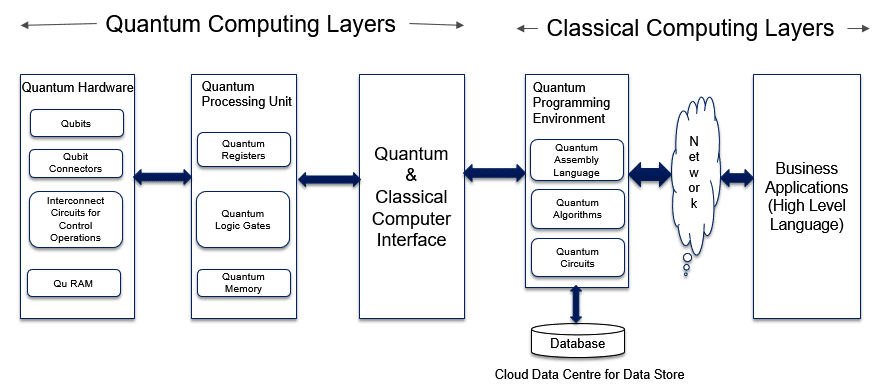
The quantum computing layer is composed of three main elements: quantum hardware, the quantum processing unit (QPU), and the quantum-classical interface. Quantum hardware includes qubits, typically realised using superconducting loops, along with interconnect circuitry that enables its control and operation. The QPU encompasses quantum registers, quantum logic gates, and quantum memory, forming the core of quantum computation. The quantum-classical interface, comprising both hardware and software, facilitates communication and interaction between classical computers and the QPU. Complementing this is the classical computing layer, which consists of the quantum programming environment, cloud data centres, and business applications that together support the practical deployment and utilisation of quantum computing.
The quantum programming environment consists of several key components that enable interaction with quantum systems and the execution of algorithms. It includes quantum assembly language for instructing the QPU, high-level programming languages for writing quantum programs, and quantum algorithms designed to solve complex problems more efficiently than classical computers. Quantum circuits serve as the standard model for representing quantum computation, where each step of an algorithm is expressed as a sequence of quantum logic gates that transform input qubits through matrix and vector operations. A high-level programming API provides the necessary instructions for composing quantum programs, which typically involve tasks such as mapping classical bits to qubits, initialising qubit states, constructing quantum circuits with suitable logic gates to represent algorithmic steps, and performing measurements to obtain output qubit states that are then translated back into classical bits. Finally, a cloud data centre is used to store and manage processing data derived from the outputs of quantum algorithms.
Quantum computing technology landscape and its applications
Various industry-leading organisations are working on quantum computing. IBM, Microsoft, Alibaba, D-Wave Systems, Google, Nokia, Fujitsu and Intel continue to work and compete for authority in this field. The attempt is to deliver seamless data encryption, real conversations with AI, and better financial modelling through quantum technology.
IBM
IBM has been working to develop a quantum computer for over 35 years. In December 2023 it unveiled a 1121-qubit quantum processor called Condor, setting a new industry benchmark for qubit count.
IBM Quantum Experience is a cloud platform where people can conduct experiments on their actual quantum hardware. Multinational companies such as JPMorgan Chase, Daimler (used in logistics for optimising vehicle delivery routes), Honda, Samsung and Barclays (settlement of large batches of transactions) were the first to sign up for the active testing of this service.
Google’s most recent quantum processor is called Willow. Unveiled in December 2024, this 105-qubit superconducting chip for the first time demonstrates exponential error suppression as qubit count scales.
Microsoft
In February this year, Microsoft announced the release of Majorana 1, the first quantum processing unit powered by topological qubits. The quantum computing development kit, the full quantum software stack, including the Q# programming language and the Quantum Development Kit (QDK) are all open sourced. Azure Quantum provides access to various quantum hardware and quantum-inspired services.
D-Wave Systems
D-Wave built the world’s first commercially available quantum computer using simpler technology, which was limited in capability. The company is focusing on how quantum computing can be applied to artificial intelligence, machine learning, and difficult optimisation problems. In May 2025, it developed the 4400+ qubit quantum computing system called D-Wave Advantage2 to address cybersecurity and logistics optimisation. D-Wave’s Leap Quantum LaunchPad gives companies a chance to explore the former’s quantum-based technology for free for three months.
Rigetti Computing
Rigetti recently launched a 36-qubit multi-chip quantum processor. Its quantum computing system provides a full-stack solution that tightly integrates hardware and software, offering low-latency cloud access for hybrid quantum-classical workflows.
Intel
Intel has announced the delivery of a 49-qubit test quantum processor called ‘Tangle Lake’ and a 12-qubit silicon chip called ‘Tunnel Falls’.
Amazon Web Services
In February 2025, AWS launched its first quantum chip named Ocelot. This chip is still in the prototype stage.
NVIDIA
In March 2025, NVIDIA launched the NVIDIA Accelerated Quantum Research Center (NVAQC) in Boston. This centre is all about developing new quantum computing architectures and algorithms that can work together with NVIDIA’s powerful AI supercomputers.
IonQ
IonQ has developed quantum computers based on trapped ion technology.
Other leading quantum computing vendors are Alibaba, PsiQuantum, Xanadu, QuEra Computing, Pasqal, and Riverlane.
The implications of true quantum computing at scale are staggering and can have an extraordinary impact on society. Quantum algorithms can be applied for:
- Optimisation problems such as scheduling and route planning to find the best possible solution from the many decisions or options that are available
- Search, sampling and pattern matching
- Quantum encryption
The various ways it can be used in different industries are listed in Table 3.
| Industry | Usage |
| Health care and pharma services |
|
| Financial services |
|
| High tech |
|
| Transportation |
|
| Energy |
|
| Governments |
|
Challenges in quantum computing
Lack of good software
Only a handful of quantum algorithms (VQE, QAOA, Grover, Shor) demonstrate meaningful speedups today; most real-world problems still lack proven quantum advantage.
Hybrid orchestration complexity
Integrating quantum subroutines into classical workflows requires robust middleware, cross-stack compatibility, and new programming paradigms.
Technological challenges
These include limited qubit connectivity, too low gate fidelities, or large amounts of qubits required for error correction. Therefore, detecting, controlling and correcting errors becomes a major challenge.
Benchmarking and standardisation gap
The absence of industry-wide metrics and transparent performance benchmarks hampers objective comparison of hardware and software stacks.
Vendor lock-in
Proprietary SDKs and cloud APIs lack unified standards, complicating multi-platform development and collaboration.
Collaboration woes
Lack of collaboration and exchange between industry and academia.
Cryogenic infrastructure challenges
Quantum computers operate at temperatures close to absolute zero. Maintaining such a low temperature is a big challenge.
However, quantum computing is poised to revolutionise the healthcare, pharma, banking, logistics and materials science industries by unlocking solutions to challenges once deemed intractable. Modern industries are actively exploring cloud-based quantum computing solutions to enhance productivity and operational efficiency. Organisations are also exploring quantum hardware roadmaps, error mitigation techniques, and hybrid quantum-classical algorithm frameworks that bridge the gap between classical systems and emerging quantum processors.
Acknowledgements
The authors would like to thank Tricon Solutions LLC and Gspann Technologies, Inc., for giving the required time and support in many ways while this article was being written.
Disclaimer : The views expressed in this article are those of the authors. Tricon Solutions LLC and Gspann Technologies, Inc., do not subscribe to the substance, veracity or truthfulness of the said opinion.