






























































With its many libraries, Python has emerged as a popular programming language for quantum computing. Here’s a simple example of how it can enable superposition of qubits.
Quantum computing uses the principles of quantum mechanics. Unlike conventional computers (which use the bits 0 or 1), quantum computers use qubits that can be 0, 1, or both at the same time. Because of this, quantum computers can work exponentially faster than classical computers in many domains including cryptography and simulations.
Think of it like this:
- A classical computer is equivalent to travelling only on one road at a time.
- A quantum computer is equivalent to exploring many roads at the same time.
A qubit (quantum bit) is the basic unit of information in quantum computing. A normal bit can only be 0 or 1. A qubit can be 0, 1, or a combination of both (this is called superposition). Qubits can also be entangled, meaning their values are connected. This makes qubits very powerful compared to normal bits.
The Hadamard gate is one of the most important gates in quantum computing. It takes a qubit and puts it into a superposition state.
How to use Python for quantum computing
Python is one of the most popular languages for quantum programming. There are many Python libraries (modules) available for simulating and running quantum programs.
Python can be used to:
- Create and test quantum circuits.
- Simulate qubits and gates on a normal computer.
- Run programs on real quantum computers (like IBM Quantum).
- Study algorithms such as Grover’s algorithm or Shor’s algorithm.
Some famous Python libraries are:
- Qiskit (by IBM): Creates and runs quantum circuits.
- Cirq (by Google): Used for quantum circuits and algorithms.
- PennyLane: Combines quantum computing with machine learning.
- PyQuil: For programming quantum computers by Rigetti.
Here’s a basic example in Python for implementing the Hadamard gate using Qiskit.
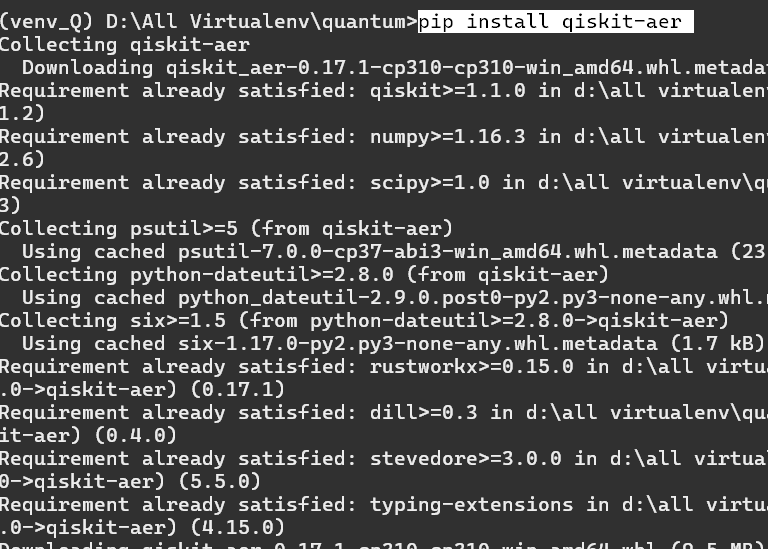
Installation of modules
Figures 1 and 2 show the installation of the qiskit and qiskit_aer modules. The code for Hadamard gate implementation is shown in Figure 3.


The output is:
(venv_Q) D:\All Virtualenv\quantum>python q1.py
Result: {‘0’: 509, ‘1’: 491}
Here’s the explanation of this example.
- QuantumCircuit lets us build quantum circuits. Aer is used to simulate the quantum computer. We make a circuit with 1 quantum bit (qubit) and 1 classical bit to store measurement results.
- qc.h(0) applies a Hadamard gate on the qubit. This puts the qubit in superposition (both 0 and 1).
- qc.measure(0, 0) measures the qubit and stores the result (0 or 1) into the classical bit.
- We use Aer’s qasm_simulator, which mimics a quantum computer for running our circuit.
- We run the circuit 1000 times (shots=1000) to get probabilities of results.
- result.get_counts() shows how many times we got 0 and how many times we got 1.
- Out of 1000 runs, ~509 times the qubit collapsed to 0 and ~491 times it collapsed to 1.
- This is very close to 50–50, because the Hadamard gate ensures equal probability.
- This shows a nearly equal chance of 0 and 1 because of superposition.
Quantum computing is still in the early stages of development but has a huge future.
With Python and libraries like Qiskit, anyone can learn the basics of quantum programming, even on a conventional laptop. It is a great way to understand how the next generation of computers will work.