

























































Open source could well be the backbone of quantum computing. Explore how the most popular open source quantum computing frameworks work and what they can be used for.
Quantum programming differs significantly from conventional programming. A developer or researcher must deal with abstract concepts such as superposition, entangled particles, and noisy qubit (quantum bit) interactions in quantum computing, making it difficult to work without the proper tools. The good news is that there are open source frameworks available today that allow developers to prototype or theorise a quantum algorithm in either simulation environments or real hardware.
In classical computing, information is stored as bits, where each bit can have the value of either 0 or 1. In quantum computing, the basic unit of information is a qubit, which can have multiple values ‘at once’ (superposition) and can relate across states (entangled).
As programming at the physical qubit level is complicated, software frameworks will be necessary. Frameworks provide abstractions for constructing circuits, include various libraries of algorithms (like those used in classical computing frameworks), and provide some interface for simulators or real quantum devices.
Open source frameworks are playing a key role in lowering the barriers of quantum software development as different stakeholders can potentially contribute to them (academics, startups and industry). These frameworks offer transparency and affordability, and enable rapid prototyping.
While most of the leading frameworks used today are maintained by the leading tech companies (IBM, Google, D-Wave, Xanadu, and Rigetti) they are still free and available to the community.
Top open source quantum computing frameworks
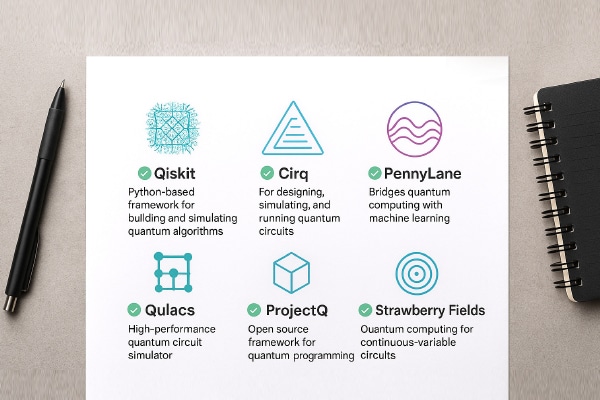
Open source frameworks provide the necessary interface, tools, and resources for conceptualising, simulating, and testing quantum algorithms across many different hardware platforms. Each framework embodies a different philosophy — some provide gate-based programming, while others focus on annealing or photonic frameworks. Here’s a quick look at how the leading open source frameworks work and what they are good for.
Qiskit
One of the most well-known quantum SDKs is IBM’s Qiskit. Built in Python, it has a modular design with the following libraries.
- Terra: Allows building and compiling quantum circuits.
- Aer: Simulates circuits using classical hardware.
- Aqua: Application-level algorithms for chemistry, AI, and optimisation.
Qiskit interfaces directly with the IBM Quantum Experience allowing users to conduct experiments with quantum processors hosted in the cloud. It also has a very wide ecosystem with a highly active worldwide community, making it the most adopted framework today.
Use cases of Qiskit
- Quantum chemistry and drug discovery: Accelerating molecular simulations in drug research and innovation.
- Portfolio optimisation in finance: Better portfolio allocation in times of uncertainty.
- Quantum-enhanced machine learning: Accelerating classification, clustering and pattern recognition.
- Optimising supply chain and logistics: Reducing the operational inefficiencies in supply chain and logistics.
- Cryptography and security research: Experimentation with post-quantum cryptographic protocols.
- Innovation in materials science: Simulating properties of advanced materials for renewable energy and electronics.
Cirq
Written in Python, Google’s Cirq is an open source framework designed for building, simulating, and running quantum circuits on Noisy Intermediate-Scale Quantum (NISQ) machines. Cirq is not a general-purpose SDK but is designed to be anchored around a specific device (Google’s Sycamore processor). It provides simulation for algorithms running in a realistic hardware environment, and offers support for hybrid quantum-classical modes of operation.
Cirq allows researchers to work on increasingly sophisticated quantum error correction prototypes, benchmarking the performance of quantum hardware and working with novel quantum algorithms.
Use cases of Cirq
- Simulations of quantum circuits: Modelling circuits, which gives us an insight into how they run on noisy processors.
- Error mitigation: Developing strategies to reduce errors in NISQ devices.
- Variational quantum algorithms: Hybrid approaches that allow us to extend the application of optimisation, chemistry, and AI.
- Benchmarking NISQ hardware: Testing the fidelity of devices and evaluating the performance of processors against one another.
- Experimenting with quantum machine learning: Prototyping ML models together with real world data and unleashing quantum features.
PennyLane (Xanadu)
Developed by Xanadu, PennyLane is perhaps the best known open source quantum machine learning (QML) library. This hybrid quantum-classical computing library is focused on the developing field of QML and is built entirely in Python. It has seamless compatibility with some of the most widely used deep learning frameworks such as TensorFlow, PyTorch and JAX, enabling researchers and developers to easily train quantum circuits with classical neural networks.
The main feature of PennyLane pertaining to quantum AI has to do with differentiable programming, which allows for the automatic differentiation of quantum circuits. It is capable of exploratory experiments and deploying virtually any quantum hardware.
Use cases of PennyLane
- Quantum neural networks (QNNs): Adding quantum layers to a classical deep learning architecture.
- Variational quantum algorithms (VQAs): Making solving eigenvalue problems or optimisation problems more feasible.
- Differentiable programming: Enabling end-to-end optimisation.
- Quantum chemistry simulations: Generating molecular property estimates and expediting computational chemistry.
- Quantum-enhanced generative models: Used for investigating quantum enhancements in generative adversarial networks and probabilistic modelling.
- Education and research: Many universities use PennyLane for research on quantum AI.
Because of its focus on hybrid architectures, PennyLane will play a significant role in future quantum AI applications.
Forest SDK
Rigetti’s Forest SDK is a framework for quantum development and research built in Python. It has two components:
- pyQuil: A library written in Python that allows for quantum program construction, simulation and execution.
- Quilc: A fast compiler that takes a Quil (Quantum Instruction Language) program as input and outputs gate instructions for Rigetti’s hardware (in an optimised way).
Forest SDK is designed to facilitate seamless integration with Rigetti Quantum Cloud Services (QCS), which allow developers to evaluate quantum algorithms on real superconducting qubit devices and simulators. The SDK’s modular structure fits both academic research and industry-based prototyping.
Use cases
- Quantum implementation development: Using pyQuil to build and compile circuits while exploring algorithms for implementation.
- Real hardware execution: Running workloads on Rigetti’s quantum processors through QCS.
- Hybrid quantum-classical workflows: Using quantum circuits in conjunction with classical resources for variational and optimisation algorithms.
- Compiling research: Using Quilc to evaluate and enhance quantum compilation.
- Education and prototyping: Allowing quantum algorithm development in the early stages in educational and research environments.
- Applied quantum algorithms: Support for simulations and optimisation problems in finance, manufacturing, and logistics.
With its simulators, Forest SDK affords a practical testbed for innovators looking to connect today’s world of quantum research with tomorrow’s commercial reality.
Ocean SDK
D-Wave’s Ocean is a quantum software development kit specifically designed for quantum annealing, which is quite different from gate-based computing. Rather than translate universal quantum logic into quantum code, Ocean is aimed at solving combinatorial optimisation problems by mapping into Quadratic Unconstrained Binary Optimisation (QUBO) models.
The SDK leverages Python along with a variety of tools, and is of great importance to businesses that grapple with optimisation challenges on a large scale. It helps integrate with D-Wave’s Leap cloud platform and provides full access to quantum annealers.
Use cases
- Logistics optimisation: Improving route planning, vehicle scheduling, and warehouse management.
- Supply chain management: Overcoming bottlenecks throughout production, inventory and distribution networks.
- Portfolio optimisation: Assisting financial institutions to manage investment risks and returns.
- Scheduling: Controlling workforce shifts, manufacturing order, and project planning.
- Energy sector optimisation: Ramping up grid balancing, renewable energy planning, and resource allocation.
- Combinatorial optimisation research: Quantifying quantum annealing’s performance against classical optimisation.
- AI and ML acceleration: Using annealing to train Boltzmann machines and generative models.
ProjectQ
ProjectQ is a minimal, open source quantum framework developed with the aim of being simple and modular. Written in Python, it provides researchers and educators the ability to rapidly prototype quantum algorithms and experiment with ideas without worrying about heavy dependencies.
The ProjectQ framework allows researchers to implement simulation backends, execute experiments on IBM Quantum hardware, and structure projects to easily switch from theory to practice. ProjectQ’s modular design lends itself for easy extensions – it’s an excellent framework for research, teaching, and proof-of-concept demonstrations.
Use cases
- Prototyping quantum algorithms: Quickly testing and iterating on an algorithmic idea.
- Education/training: Familiarising both faculty and students with otherwise complicated quantum ideas.
- Integration with IBM hardware: Executing circuits on real hardware.
- Modular design for research: Allowing researchers to extend the platform when they want to run custom experiments.
- Demonstrations and workshops: Using ‘tool-kits’ for tutorials, hackathons and a classroom experience.
By balancing ease of use with extensibility, ProjectQ allows people new to quantum computing to engage with it while still providing a research platform for further study.
A comparison of frameworks
The quantum computing ecosystem is developing rapidly, and the open source frameworks we just discussed have unique capabilities. While some frameworks are designed for general-purpose gate-model programming, others are focused on optimisation tasks, photonics, and hybrid quantum-classical workflows.
Table 1 compares a number of different frameworks to help choose the best tool for a specific purpose, which will vary for researchers, developers and the industry.
Table 1: A comparison of popular open source frameworks for quantum computing
| Framework | Hardware support | Specialisation | Target audience |
| Qiskit | IBM quantum devices | General-purpose (gate model) | Broad developer base |
| Cirq | Google Sycamore | NISQ circuits, error studies | Researchers, academics |
| PennyLane | Multiple backends | Hybrid quantum-classical ML | AI/ML researchers |
| Forest SDK | Rigetti QCS | Gate model with Quil | Developers, educators |
| Ocean SDK | D-Wave annealers | Optimisation (QUBO) | Industry practitioners |
| ProjectQ | Simulators + IBM | Educational, prototyping | Academics, students |
The final decision on which framework to use will be based on the problem space, access to hardware, and the skills of the developers to be able choose the best ‘system’ that will allow them to innovate and explore the quantum environment.
Emerging trends in open source quantum development
Hybrid quantum-classical workflows
Hybrid workflows take advantage of both classical and quantum resources, making them highly effective for tasks in artificial intelligence, machine learning, and optimisation, as well as other applications as the quantum universe continues to unfold.
Cloud-based services
IBM, Rigetti, D-Wave, etc, provide open APIs and cloud-based platforms, giving developers across the globe access to scalable quantum hardware without having to invest in costly infrastructure. This increased access will promote experimentation and encourage adoption across industries.
Quantum ML libraries
The interplay between quantum algorithms and artificial intelligence continues to gather speed. Open source libraries are increasingly providing the means to implement quantum neural networks (QNNs), generative models, and variational algorithms, all of which enhance traditional AI capabilities.
Interoperability
As new frameworks are developed, they are being standardised so that tools can work across them. This opens the possibility for developers to change tools, build platforms together, and be productive without needing to be tied to a specific ecosystem.
Challenges and opportunities in open source quantum development
Open frameworks and community-developed tools are easing the path to experiment with and evaluate new ideas in quantum computing; however, the technology is still embryonic. Developers, researchers, and startups will naturally encounter hardware inefficiencies, limitations to scalability, and a steep learning curve associated with quantum mechanics fundamentals. But opportunities are emerging too, by way of partnerships, design frameworks, and an increase in quantum-first company launches.
Challenges
- Hardware limitations: Today’s quantum processors are constrained by noisy qubits and limited scalability.
- Error correction bottleneck: Quantum error correction is not understood well and has theoretical hurdles to overcome; constructing fault-tolerant systems remains a challenge for real deployment.
- Steep learning curve: Developers lacking any quantum mechanics background have a challenging entry path, limiting widespread adoption.
Opportunities
- Collaboration between academia and startups: Collaborative research projects enable fast-tracked innovations by combining the latest theories with agile development.
- Open source standards: Initiatives to standardise tools and frameworks for interoperability are facilitating the ability to build across platforms.
- Quantum-first startups: New companies are utilising open source quantum frameworks to create commercial use cases in optimisation, finance, logistics, and drug discovery.
These challenges and opportunities will together determine the trajectory of quantum technology. Encouraging the use of open standards will be critical in realising the promise of quantum computing in the research and commercial domains.
Open source is the foundation of quantum software development, providing massive accessibility, supporting global interaction, and enabling anyone to experiment. Open source frameworks are democratising cutting-edge technology and will be vital players in the applications of quantum computing, including AI, finance, logistics, drug discovery, and more. For developers, researchers, and innovators, this is an opportunity not only to learn but to help shape the future of the quantum revolution by contributing to these frameworks.