





















































AI and IoT are complementing each other to build powerful and secure connected devices.
The Internet of Things (IoT) is rapidly altering our surroundings by giving commonplace objects intelligence and connectivity. However, this expansion comes with its own set of difficulties. For the upkeep and growth of these interconnected systems, a dependable network, strong data management, and carrier infrastructure are necessary.
IoT’s journey
Growth and industry impact
From simple connected objects to a vast ecosystem of industries, the history of the Internet of Things has been remarkable. IoT is now at the core of healthcare, manufacturing, transportation, and smart cities, although it was initially used in fields like asset tracking and remote monitoring. Its growth has led to new business models, increased operational efficiency, and new career opportunities in network management and analytics.
Role of networks and data
Connectivity forms the basis of the Internet of Things. Simultaneously, data plays a crucial role in producing actionable knowledge through data collection, processing, and analysis. IoT expands readily with the aid of carriers, cloud platforms, and data management systems that can convert unstructured data into useful solutions. The way devices, networks, and data interact helps us understand why the Internet of Things is expanding and how it can affect the industry.
The role of AI in the Internet of Things
Differences in scope
IoT and AI have distinct but complementary applications. AI seeks to analyse, interpret, and react to data, whereas IoT seeks to connect and collect data about the physical world. This distinction makes it possible for AI to infuse IoT systems with intelligence by converting raw device data into automation, predictive understanding, and more intelligent decision-making. AI extends beyond connectivity, adding new levels of creativity and productivity to Internet of Things applications.
AI adoption and dominance
IoT systems across all industries are rapidly integrating AI technologies. AI-driven analytics and automation are becoming standard features in the Internet of Things space, from intelligent traffic management in smart cities to predictive maintenance in manufacturing. By transforming IoT from a network of interconnected devices into a learning, adaptable, and self-optimisable ecosystem, AI is expanding the capabilities of IoT and altering how we interact with connected technology.
Table 1: The IoT journey
| Key points | Details/Examples | |
| Growth and industry impact |
Evolution from simple connected devices to a large ecosystem | Initially applied in asset tracking and remote monitoring; now central to healthcare, manufacturing, transportation, and smart cities |
| Operational efficiency and innovation | IoT enables better processes, predictive maintenance, and improved decision-making | |
| Career opportunities | New roles in technology, analytics, network management, IoT solution development, and operations | |
| Role of networks and data | Connectivity as the foundation | Reliable network connections allow seamless communication between devices |
| Data collection, processing, and analysis | Turning raw data into actionable insights for decision-making and process optimisation | |
| Scaling IoT with carriers and platforms | Cloud platforms, carriers, and data management systems help IoT expand efficiently | |
| Interplay between devices, networks, and data | Understanding this interaction explains IoT growth and its industry impact |
Table 2: The AI impact on IoT
| Key points | Details/Examples | |
| Differences in scope | Complementary roles of AI and IoT | IoT connects devices and gathers data; AI analyses, interprets, and acts on that data |
| Bringing intelligence to IoT | Transforms raw device data into predictive insights, automation, and smarter decision-making | |
| Expanding beyond connectivity | AI adds new layers of productivity and innovation to IoT applications | |
| AI adoption and dominance | Rapid incorporation into IoT systems | AI is being integrated across industries: manufacturing (predictive maintenance), smart cities (traffic management), healthcare, etc |
| Extending IoT capabilities | IoT becomes a learning, adaptive, and self-optimising ecosystem | |
| Changing engagement with technology | Businesses and professionals interact with IoT in more intelligent, automated, and efficient ways |
Synergy or competition?
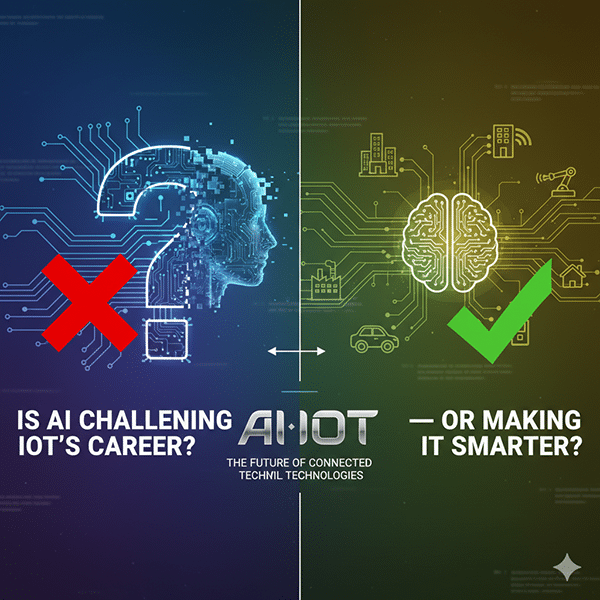
AI complementing IoT (AIoT)
AI and IoT are working together increasingly to create smarter, efficient systems, and we have coined the acronym AIoT to refer to this partnership. In this relationship, IoT provides the data from connected devices, and AI analyses it to create insights, improve operations, and enable prediction-based actions. The combination of IoT with AI offers the opportunity to use them across industries, from smart homes and healthcare to industrial automation and logistics.
Overlap and rivalry myths
IoT and AI rarely directly compete with one another, despite the common assumption that they do. AI adds intelligence and decision-making to the connectivity and data collection that IoT provides. Any suggestion of competition is a misinterpretation of one technology as an improvement over another. Both complement one another, which opens more possibilities for innovation and value creation.
Table 3: Industry use cases
| Industry | Use case | Impact of IoT | Examples/Notes |
| Smart cities | Traffic management, energy optimisation | Reduces congestion, lowers energy consumption, improves urban planning and safety | Smart traffic lights, intelligent street lighting, real-time air quality monitoring |
| Healthcare | Remote patient monitoring, wearable devices | Enhances patient care, enables early diagnosis, reduces hospital visits, supports telemedicine | Wearables tracking heart rate, glucose monitors, remote ICU monitoring |
| Manufacturing | Predictive maintenance, automation | Minimises downtime, improves efficiency, reduces operational costs, ensures product quality | Sensors on machines detect faults, automated production lines |
| Agriculture | Precision farming, soil and crop monitoring | Increases yield, optimises resource use, reduces waste, supports sustainable practices | Soil moisture sensors, automated irrigation, drone-based crop monitoring |
| Retail | Smart shelves, inventory tracking | Improves supply chain, enhances customer experience, reduces stockouts, enables personalised promotions | RFID tags, automated checkout, real-time inventory alerts |
| Transportation and logistics | Fleet tracking, route optimisation | Cuts delivery times, reduces fuel costs, improves safety, enhances customer satisfaction | GPS tracking, smart route planning, condition monitoring for perishable goods |
| Energy and utilities |
Smart grids, automated metering | Enhances energy efficiency, reduces outages, supports renewable energy integration, enables predictive maintenance | Smart meters, grid load balancing, predictive maintenance for turbines and transformers |
| Home and consumer IoT |
Smart appliances, security systems | Increases convenience, energy savings, enhances safety and lifestyle management | Smart thermostats, connected refrigerators, security cameras, voice assistants |
| Environmental monitoring | Air/water quality sensors, disaster alerts | Enables real-time monitoring, early warning systems, supports environmental conservation | Flood sensors, pollution monitoring, wildfire detection systems |
| Finance and banking | Fraud detection, smart ATMs | Improves security, enhances customer experience, enables real-time insights | IoT-enabled ATMs, transaction monitoring sensors, branch automation |
Collaborative potential
A self-learning and adaptable ecosystem will be produced if artificial intelligence (AI) and the Internet of Things (IoT) are successfully integrated. Predictions, resource optimisation, and real-time change response will all be possible for businesses. In addition to opening new career paths in fields as diverse as data analytics, IoT engineering, and smart system management, this will improve how networks and devices function.
Table 4: The future of IoT careers
| Aspect | Details | Career implications |
| AIoT opportunities | Integration of AI with IoT devices to create intelligent, adaptive systems. Enhances automation, predictive analytics, and decision-making across sectors. | Professionals skilled in both IoT and AI analytics will be highly sought after in tech, manufacturing, healthcare, and smart city projects. |
| Emerging skills | Data analytics, cloud computing, edge computing, network management, and IoT platform development. Knowledge of protocols (MQTT, CoAP) is valuable. | Upskilling opens roles in IoT engineering, cloud-based solution design, data analysis, and system integration. |
| Carrier and network trends | 5G, LPWAN, NB-IoT, and advanced connectivity solutions enable massive device deployments and low-latency applications. | Network architects, IoT solutions engineers, and connectivity specialists are critical for implementing and maintaining these infrastructures. |
| Industrial applications | Smart manufacturing, predictive maintenance, supply chain optimisation, and Industry 4.0 initiatives. | Roles in industrial IoT, automation, operations analytics, and digital twin implementation will expand. |
| Security and compliance | IoT cybersecurity, data privacy, regulatory compliance (GDPR, HIPAA), and risk management. | Careers in IoT security analysis, compliance monitoring, penetration testing, and secure system design are growing rapidly. |
| Entrepreneurial prospects | Startups and innovators developing IoT devices, platforms, and smart solutions. Opportunity to create niche products or B2B services. | Product managers, IoT business analysts, and startup founders can leverage market gaps and emerging needs. |
| Global expansion | Adoption of IoT in emerging markets, cross-border deployments, and integration with global supply chains. | Demand for international IoT project managers, systems integrators, and consultants with cross-cultural tech experience. |
| Sustainability and green IoT |
IoT for energy efficiency, smart grids, environmental monitoring, and resource optimisation. | Careers in green tech, environmental IoT solutions, and sustainability-focused projects are emerging rapidly. |
| Consumer and smart home IoT |
Growth of connected home devices, smart appliances, health wearables, and lifestyle management solutions. | Roles in product development, UX design, mobile IoT applications, and consumer data analytics are expanding. |
| Research and innovation | Development of new sensors, communication protocols, and AI-driven IoT platforms. | Opportunities in R&D, academic-industry collaboration, and advanced prototyping labs. |
The Internet of Things (IoT) has transitioned from basic connected devices to a comprehensive ecosystem driving change in industries, cities, and homes. Its impact is observable across industries (healthcare, manufacturing, agriculture, and smart cities) where it enables efficiency, predictive insights, and superior user experiences. The expanding ecosystem will continue to create business models, solutions, and career paths not yet imaginable.
Emerging opportunities aside, IoT continues to face challenges. Security, data management, interoperability, and regulatory compliance are all significant concerns. Plus, the rapid pace of technological change puts pressure on professionals to regularly upskill, adjust to changes in standards, and embrace developments like 5G, edge computing, and cloud systems. Carriers and network providers are essential for the reliability, scalability, and security of IoT systems.
The future of IoT will be characterised by collaboration and integration, rather than competition with AI. IoT will combine strong connectivity, intelligent data processing, and enhanced applications, changing the shape of industries and improving everyday life.