
























































Presented at COLING 2025, Hanchen Su and collaborators unveil an open source–aligned ICA framework that helps smaller LLMs match proprietary systems in enterprise customer support, cutting costs while improving accuracy and scalability.
A new LLM-friendly knowledge representation framework designed to improve customer support automation has been presented at the 31st International Conference on Computational Linguistics (COLING 2025). Titled “LLM-Friendly Knowledge Representation for Customer Support,” the study introduces a structured approach that enables Large Language Models (LLMs) to interpret, reason over, and execute enterprise workflows more effectively.
At the core of the research is the Intent, Context, and Action (ICA) format, which restructures complex operational workflows into a pseudocode-style representation optimised for LLM comprehension. By translating business processes into machine-readable reasoning steps, ICA improves model interpretability, decision accuracy, and the scalability of AI-driven customer support systems.
Experimental results reported in the study show up to a 25 per cent improvement in action prediction accuracy and a 13 per cent reduction in manual processing time, positioning ICA as a new benchmark for structured reasoning in customer support automation.
To address enterprise data limitations, the study also introduces a synthetic data generation pipeline that simulates user queries, contextual conditions, and decision-tree reasoning paths. This approach enables supervised fine-tuning with minimal human involvement while significantly reducing training costs.
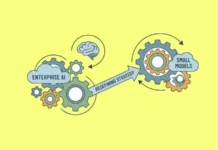
Crucially, experiments show that this pipeline allows smaller open-source LLMs to approach the performance and latency of larger proprietary models, lowering the barrier to enterprise AI adoption. The framework is designed to be model-agnostic and reusable, aligning strongly with open-source development principles.
While demonstrated in customer support, the ICA methodology is intended to extend to legal, financial, and other complex rule-driven enterprise domains. The research was authored by a team affiliated with a leading Silicon Valley technology company and includes contributions from Hanchen Su, Staff Machine Learning Engineer.