
























































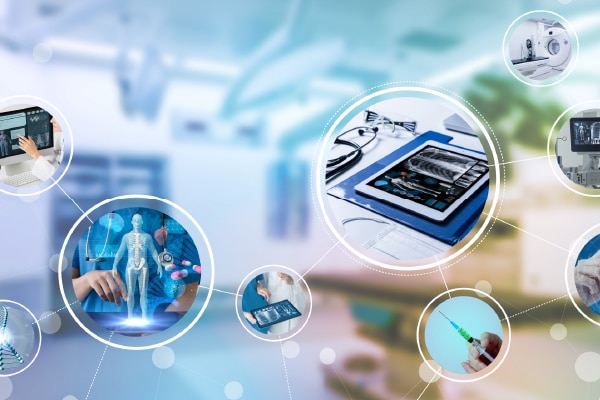
The Internet of Things is enabling faster emergency response times in the healthcare industry along with continuous and real-time monitoring of chronic diseases. What’s more, it’s enabling better healthcare services in remote areas.
The Internet of Things (IoT) has made healthcare more accurate and quicker, with remote monitoring and real-time insights enhancing patient care. IoT devices give direct, 24/7 x 365 access to the patient, while IoT-based analytics and automation allow health providers to access reports even before patients arrive at the hospital. This improves the responsiveness in case of a health emergency.
Healthcare uses IoT for data acquisition, data storage, real-time monitoring and device connection. IoT devices like wearables, connected pacemakers, and glucose monitors are improving health outcomes and reducing hospital visits for patients.
Today, healthcare institutions and hospitals offer remote monitoring, healthcare delivery, and in-home diagnostics capabilities that leverage machine learning and the Internet of Things.
IoT for patients
Wearables like fitness bands and other connected devices such as blood pressure and heart rate monitoring cuffs, glucometers, etc, track a patient’s health condition. These devices can be tuned to monitor the calories burnt, blood pressure and pulse fluctuations, and other critical health parameters.
IoT-based connected devices and telehealth consultations can be as effective as in-person visits, providing much-needed access to healthcare for patients in rural locations.
IoT for doctors
Doctors can keep track of patients’ health more effectively by using wearables and other home monitoring equipment embedded with IoT. These devices help monitor patients’ response to treatment plans. Data collected from IoT-based applications can help doctors identify the best treatment process for patients.
IoT for hospitals
Medical staff across different locations can be tracked using IoT devices. Hospitals use these devices to track the location of wheelchairs, defibrillators, nebulizers, oxygen pumps, and other such monitoring equipment. Hygiene monitoring IoT devices help to prevent infections in patients.
IoT for health insurance
IoT-based devices help establish transparency between insurance companies and customers. They help to document the cost of treating the health issue, as well as submit and process claims. They enable insurance companies to validate claims through the data captured by these devices.
According to a report by Markets and Market, the IoT technology industry is projected to grow from US$ 945.6 billion in 2024 to US$ 1,377.8 billion by 2029, registering a CAGR of 7.8% during this period. As per a Future Market Insights report, the global healthcare IoT market is projected to grow from US$ 108.6 billion in 2024 to US$ 167.7 billion by 2028, at a CAGR of 11.47%.
Challenges in implementing IoT in healthcare
Scalability
As the number of connected devices increases, so does the volume of data. This requires robust cloud infrastructure, edge computing, and device lifecycle management. Ensuring that the IoT devices can scale to handle this data efficiently is a significant challenge.
Interoperability
IoT devices often use a variety of proprietary protocols and standards. Ensuring seamless interoperability between these diverse systems is a challenge. Lack of universal standards makes integration with EHRs (electronic health records), hospital systems and hospital infrastructure difficult. For example, a smart pill dispenser may not easily sync with a hospital’s Epic or Cerner EHR system.
Security
Sensitive patient data is continuously transmitted across devices and networks. IoT systems are vulnerable to cyber threats that include data breaches, unauthorised access and ransomware attacks. Ensuring robust security measures within the IoT middleware to protect data and devices is crucial but challenging.
Privacy concerns
Safeguarding patients’ data and ensuring compliance with privacy regulations like HIPAA and GDPR is an ongoing challenge. For example, a wearable glucose monitor transmitting data to the cloud must ensure encryption at rest and in transit.
Reliability
IoT devices require stable, low-latency connections (Wi-Fi, 5G, LPWAN). In rural or poor network settings, connectivity gaps can disrupt monitoring. For example, remote patient monitoring for cardiac patients may fail if network coverage is weak.
Characteristics of IoT healthcare systems
To perform well, IoT healthcare systems must possess a few key characteristics.
Connectivity and interoperability
There should be seamless communication between devices, gateways, the cloud, and hospital systems (EHR/EMR). HL7, FHIR, and DICOM are the standards that ensure interoperability across vendors and platforms.
Real-time data collection and monitoring
Continuous tracking of vitals (heart rate, glucose, oxygen saturation, etc) enables early detection of anomalies and proactive interventions.
Remote accessibility
Patients and clinicians should be able to access health data anytime, anywhere. Remote accessibility supports telemedicine, home care, and chronic disease management.
Scalability and flexibility
Systems can expand from a few devices to thousands across hospitals or patient populations. A modular design allows the integration of new sensors, apps, or analytics engines.
Data analytics and intelligence
AI/ML models should be applied to IoT data for predictive insights (e.g., risk of cardiac arrest). Data analytics enables personalised treatment plans based on continuous data streams.
Key applications of IoT in healthcare industry
The integration of IoT devices into the healthcare industry is revolutionising patient care, improving medical outcomes, and streamlining operations.
Remote patient monitoring
IoT-based remote patient monitoring uses smartwatches, smart inhalers, connected pacemakers, blood glucose monitors, phones and other monitoring devices to collect patient health data automatically. These devices allow for continuous monitoring of vital signs, temperature, blood pressure, body fat percentage, etc, to enable real-time data collection and analysis.
For example, patients with chronic conditions like diabetes or hypertension receive constant monitoring from the comfort of their homes, reducing the need for frequent doctor visits and hospitalisations. This not only enhances the quality of care but also facilitates a shift to more cost-effective and accessible healthcare, especially for underserved and remote populations.
Mobile health
IoT devices can send patients’ medical or physical data to the smartphones of healthcare providers using a healthcare app. Doctors can swiftly schedule online appointments with this application.
Electronic health records
Doctors can acquire real-time patient reports using IoT-based health systems. IoT in healthcare allows patients to contact their doctors at any time.
Real time health systems (RTHS)
RTHS simplifies operational, clinical, and administrative teamwork, improving healthcare services.
IoT heart rate monitors track a person’s heart rate continually. IoT-based health monitors can measure Parkinson’s disease symptoms and their severity throughout the day. Digestible sensors help to measure the stomach’s pH and check for any internal bleeding.
Emergency care
IoT devices alert rescue workers to provide faster and better medical care by collecting or sending data in real time.
Hospital automation
IoT streamlines hospital workflows through smart beds, asset tracking, and automated inventory management. It enhances safety, reduces costs, and improves staff efficiency in hospitals.
Future of IoT in healthcare
AIoT (AI + IoT)
AI will be used to analyse IoT data in real-time, enabling predictive diagnostics and personalised therapies. This will lead to faster, more accurate diagnoses from real-time data streams (e.g., predicting asthma attacks or cardiac events).
Digital twins of patients
Virtual replicas of individuals will help in predictive modelling of hospital operations to optimise staffing, bed allocation, and emergency response.
5G-enabled healthcare
Ultra-low latency networks will power real-time telemedicine, robotic surgeries, and AR/VR-assisted care. This will provide affordable healthcare for rural and underserved areas where connectivity is currently a barrier.
Voice-assisted smart devices
This will enable hands-free interaction in surgical rooms or senior care.
Blockchain for health data security
Decentralised health record management will enable better trust in them.
IoT in mental health
IoT systems will help monitor sleep, behaviour, and speech patterns to support mental wellness.
IoT in healthcare is reshaping the healthcare delivery model. Its data-driven nature provides actionable insights and supports caregivers with timely information, among other things. IoT-based solutions enable a proactive approach where continuous monitoring, predictive analytics, and real-time alerts help anticipate health issues instead of waiting to respond to acute episodes.
Disclaimer: The views expressed in this article are those of the authors.
Tricon Solutions LLC and Gspann Technologies, Inc., do not subscribe to the
substance, veracity or truthfulness of the said opinion.