





























































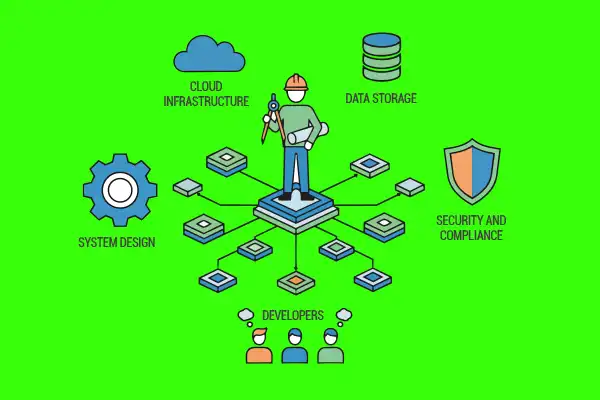
Software architects design software projects and ensure these meet their goals. They must balance tech skills with leadership and mentoring abilities.
Software architects are the principal designers of software development projects. They are in charge of the overall software project structure, making sure that software modules are properly integrated with the stated business goals, while software developers concentrate on producing code for a particular objective or feature. An architect makes a project secure, scalable, and feasible given the resources at hand.
Software architects help technical teams to achieve business goals in a seamless way. Their responsibilities typically include:
High-level design
Designing the outline of the project by defining components, and their work and data flow.
Technology selection
Selecting the best technology from a range of possibilities, such as Java or Python, SQL or NoSQL, and cloud providers like AWS or Azure.
Setting standards
Advising the development team to adhere to quality standards, security procedures, and coding norms.
Risk mitigation
Identifying possible bottlenecks in the areas of maintenance, storage, performance, and scalability.
The roles of a software architect and software engineer are collaborative but differ significantly in scope.
| Feature | Software architect | Software engineer |
| Focus | Designing high-level system structure | Developing individual features and module |
| Perspective | Designing the conceived project | Implementing the project |
| Key output | Flow-diagram, UML diagrams, plan | Program code, tests of modules, and bug fixing |
| Stakeholders | Clients, project managers | Architects, testing teams, and lead developers |
Essential skills
To be a successful software architect, a software professional should balance technical skills with leadership qualities.
System design
Proficiency in architectural patterns like microservices, monolithic, or event-driven architecture.
Communication
The ability to explain technical trade-offs to non-technical business owners.
Strategic thinking
Comprehend the problem domain to ensure the best software-based solution for the given project.
Leadership and mentoring
Oversee the entire team’s work and guide the group through the challenging technical aspects of the project.
Architects typically begin their careers as senior software engineers and are promoted to the position of software architect after five to ten years of experience. Then, rather than how to write a function, they focus on how to solve a problem as a whole.
Software engineers must maintain a balance between technical proficiency and emotional intelligence to become great software architects. An architect is frequently described as a “developer who knows how to talk to management” and “still remembers how to code.”
Here are 10 critical ‘Dos’ and ‘Don’ts’ for the role.
The 5 success drivers
Focus on trade-offs
There are benefits and drawbacks to every architectural decision. The trade-offs of the possibilities should be weighed and the architecture most suited to the project’s execution and success should be selected.
Write ADRs (architecture decision records)
To make it possible for the customer and other members of the project team to understand the rationale behind the chosen design, it is important to document its background.
Stay ‘hands-on’
To guarantee the implementability of the selected design, the coding process should proceed with prototype implementation, PoCs (proof of concepts), and codebase execution.
Monitor parameters
For the system’s long-term health, an eye must be kept on non-functional metrics like security, scalability, and maintainability.
Practice an evolutionary approach
In order to adjust to changes in the future, an evolutionary approach should be taken.
The 5 common pitfalls
Don’t be an ‘Ivory Tower’ architect
Discuss with the development team rather than working alone. For a design to be successful, the developers must approve it.
Don’t over-engineer
Avoid complex design; if a straightforward monolithic design on a single server can solve the intended business issue, stay away from designs utilising Kubernetes or microservices.
Don’t be a bottleneck
Don’t design the project with complex and hard to learn technologies. To enable the team to work quickly without you, design the project using straightforward and uncomplicated technology.
Don’t ignore future technical risk
The project should never descend into chaos; instead, it should always emphasise the risks with justification and potential remedies.
Don’t fall in love with a technology
Avoid being biased towards a technology; even if you don’t like it, the best tool is the one that matches the particular project.
Example of an architectural design
ADR 000: Database selection for user profile and activity service
Given below is the architecture decision record (ADR) of a project where the main design task is to select a RDBMS or NoSQL for a user profile and activity tracking system. Since data transfer is much more difficult than rewriting code, selecting a database is one of the most important choices.
- Status: Accepted
- Date: 2026-01-15
- Deciders: Manoj Bhattacharjee (lead architect), Anjan Dutta (data engineer)
- Consulted: Backend team, Analytics team
Problem statement
A user appointment system needs to store two types of data:
- Core profile data: Highly structured information: user ID, email, subscription plan, password.
- Activity logs: Unstructured, high-volume data: clicks, page views, device metadata, and custom event attributes that change frequently.
The task is to decide whether to use a strict relational schema (PostgreSQL) or a flexible document store (MongoDB).
Decision-making factors
- Data consistency: Core user data must follow ACID properties: no partial updates to subscription status.
- Schema flexibility: Weekly adjustments in tracking points cause activity logs to change. To accommodate all these modifications, the system requires a flexible configuration.
- Query complexity: The system requires a process to join user profile data with billing data regularly.
- Write throughput: During peak hours, activity logs typically produce a large volume of data (5,000+) per second and grow quite quickly.
The options and the decision
- Option A: Pure relational (PostgreSQL): Use standard tables for profiles and JSONB columns for unstructured logs.
- Option B: Pure NoSQL (MongoDB): Store everything as documents.
- Option C: Use PostgreSQL for core profiles/billing and MongoDB for activity logs.
- Chosen option: Option A: Pure relational (PostgreSQL) with JSONB
Justification for the choice
Although Option C is theoretically feasible, the two distinct backup strategies, two security strategies, and the enormous effort of synchronisation between them can lead to significant operational complexity.
On the other hand, option A’s PostgreSQL offers ACID compliance by default, and its JSONB capability enables the system to store unstructured activity logs with MongoDB-like performance. In a single, sophisticated database engine, this offers the best of both worlds. For storing and working with JSON (JavaScript Object Notation) data, PostgreSQL has a very effective binary data type called JSONB. JSONB’s binary format makes it significantly faster for processing and querying compared to the plain-text JSON type.
The positives of this choice are:
- Simplified operations: One database technology for scaling, backup, and monitoring.
- Strong integrity: The system can guarantee the integrity of activity logs in relation to a valid user ID by using the user ID as a foreign key.
- SQL power: The software team can use standard BI tools (Tableau/Metabase).
The downsides are:
- Storage size: Large PostgreSQL indexes on JSONB may necessitate a stringent data retention strategy by restricting the amount of time logs that are stored.
- Vertical scaling limits: In contrast to MongoDB, Postgres scaling is primarily vertical (larger servers) as opposed to horizontal (sharding), which could result in additional costs.
The golden rule for a software architect is to consider the design that is easy to implement both in terms of human and operational resources (hardware and software). It is preferable to view a design as immutable. For any significant modification, it is advisable to make a new design and designate the previous one as ‘superseded’ rather than altering the original. This helps us learn from earlier mistakes and maintains the history of the system’s evolution.