




























































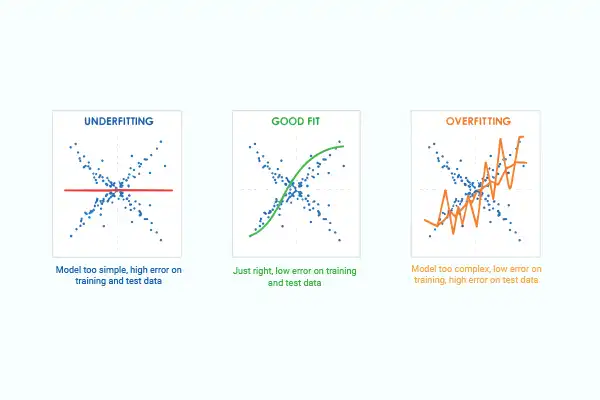
Machine learning models must balance the concepts of underfitting and overfitting.
In machine learning, a model’s goal is not just to fit the given data, but to generalise well to unseen data. Two common failure modes prevent this:
- Underfitting – the model is too simple to capture the true pattern.
- Overfitting – the model is too complex and memorises the training data.
I will demonstrate both concepts using simple, executable Python code, and a dataset generated from a known mathematical formula. This makes it easy to compare predicted values with true values.
Dataset with known ground truth
To clearly understand model behaviour, we generate data using a known formula:
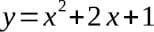
This quadratic relationship allows us to check:
- How well a model fits training data
- How it behaves on unseen values
import numpy as np
X = np.array([[1], [2], [3], [4], [5], [6], [7], [8], [9], [10]])
y = np.array([x[0]**2 + 2*x[0] + 1 for x in X])
Underfitting example: Linear regression
Linear regression assumes a straight-line relationship between input and output. Since our data is quadratic, this assumption is incorrect. Here’s the code:
from sklearn.linear_model import LinearRegression

model = LinearRegression()

# Train

model.fit(X, y)

# Predict

print(“Underfitting (Linear Regression)”)

print(“x | predicted | true”)

print(“--+-----------+------”)

print(“Seen (training range)”)

for v in [1, 3, 5, 7, 9]:

y_pred = model.predict([[v]])[0]

y_true = v*v + 2*v + 1

print(f”{v:2d} | {y_pred:9.2f} | {y_true:4d}”)

print(“\nUnseen (outside training range)”)

for v in [11, 12, 15]:

y_pred = model.predict([[v]])[0]

y_true = v*v + 2*v + 1

print(f”{v:2d} | {y_pred:9.2f} | {y_true:4d}”)
The output is:
x | predicted | true

--+-----------+------

Seen (training range)

1 | -8.00 | 4

3 | 18.00 | 16

5 | 44.00 | 36

7 | 70.00 | 64

9 | 96.00 | 100


Unseen (outside training range)

11 | 122.00 | 144

12 | 135.00 | 169

15 | 174.00 | 256
This is what is observed:
- The model makes noticeable errors even on training data.
- Errors increase smoothly for unseen values.
- The model cannot capture curvature.
- This is a classic case of underfitting:
- The model is too simple.
- It fails to learn the true data pattern.
Overfitting example: K-Nearest Neighbors (K = 1)
K-Nearest Neighbors (KNN) makes predictions based on nearby data points. With K = 1, the model simply copies the nearest training value. The code is:
from sklearn.neighbors import KNeighborsRegressor

model = KNeighborsRegressor(n_neighbors=1)

# Train

model.fit(X, y)

# Predict

print(“Overfitting (KNN(N=1)”)

print(“x | predicted | true”)

print(“--+-----------+------”)

print(“Seen (training range)”)

for v in [1, 3, 5, 7, 9]:

y_pred = model.predict([[v]])[0]

y_true = v*v + 2*v + 1

print(f”{v:2d} | {y_pred:9.2f} | {y_true:4d}”)

print(“\nUnseen (outside training range)”)

for v in [11, 12, 15]:

y_pred = model.predict([[v]])[0]

y_true = v*v + 2*v + 1

print(f”{v:2d} | {y_pred:9.2f} | {y_true:4d}”)
The output is:
x | predicted | true

--+-----------+------

Seen (training range)

1 | 4.00 | 4

3 | 16.00 | 16

5 | 36.00 | 36

7 | 64.00 | 64

9 | 100.00 | 100

Unseen (outside training range)

11 | 121.00 | 144

12 | 121.00 | 169

15 | 121.00 | 256
It can be observed that:
- Predictions are perfect on training data.
- For unseen values, the model repeats the nearest known output.
- It completely fails to follow the quadratic growth.
- This demonstrates overfitting:
- The model memorises training data.
- It does not learn the underlying function.
- The bias–variance interpretation is:
- Underfitting corresponds to high bias and low variance. The model makes strong assumptions and is consistently wrong.
- Overfitting corresponds to low bias and high variance. The model fits training data perfectly but is unstable on new data.
The goal of machine learning is to find a balance between these two extremes as the table below indicates.
| Model | Training error | Test error | Behaviour |
| Linear regression |
High | High | Underfit |
| KNN (K=1) | Zero | Very High | Overfit |
| Ideal | Balanced | Low | Good |
To conclude, underfitting means not learning enough while overfitting means learning too much. Good models learn the pattern, not the data points.