















































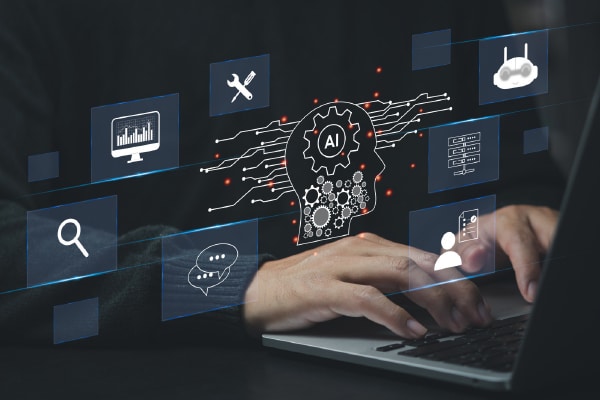

Learn how generative AI is changing the face of writing, testing, and even thinking about code.
Generative artificial intelligence (GenAI) is no longer science fiction. It has become part of our lives as an empowered force that can understand natural language and produce human-like text, images, and even code.
There are many AI tools today that can boost the software development process, if not totally automate it. What would have taken many hours to do manually — writing boilerplate code, debugging for several hours only to find syntax errors, and spending long hours on a function documentation — can now take seconds thanks to the likes of GitHub Copilot, ChatGPT, or Amazon Code Whisperer. These models are fed on huge datasets of code and text, which make up their large language models (LLM), and prompt them to understand how to respond in advanced ways even better than experienced developers.
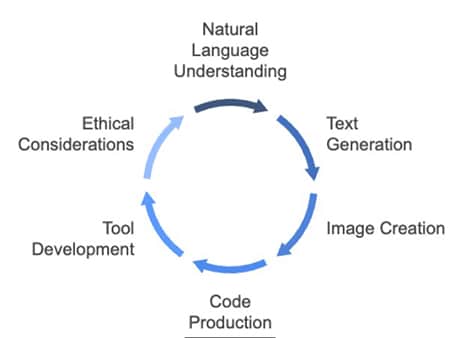
Generative AI represents a paradigm shift as it brings natural human language and computer code closer than ever before, leading to a future where coding becomes as much communication as logic.
Table 1: Popular Gen AI tools for developers
| Tool | Developer | Key features | Best for |
| GitHub Copilot | GitHub + OpenAI | Autocompletes code, suggests functions, understands comments | General-purpose development, fast prototyping |
| Amazon CodeWhisperer | AWS | Code suggestions, security scans, AWS best practices | Cloud-native apps, AWS infrastructure automation |
| ChatGPT (w/ Code Interpreter) | OpenAI | Conversational code generation, explanations, debugging | Learning, multi-language support, code exploration |
| Tabnine | Tabnine Inc. | Local/private models, multi-language support, fast autocompletion | Teams prioritising privacy and on-prem solutions |
| Replit Ghostwriter | Replit | In-browser code suggestions, error fixes, and explanations | Students, beginners, real-time collaboration |
| Codeium | Ex-FAANG engineers | Free autocompletion for 70+ languages, IDE integration | Cost-effective alternative to Copilot |
| Cody (Sourcegraph) | Sourcegraph | Understands large codebases, answers natural language questions | Navigating and documenting enterprise-level projects |
Table 2: AI’s role across the software development life cycle
| SDLC phase | AI-driven impact | Examples/Benefits |
| Planning and ideation | Translates ideas into structured requirements and technical specs. | Generate user stories, architecture outlines, or flowcharts from prompts. |
| Development | Speeds up coding with autocompletion, code snippets, and boilerplate generation. | Build features faster, reduce manual coding, accelerate MVP delivery. |
| Testing | Auto-generates unit tests, suggests edge cases, and simulates input scenarios. | Improve test coverage and catch bugs early in development. |
| Code review and debugging | Flags issues, explains code, and suggests optimisations. | Faster, more inclusive reviews; easier onboarding for junior developers. |
| Deployment and DevOps | Assists with infrastructure-as-code and script generation for CI/CD. | Generate Dockerfiles, Kubernetes manifests, or pipeline configs from text prompts. |
| Maintenance | Summarises legacy code, auto-updates documentation, and flags outdated patterns. | Reduces technical debt, improves long-term maintainability. |
| Collaboration | Bridges gaps between technical and non-technical teams with summaries and visuals. | Converts code to readable insights, enabling clearer stakeholder communication. |
How GenAI is transforming programming and the SDLC
Generative AI tools do not simply replace mundane tasks but redefine the process of building an application. Here is how these tools are helping.
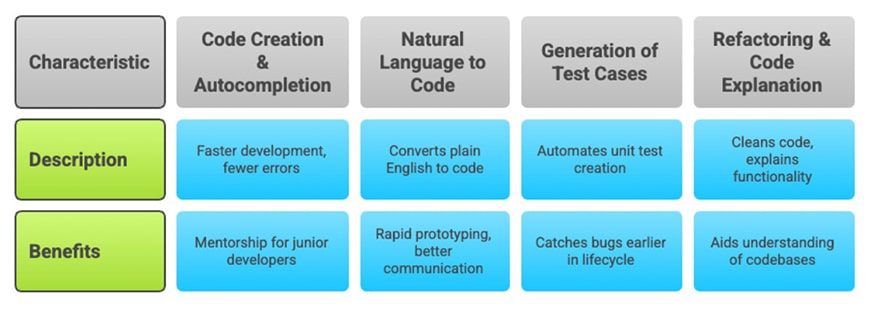
Code creation and autocompletion
Code generation has traditionally been a painstaking task that required deep knowledge of syntax, libraries, and logic structures. Generative AI tools such as GitHub Copilot and Tabnine change that by providing suggestions for complete lines or blocks of code as programmers type.
These tools are clearly more than just autocomplete; they know something about the context of your project and the structure of a given function, and they actually get the meaning of your comments. This means they allow for faster development in fewer lines of code and with less syntax errors. To junior developers, they offer mentorship; for senior developers, they act as a speed multiplier.
Natural language to code
One of the most revolutionary aspects of GenAI is converting plain English into working code. Developers can now state the desired functionality, such as “write a function to sort a list of objects by a date field,” and the AI can generate the implementation in Python, JavaScript, or whichever language one chooses.
This encourages non-developers to participate, enables rapid prototyping, and enhances communication between the technical and non-technical. This also paves the way for a more creative and exploratory approach to software design.
Generation of test cases
The writing of test cases is an important task in maintaining software, though it is time-consuming and tedious. GenAI automates it by generating unit tests of your current functions and classes. By examining method signatures and the code logic, it suggests relevant test scenarios, edge cases, and even mock data.
This not only improves test coverage but also catches bugs earlier in the development lifecycle, resulting in more stable and reliable applications.
Refactoring and code explanation
Refactoring is the art of cleaning up existing code while keeping functionality intact—a feat at which GenAI excels. It suggests better names for variables, corrects logic that is unnecessarily complex, or transforms old paradigms into newer and better ones.
AI can also, in plain language, describe what a piece of code does. This ability aids in the understanding of codebases inherited by team members, in the onboarding of new developers, or in the documentation of complex functions. This enhances teamwork and makes long-term maintenance easier.
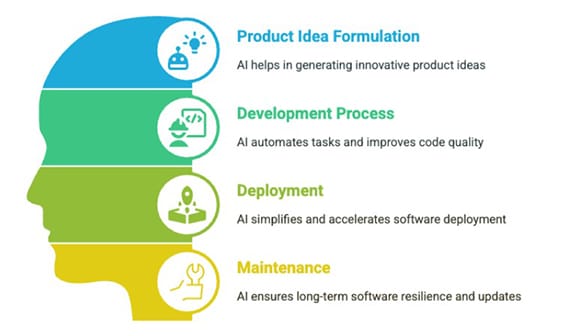
Generative AI is also radically changing the entire software development life cycle (SDLC) itself — from formulating a product idea to its deployment and long-term maintenance. By automating repetitive tasks, improving code quality, and simplifying processes, teams can move fast and build more resilient software. Table 2 shows how GenAI affects every important phase of the SDLC
Challenges and ethical considerations
The promise of generative AI in programming is immense; however, it does come with a series of challenges and ethical considerations that cannot be ignored. Developers must be vigilant about addressing these concerns as long as these tools continue to evolve, so that AI can be applied to the software development life cycle in a responsible and effective manner.
Code quality and reliability
One of the greatest challenges of using generative AI for programming concerns the quality and reliability of the code generated. Although AI-generated code often satisfies the syntactical criteria, it may not necessarily adhere to best practices or be logically sound. These tools generate code based on some patterns derived from a big dataset; hence, AI may generate technically functional solutions that are totally inefficient or suboptimal with regard to a specific project.
The risk here is that developers, particularly junior developers, may develop an unhealthy reliance on AI-generated suggestions without grasping the underlying logic or potential code shortcomings. AI could then inadvertently propel performance issues, bugs, or security vulnerabilities. As developers are responsible for ensuring that the code is robust, secure, and efficient, any AI-generated code should be subjected to the same rigorous review as code produced manually by a human.
Intellectual property and licensing
The other big issue is with respect to intellectual property (IP) and licensing. Generative artificial intelligence tools depend on massive datasets, which are public repositories of code with specific licences like the GNU General Public License (GPL), Apache License, etc. Thus, whenever AI generates code based on this data, there is a high chance that certain parts may be licensed, leading to possible copyright infringement.
For instance, in case the AI-generated code reflects very closely some function from a GPLed project, it could call for a violation of the agreement of that licence. Developers have to be very cautious about generating a portion of code for commercial products using AI tools, keeping in mind relevant licences and IP laws. Tools that provide attributions or checks for licences, like automated legal scanning, can help mitigate the risks.
Bias that comes with data quality
Generative AI models are trained on large datasets that include outdated or biased coding practices. If the data used for training is either limited or lacks a modern edge, AI may repeat those defects and produce biased or exclusionary code. For example, outdated solutions could be suggested, or AI could forget factoring in the needs of inclusivity and access. Use of rich, ethical, and modern datasets must be ensured when training AI models.
The balance between human and artificial intelligence
A key challenge is finding the right balance between human intelligence and AI intelligence. If AI is overused, the problem-solving powers of developers run the risk of dwindling. If AI codes more than developers, they may not attain the level of deep clarity that is a must in critical determination-making. The goal should be not to replace developers but rather help them to work smarter as well as control and direct software development.
Table 3: The future of AI
| Aspect | Key points |
| Smarter, more context-aware AI | AI will become more adept at understanding project context and business goals, leading to better code suggestions. |
| AI-powered collaboration | AI will assist in real-time collaboration, improving team productivity and speeding up development cycles. |
| Democratising software development | AI tools will become more accessible, enabling non-technical users to create software and fostering innovation. |
| Ethical and regulatory developments | Ethical frameworks and regulations will be established to ensure responsible AI use, addressing issues like bias and privacy. |
| Continued integration with other technologies | AI will integrate with emerging technologies like blockchain and quantum computing, simplifying complex tasks and expanding possibilities. |
The future
AI will evolve as a real-time software development collaborator that assists in brainstorming, debugging, and even project management. With this collaboration, we can develop in shorter cycles, enhance team productivity, and create innovative solutions.
Generative AI will also usher in a radical change in the accessibility of software development for people who may not have a technical background. As these tools become easier to operate, many non-technical people will develop software, creating a wave of innovation and a diverse tech ecosystem.
However, ethical and regulatory frameworks will be critical as AI becomes rampant. Governments and industry bodies will come together to create responsible AI frameworks to handle concerns like bias, privacy, and job displacement.
AI is increasingly becoming context-sensitive. It is empowering developers to work smarter, effectively, and inclusively towards democratisation in software development, even making it possible for a layperson to create applications independently. Nevertheless, ethical and regulatory frameworks will remain paramount in ensuring its success.