




























































Two new AI products and a global startup program aim to make graph technology the backbone for agentic and generative AI systems.

Neo4j has announced a $100 million investment aimed at accelerating innovation in agentic and generative AI (GenAI), marking its largest expansion in the space to date. The move includes the launch of two new agentic offerings—Aura Agent and MCP Server—alongside one of the world’s largest AI-native startup programs, which will support 1,000 startups globally over the next year.
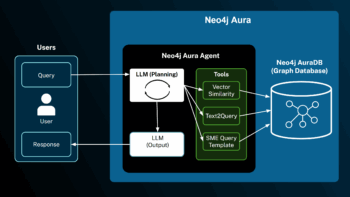
The investment underscores the company’s bid to become the “default knowledge layer” for agentic systems—AI models that require contextual memory, reasoning, and explainable results. As enterprises struggle to move GenAI from pilot to production—95% of pilots fail to deliver returns, according to MIT—Neo4j aims to close the gap with graph-based infrastructure that helps AI systems understand, reason, and act reliably.
The company’s customer base already includes 84 of the Fortune 100, with deployments powering AI systems at Uber, Walmart, and Klarna. In the past year, Neo4j recorded 6X growth in GenAI customers, 58% growth in cloud consumption, and 82% growth in product-led adoption, with over half its top clients expanding usage in 2025.
The new Aura Agent platform, now in early access, allows enterprises to build and deploy AI agents grounded in their own data within minutes. Complementing it, MCP Server for Neo4j integrates graph-based memory and reasoning into existing AI applications, offering persistent memory, automated management, and natural language querying—both slated for general release in Q4.
Alongside product innovation, the company’s Startup Program will provide cloud credits, technical enablement, and go-to-market support to over 1,000 AI-native startups. Early participants include Firework, Hyperlinear, Rivio, and Mem0. The company also announced key executive appointments to support scaling, including Sudhir Hasbe as President and Chief Product Officer, and Ajay Singh, formerly of Databricks, as Head of Global Field Engineering. It surpassed $200 million in 2024 revenue, reflecting its growing dominance in enterprise AI infrastructure. Backed by board confidence, CEO Emil Eifrem said the company’s vision is clear: to make graphs the foundation for intelligent, context-aware AI systems.