













































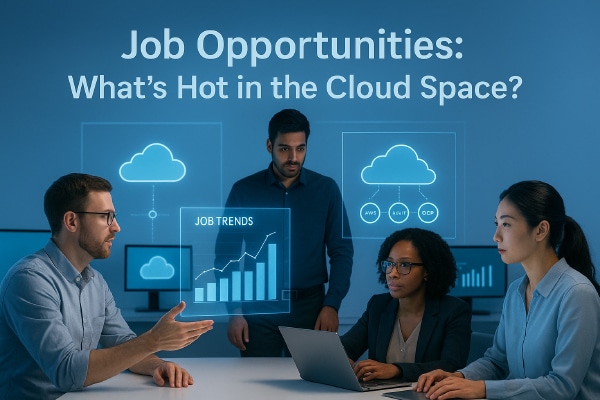

Companies will continue to hire developers with cloud expertise in 2026, provided they are continuously upgrading their skills in this domain and are experienced in open source software development.
If there’s one field that refuses to slow down, it’s cloud computing. Even as automation and AI reshape roles, cloud adoption continues to surge. From startups deploying microservices overnight to enterprises migrating decades of legacy systems, cloud remains the engine of digital transformation. For professionals, this means one thing: skills that live in the cloud won’t come down anytime soon.
Recruiters are no longer looking for generic ‘IT engineers’. They want people who can design scalable, cost-efficient, secure, and AI-ready infrastructure — all using a mix of open source and cloud native tools.
Emerging domains defining 2026
The year 2026 is shaping up to be about intelligence + efficiency + governance in the cloud. Here are the five domains commanding attention and hiring budgets.
| Domain | What it means | Why it’s hot |
| Multi-cloud and hybrid | Managing workloads across AWS, Azure, GCP and on-prem | Avoids lock-in and offers resilience |
| MLOps and LLMOps | Operationalising ML and LLM pipelines on cloud | Every AI product now needs reliable model delivery |
| Cloud security and zero trust | Protecting data, containers and APIs at scale | Compliance and ransomware concerns |
| FinOps and sustainable cloud | Managing and optimising spending with carbon-aware choices | Cloud cost governance is board-level |
| Edge and serverless AI | Inference near data sources using lightweight runtimes | Enables low-latency AI and IoT integration |
Top roles in demand
Even though job titles keep morphing, recruiters across LinkedIn and Indeed show remarkable consistency in five areas.
Cloud engineer/DevOps engineer
Designs and automates scalable deployments using Docker, Kubernetes, Terraform, and CI/CD pipelines. Tools to know are AWS CLI, Argo CD, Jenkins, Crossplane, and GitHub Actions.
MLOps engineer/LLMOps engineer
Bridges data science and infrastructure. Responsible for model versioning, deployment and monitoring using MLflow, Kubeflow, Weights & Biases, and Grafana. Companies rolling out AI features in their cloud apps actively seek this hybrid role.
Data engineer/DataOps specialist
Builds pipelines that move data between cloud storages and analytics layers. Open source skills in Airflow, Spark, Kafka, and dbt remain top of the list.
Site reliability engineer (SRE)
Keeps systems resilient and observable using Prometheus, Grafana, and OpenTelemetry. This role requires equal fluency in coding and incident response.
Cloud security architect/FinOps analyst
Security engineers design zero-trust networks with OPA and SPIFFE/SPIRE, while FinOps analysts track and optimise costs using Kubecost, OpenCost, and Infracost.
Tools and platforms to master
Cloud hiring today is ‘tool-first’. Recruiters often scan résumés for specific open source stacks before reading the experience summary.
Here’s what’s dominating 2025-26 interviews.
| Area | Must-know open source tools |
| Infrastructure automation | Terraform/OpenTofu, Pulumi, Ansible |
| Container orchestration | Docker, Kubernetes, K3s |
| CI/CD and GitOps | Argo CD, Flux, GitHub Actions |
| Monitoring and observability | Prometheus, Grafana, Loki, Tempo |
| MLOps and LLMOps | MLflow, Kubeflow, Airflow, LangServe, Ray |
| Cost governance | Kubecost, OpenCost, Infracost |
| Security and policy | OPA, Trivy, SPIFFE/SPIRE |
| Cloud platforms | AWS, Azure, GCP, and OpenStack for private deployments |
The open source advantage
If there’s one factor that keeps cloud careers dynamic, it’s the open source movement. Enterprises that once relied purely on AWS or Azure tools now blend their stacks with vendor-neutral open source technologies for flexibility and cost control.
Professionals who understand Argo CD, Crossplane, OpenTofu, Grafana, and MLflow have a clear edge. These tools make engineers platform-independent and far more adaptable in multi-cloud and hybrid environments.
Even leading enterprises now maintain internal open source mirrors — from Kubecost for spend analysis to Prometheus for metrics collection. Being ‘cloud-native’ no longer just means using containers; it means thinking open, portable, and observable.
Certifications and learning paths
Recruiters still rely on certifications to validate cloud readiness but now they look for specialised certifications tied to modern workflows.
Here’s how the learning path typically stacks up in 2026.
| Career goal | Recommended certifications/programmes |
| Cloud Engineer/ DevOps | AWS Solutions Architect, Azure Administrator, CKA (Certified Kubernetes Administrator) |
| MLOps/LLMOps | TensorFlow Developer, MLflow Fundamentals (Databricks), AWS Machine Learning Specialty |
| Data Engineer | Google Professional Data Engineer, Snowflake Certified, dbt Fundamentals |
| Security/FinOps | Certified Cloud Security Professional (CCSP), FinOps Certified Practitioner |
| Open source and cloud native | CNCF Kubernetes and Observability badges, Linux Foundation Cloud Engineer Bootcamp |
For beginners, free resources like AWS Educate, Kubernetes Labs, or Grafana Playgrounds provide great entry points before moving into formal training.
Future trends and salary insights
By 2026, the lines between cloud, AI, and automation will blur even further. Roles that combine infrastructure and intelligence — like LLMOps engineers managing GPT-like models on Kubernetes — are already emerging.
Key trends to watch are:
- AI-driven CloudOps: Predictive scaling and auto-remediation using ML.
- Observability-first engineering: Grafana + Prometheus + Tempo + Loki stacks as must-haves.
- Green cloud and FinOps fusion: Optimising carbon footprint along with cost.
- Remote-first cloud teams: Global collaboration via GitOps workflows.
- Security by default: SPIFFE/SPIRE, OPA, and Zero Trust baked into deployment.
Salaries for the key roles discussed here can vary from 10 LPA to 35 APL depending on experience and expertise. These will grow even faster for those with multi-cloud exposure or OSS contribution records, as companies see this as proof of real-world skills and curiosity.
The cloud of 2026 isn’t just about storage and compute anymore — it’s about intelligence, efficiency, and adaptability. Whether you’re fine-tuning MLflow pipelines, setting up Kubernetes clusters, or monitoring with Grafana, one thing is clear — cloud skills multiply in value when paired with an open source mindset and continuous learning.
For those entering or evolving in tech, this is the time to move beyond traditional roles — to become a ‘hybrid professional’ who understands both AI and infrastructure. In short, the next wave of job opportunities lies where cloud meets MLOps.