


























































GLM-5 pushes large models beyond coding into autonomous system execution.
The release of GLM-5 as an open-source model marks a structural shift in artificial intelligence, moving large language models from generating code fragments toward executing full-scale engineering tasks. The model reflects what researchers are calling “agentic engineering” systems capable of sustained reasoning, planning and end-to-end task delivery rather than short bursts of prompt-driven output.
GLM-5 positions itself among the strongest open-source coding and autonomous execution models to date. In complex programming environments, its performance is reported to approach that of Anthropic’s Claude Opus 4.5, particularly in long-horizon assignments that require architectural design decisions and coordinated multi-step execution.
Under the hood, the model represents a major scale-up. Total parameters increase from 355 billion to 744 billion, with active parameters rising to 40 billion. Pre-training data expands to 28.5 trillion tokens, signaling a significant leap in training depth. These gains are paired with architectural and optimization changes aimed at maintaining deployment efficiency despite the expanded scale.
A reinforcement learning framework called Slime enables asynchronous large-scale training, allowing the model to refine behavior through extended interactions. GLM-5 also incorporates DeepSeek Sparse Attention, designed to preserve long-context reasoning while reducing computational overhead and token usage a key factor for enterprise-grade deployment.
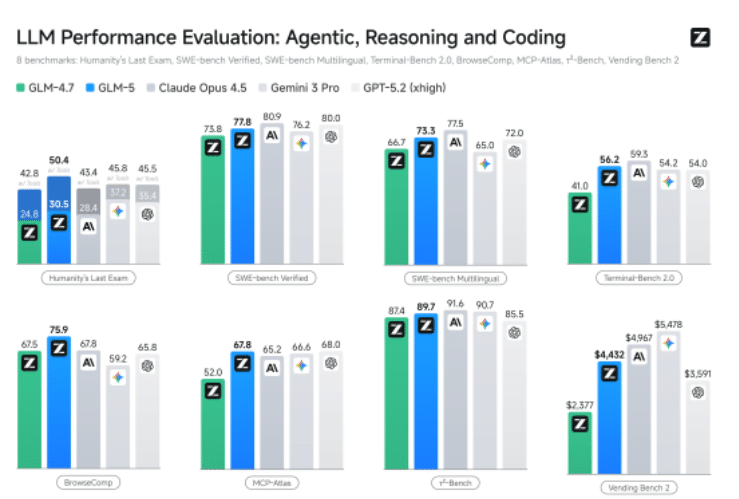
Benchmark data suggests the upgrades translate into practical gains. On SWE-bench-Verified and Terminal Bench 2.0, GLM-5 posts scores of 77.8 and 56.2 respectively the highest reported among open-source models. It also surpasses Google’s Gemini 3 Pro in several software-engineering evaluations. In Vending Bench 2, a year-long simulation of operating a vending-machine business, GLM-5 finishes with a balance of $4,432, leading other open-source systems in operational strategy and economic management.
The broader implication is that AI models are evolving beyond code suggestion engines. Sustained goal tracking, resource allocation and multi-phase execution are becoming core capabilities. If current trajectories hold, the next competitive frontier will not be writing code faster, but autonomously delivering functioning, optimized systems at scale.