























































NxtGen unveils M, India-built open GenAI
NxtGen has officially rolled out ‘M,’ an open source, agentic generative AI platform developed entirely in India, designed to convert human instructions into actionable outcomes for both public and enterprise use.
The launch marks a strategic step for NxtGen in the sovereign cloud and AI infrastructure sector. Built on Indian infrastructure and powered by models such as Llama 4 and DeepSeek 671B, M operates on NVIDIA H200 servers to deliver speed, scalability, multilingual support, and data sovereignty.
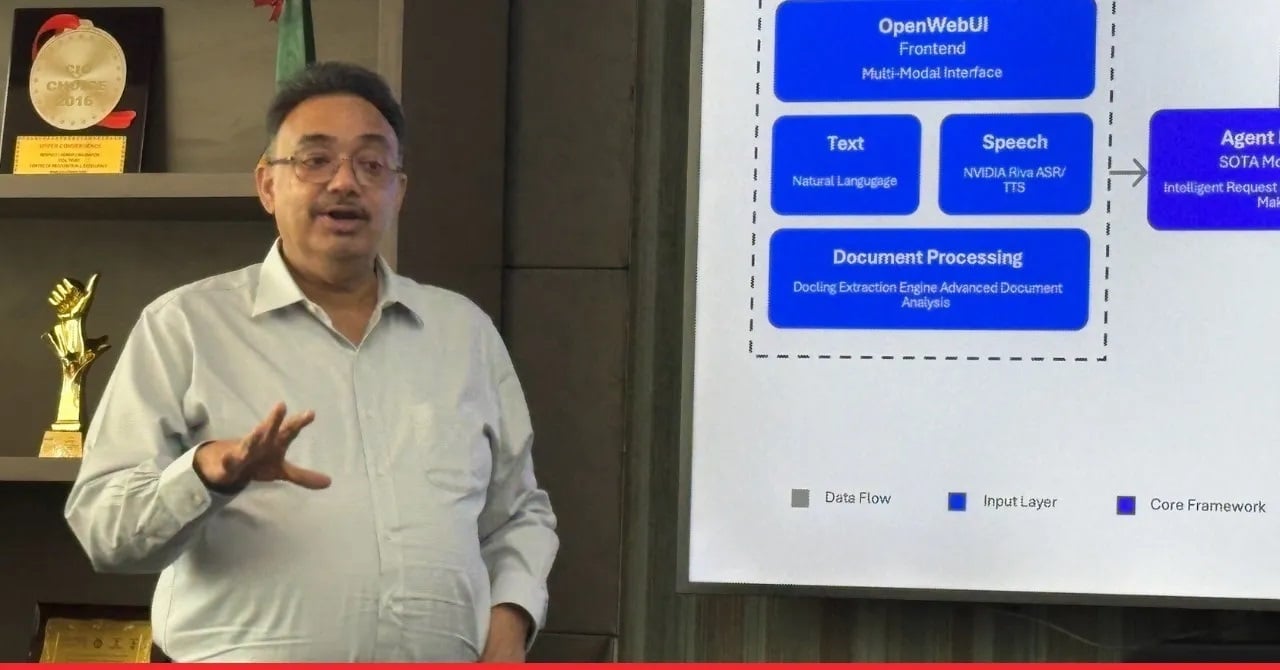
Rajgopal A.S, Managing Director and CEO of NxtGen, said the platform’s name was deliberately chosen. ‘M’ reflects the first sound many humans make, symbolising the beginning of awareness, intelligence, and connection. Speaking at the launch, he compared AI’s transformative potential to electricity, adding, “We asked ourselves — can AI be a public utility? The reality today is that it’s already getting concentrated in a few hands. Our goal with M is to break that mould, leveraging open-source to create something that works for everybody.”
Unlike closed-source systems, M uses a modular orchestration layer capable of working with thousands of open-source large language models. It can dynamically select the most suitable model for a task, integrate with APIs, and perform real-world actions such as booking medical appointments, purchasing tickets, processing enterprise workflows, or retrieving government service information.
“India has the talent, but we need the infrastructure and accessible platforms. Without them, the general public, enterprises, and especially startups will struggle because they lack the tools and talent to compete at scale,” Rajgopal said, emphasising India’s strong services ecosystem and emerging AI policy framework.
How it operates
M’s ‘smart model’ middleware decides which AI model is best suited for a user request, switching to domain-specific models when necessary — for example, those trained on financial or legal datasets. Llama 4 supports general interaction, while DeepSeek 671B enhances reasoning and logic capabilities.
The platform works with both text and speech input and integrates with any service that offers API access. “For instance, if two taxi providers open their APIs and one doesn’t, M will work with those that do. Over time, competitive pressure will likely force the others to participate,” Rajgopal noted.
Security and sovereignty
NxtGen has designed M to run core models on its infrastructure without retaining user data. Internet access, when required, is managed through a controlled process outside the core model. “Most of the internet already runs on open source. With M, there’s no closed-source dependency for scale,” Rajgopal said. “We don’t let the model extract external data directly. The architecture has guardrails.”
Demonstrations at launch
The platform’s launch featured several live demonstrations:
- Rapid website development – Generating a business plan, building a website, and designing a logo in one session.
- Voice-driven actions – Provisioning a virtual machine on NxtGen’s Speed Cloud using voice commands.
- Document intelligence – Analysing PDFs and spreadsheets to answer questions in context.
“These were not lab experiments but deployable features,” Rajgopal said. “We’ve already built numerous enterprise use cases. The challenge for startups is not technology but market adoption.”
Open to enterprises and public services
M is positioned as a B2B enabler and a public utility. Enterprises can integrate their services, while public-facing applications could streamline citizen services such as voter ID queries or passport applications. “I don’t want citizens to go through 50 questions to find a polling booth location. With M, you could just ask and get the answer instantly, over voice,” Rajgopal said.
Competing globally
When asked how M compares to leading closed-source models, Rajgopal pointed to its adaptability. “If tomorrow there’s a better model, we replace it. We haven’t sunk costs into building a single foundation model; we’ve built the infrastructure to integrate the best available models for each task.”
With no restrictive token limits, M can maintain conversational context over extended interactions and handle multi-step reasoning. Its architecture, Rajgopal said, makes it suitable for regulated and sovereign workloads.
Next steps
NxtGen is inviting startups, SMEs, and large enterprises to integrate their services into M, aiming to expand its library of real-world use cases. Future developments include sector-specific tools for finance, law, and healthcare, along with autonomous task execution triggered by natural language.
Rajgopal’s closing message reflected the platform’s mission: “We want to take AI to everybody, drive real-world use cases, and make it easy. M is built for the world, but its thought process comes from India.”