



























































In a world where agility and resilience are essential, embracing GitOps isn’t just a smart move — it’s a transformative step towards future-ready DevOps. Explore what GitOps means, and how to choose between FluxCD and ArgoCD – two tools designed to help automate Kubernetes deployments directly from Git repositories.
In the ever-evolving world of DevOps, GitOps has emerged as a fresh and powerful approach to managing infrastructure and deployments. Imagine managing your entire cloud environment — from server configurations to application rollouts — just by pushing code to Git. That’s the promise of GitOps.
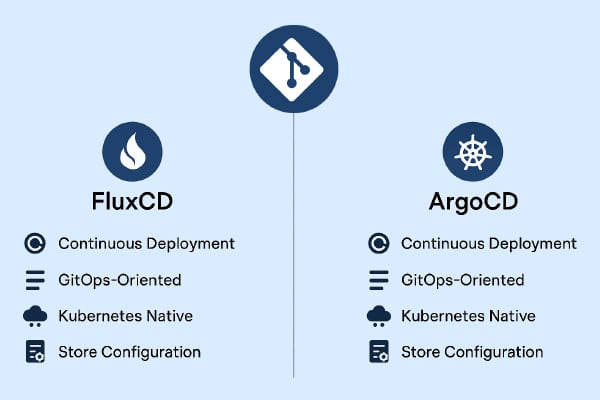
Two open source champions of this practice are FluxCD and ArgoCD, tools designed to help automate Kubernetes deployments directly from Git repositories. While they share a common goal, their unique capabilities and philosophies cater to different needs.
Let’s start with the basics. GitOps is a set of practices that uses Git repositories as the source of truth for declarative infrastructure and application code. Instead of manually configuring environments or deploying via traditional CI/CD pipelines, GitOps agents ensure your cluster matches what’s in your Git repository, automatically.
Key principles of GitOps are:
Single source of truth: Git stores your infrastructure and app definitions. No more guessing what’s deployed where.
Declarative configuration: You describe what the system should look like. The GitOps tool ensures it matches the real state.
Automated reconciliation: If someone accidentally changes something in the cluster, GitOps corrects it.
Auditability and rollbacks: Git’s version history provides transparency and easy rollback options.
Think of GitOps like a thermostat. You set your desired temperature (your infrastructure state) and the system keeps adjusting until it matches your configuration. If the room gets too cold, the heat kicks in; if something in your cluster diverges, GitOps agents bring it back in line.
GitOps in action: Typical workflow
Here’s a basic workflow to help visualise how GitOps fits into DevOps teams.
Code and config commit: Devs push application code and YAML manifests (e.g., for services, deployments) to Git.
GitOps agent detects change: FluxCD or ArgoCD watches the repo and notices the update.
Sync to cluster: The agent syncs changes to the Kubernetes cluster, creating or updating resources.
Monitoring and reconciliation: If something drifts from the declared state, the tool re-aligns the system.
This hands-off approach not only saves time but also increases reliability and reduces errors.
Setting up GitOps: Step-by-step walkthrough
Let’s make this actionable with a beginner-friendly setup outline.
Prepare Git repositories
- Separate repos for infrastructure and app configuration (infra.git, app.git).
- Use YAML manifests for Kubernetes resources.
Install FluxCD or ArgoCD
- Use Helm charts, kubectl, or CLI tools.
- Configure the Git source and target clusters.
Define sync rules
- Decide how and when to sync (e.g., automatically on commit or via approval).
Add secrets and permissions
- Use SOPS, Vault, or Sealed Secrets for sensitive data.
- Set up RBAC for team roles.
Test and monitor
- Deploy a test app, observe health, and check rollback behaviour.
Real world scenario: A QA automation engineer defines test environment configs in Git. Each update triggers automated cluster updates, ensuring consistency across test cycles and reducing manual provisioning.
FluxCD and ArgoCD: Feature comparison
The following table dives into the two powerhouses of GitOps: FluxCD and ArgoCD.
| Feature | FluxCD | ArgoCD |
| Sync mechanism | Automatic, continuous pull-based | Manual or automatic sync options |
| User interface | CLI-heavy, YAML-centric | Rich UI and dashboards |
| Secrets management | SOPS, native Kubernetes secrets | Vault, SealedSecrets, external tools |
| Multi-cluster support | Yes, via repo segmentation | Yes, centralised control panel |
| Alerting and monitoring | Prometheus/Grafana integration | Built-in dashboards +
third-party support |
| Rollbacks | Git-based rollback | One-click rollback with preview options |
| GitOps philosophy | Lightweight, Kubernetes-native | Platform-centric, broader scope |
FluxCD: A developer’s minimalist tool
Key strengths of FluxCD are:
- Seamlessly fits into Kubernetes-native workflows
- Ideal for small teams or microservice deployments
- Lightweight and fast with fewer moving parts
Case study
A startup with three developers uses FluxCD to manage their staging and production clusters. With Git as the sole source of truth, deployment errors have dropped drastically, and onboarding has become easier.
Features of FluxCD you’ll love are:
- Git commit triggers syncs — no UI approval required
- Compatible with Helm, Kustomize, and Terraform
- Integrates with observability tools using native eventing
ArgoCD: A platform engineer’s favourite
Here are ArgoCD’s key strengths:
- Rich UI with dashboards showing health, history, and rollout status
- Scales easily across environments with user-based access
- Supports custom sync policies and hooks
Case study
A financial services company with 100+ apps uses ArgoCD for production deployments. RBAC controls ensure only leads can trigger changes, while dashboards provide transparency during audits.
Features that stand out in ArgoCD are:
- Side-by-side diff viewer before applying changes
- Easy rollback interface for production stability
- Sync locks to restrict deployments outside working hours
Choosing between FluxCD and ArgoCD
Selecting between FluxCD and ArgoCD isn’t a question of which tool is “better” — it’s about understanding your team’s structure, your infrastructure complexity, and the workflows you need to support. Each tool brings powerful capabilities to the table, but they shine in different contexts.
Here are the key factors that shape the right decision.
| Need | Best pick |
| Minimal footprint, pure GitOps | FluxCD |
| Strong UI and visual observability | ArgoCD |
| Multi-cluster platform management | ArgoCD |
| Kubernetes-native simplicity | FluxCD |
| External secrets and policy control | ArgoCD |
| Quick bootstrapping and automation | FluxCD |
| Minimal footprint, pure GitOps | FluxCD |
No matter which tool you choose, the good news is this: both are open source, both are evolving rapidly, and both are backed by thriving communities ready to support your journey. Start with what feels natural to your workflow, and scale with confidence as your needs grow.
Pro tip
Many organisations start with FluxCD for its simplicity and later migrate to ArgoCD as their infrastructure grows and operational needs evolve.
Security in GitOps: Building trust through automation
In GitOps, infrastructure becomes code, and that code flows through automated pipelines that apply changes to real production environments. That’s powerful. But it also means any mistake, misconfiguration, or security lapse can have direct, far-reaching consequences.
That’s why securing GitOps workflows is more than a recommendation — it’s a responsibility. From managing secrets to ensuring code integrity, GitOps invites teams to blend DevOps speed with the rigour of security-first thinking.
Let’s walk through the key practices that protect GitOps pipelines from risk.
Encrypt secrets before committing to Git: Plaintext secrets in Git are an open invitation to trouble. Tools like Mozilla SOPS, Bitnami SealedSecrets, and HashiCorp Vault allow you to encrypt sensitive values while still enabling Git-based automation.
As an example, use SOPS to encrypt API keys in a Kubernetes Secret manifest. Your GitOps tool decrypts them at runtime, preserving both automation and security.
Use Git commit signing: Verifying the authenticity of code changes is essential. With commit signing (e.g., GPG or SSH), you ensure that only trusted developers push changes. The benefit is that commit signatures help detect tampering or unauthorised edits — a simple but powerful defence mechanism.
Apply RBAC to GitOps tools: Role-based access control (RBAC) restricts who can view, sync, or modify deployments. Whether using ArgoCD’s built-in RBAC or Kubernetes-native controls in FluxCD, this minimises accidental or malicious changes.
Here’s a tip. For production clusters, limit write access to just a few trusted roles, and audit changes regularly.
| Note: Treat infrastructure code with the same scrutiny as application code. Implement peer reviews, testing, and CI pipelines for every change. |
GitOps is not a passing trend — it’s shaping the very foundation of next-generation DevOps practices. As organisations strive for agility, security, and cross-cloud consistency, GitOps continues to evolve beyond automation and version control into a strategic enabler across disciplines. Let’s explore the emerging trends that are redefining its future.
AI and ML in GitOps
Artificial intelligence and machine learning are poised to supercharge GitOps workflows in powerful ways.
Predictive alerts: Instead of reacting to system failures, AI can analyse patterns in metrics and logs to flag potential issues before they occur.
Auto-rollbacks: ML models trained on historical deployment failures can trigger smart rollbacks, minimising downtime and user impact.
Contextual recommendations: Based on past deployment outcomes, the system could suggest optimised configurations or timing for future rollouts.
For example, a GitOps tool integrated with AI might pause a deployment mid-way after detecting memory spikes or latency anomalies from previous similar changes, reducing risk and improving system resilience.
GitOps meets DevSecOps
Security is shifting left — meaning it’s now embedded earlier in the software development life cycle. GitOps plays a key role in this movement.
Inline security audits: Every pull request can trigger automated vulnerability scans using tools like Trivy or OpenSSF Scorecards.
Policy-as-code enforcement: With tools like Kyverno and OPA, teams can ensure every manifest complies with predefined security policies before merging.
Secrets life cycle management: Instead of static secrets in repositories, GitOps workflows now leverage dynamic secrets fetched securely at runtime.
This integration ensures infrastructure is not just automated — it’s governed, auditable, and secure by design.
GitOps for multi-cloud and hybrid environments
As businesses expand across clouds (AWS, Azure, GCP) and on-prem data centres, maintaining deployment consistency becomes complex. GitOps solves this through:
Unified interfaces: Tools like ArgoCD support managing clusters from multiple cloud providers through a central dashboard.
Environment segmentation: FluxCD enables fine-grained control with repo-based tenant isolation, ideal for managing dev, staging, and prod environments separately.
Scalable policy management: RBAC and access policies scale across providers, making governance seamless.
Hence, developers deploy once via Git, and environments across clouds sync automatically, removing the need for cloud-specific scripts or manual interventions.
The vision ahead: AI-driven ‘smart sync’
Imagine a GitOps engine that doesn’t just blindly sync changes, but thinks before it acts.
Before syncing, it reviews telemetry data and historical deployment success rates. If anomalies are detected (e.g., spike in error rates, failed tests), it pauses the deployment or asks for human review. Over time, it learns your system’s patterns. identifying risky configurations and even suggesting improvements.
This ‘smart sync’ capability could evolve GitOps from a declarative tool to a collaborative assistant, helping teams not just automate infrastructure, but optimise it intelligently.
To sum up, FluxCD and ArgoCD stand as foundational pillars of the GitOps movement, each embodying distinct philosophies that cater to different needs across the DevOps landscape. FluxCD appeals to developers seeking a clean, Kubernetes-native experience that “just works” — no frills, just pure automation driven by Git. In contrast, ArgoCD offers a visually rich, feature-packed experience that empowers platform teams to orchestrate and monitor complex deployments with ease.
While their architectures and interfaces differ, their shared commitment to declarative infrastructure and automated reconciliation makes them invaluable assets for any team aiming to increase velocity, improve stability, and reduce operational overhead.
For QA testers building reliable environments, for cloud engineers scaling multi-cluster infrastructures, and for developers accelerating release cycles, GitOps isn’t just a workflow. It’s a mindset shift towards transparency, repeatability, and control.
Adopting GitOps through open source solutions like FluxCD or ArgoCD doesn’t require a monumental leap. You can start small, experiment safely, and expand confidently. With every Git commit, your infrastructure becomes more predictable, your deployments more secure, and your operations more streamlined.