






















































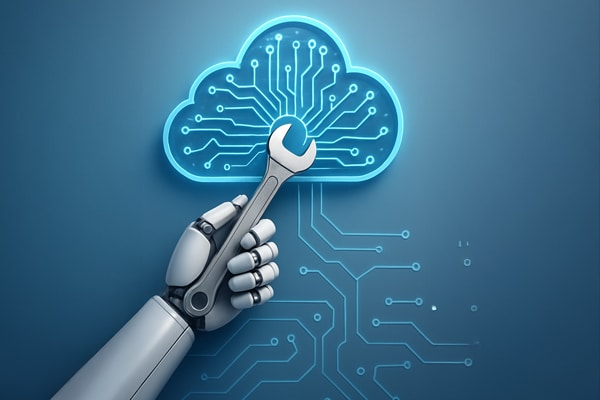
Traditional DevOps, with its rule-based automation, is struggling to work effectively in today’s complex tech world. But when combined with AIOps it can lead to IT systems that predict failures and solve issues without human intervention.
In the fast-paced and ever-changing world of software development and IT operations, automation is a great asset. From CI/CD pipelines to provisioning infrastructure, DevOps has equipped teams to construct and deploy software faster than ever. But as systems become more complex, distributed, and data-rich, automation in isolation is not enough.
This is where artificial intelligence for IT operations (AIOps) enters the conversation. By embedding AI and machine learning with DevOps practices, AIOps shifts the paradigms beyond a workflow of defined rules. Not only does AIOps analyse data patterns and detect anomalies, it can also anticipate failures and take preemptive action with little or no human assistance.
Why automation alone is no longer enough
DevOps has relied on automation for a long time to automate repetitive tasks like continuous integration, testing, deployment, and managing infrastructure. The benefit of automation is that it can eliminate repetitive manual work, speed up the delivery cycle, and reduce human errors. However, traditional forms of DevOps automation are rule based (such as ‘if x happens, do y’).
This is where the limit of automation occurs.
Modern IT ecosystems are dynamic and complex, such as cloud-native applications, microservices, containers, and systems distributed across the globe. With thousands of events and logs created every second, unplanned and unexpected issues do not always follow a pattern. Rule-based automation cannot adapt to new scenarios, unknowns, or subtle signals embedded in data in real-time. In such environments, we don’t need just a fast response, but a smart one. This is why businesses are now turning to AI-powered solutions that learn, adapt, and evolve beyond traditional scripts.
Defining ‘self-healing systems’ in modern IT
A self-healing system is an intelligent system that recognises when it has an operations problem, figures out why it is having it, and can often fix it before any user or operator even knows there is a failure.
Self-healing systems do not just react to events and incidents — they analyse historic data, identify early triggers or symptoms of failures, and act. For example, if a service is known to crash when it runs out of memory, a self-healing system can observe metrics like memory consumption, predict when the service may fail with very low memory, and take action to fix the issue—like restarting the service or allocating more memory—without human intervention.
In AIOps, self-healing systems are powered by data science in terms of machine learning models, real-time analytics, and automated workflows. The ability for these systems to learn, continue to develop processes to manage, and exist within a controllable design lets organisations work system resiliency into their designs and manage them with minimal manual intervention.
The key shift away from traditional DevOps is that self-healing systems are not just automated — they are intelligent, autonomous, and adaptive.
Table 1: AIOps vs traditional DevOps: Key distinctions
| Aspect | Traditional DevOps | AIOps |
| Data handling | Manual analysis or rule-based alerting | Real-time ingestion and machine learning-based correlation |
| Incident response | Human intervention and scripted automation | Automated diagnosis and self-remediation |
| Scalability | Limited by human capacity and rule complexity | Scales with data and adapts to new patterns |
| Root cause analysis | Time-consuming and reactive | Fast, proactive, and often predictive |
| Adaptability | Static logic, predefined workflows | Dynamic learning and evolving models |
| Alert management | High noise, false positives | Noise reduction and intelligent alert prioritisation |
Understanding AIOps
AIOps, a term created by Gartner, refers to the automation of problems in traditional IT operations using artificial intelligence technologies such as machine learning and Big Data analytics.
In AIOps, the engine consumes and ingests a vast number of data points from many sources, including logs, metrics, traces, events, user feedback, etc, and applies intelligent algorithms to:
- Recognise patterns and anomalies
- Predict incidents
- Correlate events, and
- Automatically trigger remediation workflows
AIOps can notify a system administrator of an issue and also act on the insights gained from monitoring events and behaviours in the infrastructure automatically. This could include auto scaling the cloud infrastructure, restarting a failed service, or even reconfiguring systems or environments leading to increased uptime and improved efficiency.
The fusion of AI, ML, and DevOps
At a basic level, AIOps is where DevOps automation intersects with machine intelligence.
- DevOps provides speed, automation, and collaboration across development and operations teams.
- Artificial intelligence (AI) provides pattern matching, decision making and predicting capabilities.
- Machine learning (ML) allows the system to learn from historical incidents and improve over time.
Together, these elements create an intelligent feedback loop. The system processes more data and learns from past behaviour, considers ongoing changing conditions, and improves its predictions and accuracy based on the data.
What makes a system self-healing?
A self-healing system is a system that can identify faults, determine root causes, and take corrective action without any human intervention as a first response. It models how the human body responds when injured — identify pain, determine what is wrong, and start the healing process.
Self-healing systems don’t just rely on static rules and manual checks; they utilise real-time data streams and apply pattern and anomaly detection through machine learning to ascertain the state of the environment. A self-healing system is trying to gauge its own health all the time — CPU utilisation, latency, memory, throughput, traffic, security anomalies, etc — to preemptively address an impending failure.
The key component of every self-healing system is a cycle that reflects the process followed by intelligent agents: Detect → Diagnose → Act.
Detection
First, the system must be aware that ‘something is wrong’. It does this through telemetry data: logs, metrics, traces, user behaviour, and so on, by using anomaly detection algorithms. These telemetry models can detect deviations from normal, like CPU spikes, latency anomalies, and sudden increases in error rates.
Diagnosis
After detecting an anomaly, the next step for the system is to determine why it is occurring. This is called root cause analysis (RCA). Using AI/ML, historical data, and event correlation, the system can pinpoint the most likely source of the anomaly. For example, it may correlate a sudden database lag with a recent deployment, or a recently made change in configuration for the database.
Action
After determining the root cause, the system must determine the right action to remediate the issue. In practical terms, this could mean restarting a failing service, scaling up infrastructure, rolling back a bad deployment, or rerouting traffic. The hope in operational teams is that all this will be accomplished automatically and with little or no disruption to users.
Role of real-time data and feedback loops
Self-healing systems are only as intelligent as the data they have access to. For self-healing systems to function well, they require real-time visibility into all parts of the technology stack. Infrastructure health, application performance, user interaction data, and even things like external API failures or or a cloud outage, are all components that need to be monitored for self-healing to be viable.
More critically, feedback loops must be an intrinsic part of the process or capability. For instance, after every healing action, the system needs to validate the effects: was the service really amended? Were there any side effects? Did it identify the root cause correctly?
This iterative learning process allows the system to enhance its predictions and ultimately improve accuracy over time. For instance, if a certain memory leak occurs multiple times, the self-healing system can escalate the issue, or it can identify it and suggest a fix at the code level. It can even change its thresholds in case the issue comes up again.
Real-time data gives the system its eyes and ears, and feedback loops give it the brain and memory. This self-healing intelligence advances with each incident it responds to.
Organisations are applying AIOps with the intent of removing manual processes, lowering downtime, and increasing resiliency. Table 2 lists three real-world applications of AIOps.
Let’s look at the available commercial and open source AIOps tools and how they enable observability-led intelligence.
Table 2: Real-world applications of AIOps
| Scenario | Traditional approach | AIOps-driven solution | Key benefits of AIOps |
| Auto-remediation of failed deployments | Manual monitoring of deployments. Engineers roll back when issues are detected post-failure (often based on user reports or alerts). | Real-time anomaly detection in logs and KPIs. Automatic rollback to previous stable version. Incident ticket generated with context. | Reduces downtime; Speeds up recovery; Maintains user experience; Less manual intervention |
| Predictive scaling in cloud infrastructure | Reactive scaling after hitting resource limits. Often leads to latency, crashes, or overprovisioning. | Machine learning forecasts resource needs based on traffic trends and usage history. Resources are scaled proactively. | Prevents performance issues; Improves cost-efficiency; Enhances user experience; Supports business continuity |
| Alert noise reduction in SRE teams | SREs face alert floods; many are false positives or duplicates. Manual triage is required to find root causes. | Intelligent correlation and deduplication of alerts. One consolidated, high-priority alert with root cause and action suggestions. | Reduces alert fatigue; Improves response time; Enables focus on critical issues; Enhances team productivity |
Commercial AIOps platforms
Several commercial AIOps platforms provide end-to-end solutions with real-time monitoring, machine learning, and automated incident response. Here are four leading contenders.
Dynatrace
Dynatrace has a well-known AI engine called Davis. They sell full-stack observability and have their functionality integrated into one workflow automation system with auto-discovery, real-time root cause analysis, and anomaly detection. They support auto-remediation of issues (via workflow integrations into other tools like ServiceNow or AWS Lambda).
Splunk (ITSI)
Splunk’s IT Service Intelligence (ITSI) platform utilises machine learning to help detect patterns, correlate events, and prioritise incidents. Through deep log analytics and predictive insights, Splunk helps teams prevent outages and launch automated responses.
Moogsoft
Moogsoft is focused on noise reduction phenomena and event-correlation functionality. It clusters similar alerted items through its AI and determines the probable cause of alerts. Its collaboration function helps DevOps teams through a unified event pipeline inquiry.
Datadog
Datadog includes support for AIOps and can aggregate all AIOps functionality involved with metrics, logs and traces into one interface. It empowers users to utilise a dashboard-driven view of diagnostics and alerting with CI/CD integrations, cloud services, and an expanding Kubernetes-related risk environment. These solutions are geared towards organisations that need scalable and plug-and-play AIOps.
Table 3: Best practices for implementing AIOps
| Best practice | Description | Key benefits |
| Start with small, high-impact use cases | Begin your AIOps journey with narrowly scoped problems—like log noise reduction or predictive alerting—where quick wins are visible and measurable. | Faster ROI; Easier to evaluate success; Builds confidence across teams |
| Build observability into your pipeline | Ensure your infrastructure, apps, and services emit actionable telemetry—logs, metrics, traces—for AIOps systems to analyse. | Enables accurate anomaly detection; Improves root cause analysis; Strengthens reliability |
| Keep humans in the loop (HITL) for control | Combine automation with human oversight to review, approve, or override actions taken by AIOps systems, especially in critical environments. | Prevents over-automation errors; Increases trust in AI decisions; Enhances explainability |
Open source AIOPs platforms
For organisations interested in flexibility, customisation, and cost control, open source AIOps alternatives hold promise, especially when incorporated with existing observability tools. Popular examples include:
ELK Stack (Elasticsearch, Logstash, Kibana) + ML plug-ins
This is a widely adopted set of tools used to analyse logs and metrics. By layering in machine learning extensions, ELK can identify anomalies and trigger real-time alerts.
Prometheus + Cortex + Thanos
Prometheus is mostly used for monitoring, but with the extensions of Cortex and Thanos, it can gain scalability and increase long-term storage. Machine learning would need to be layered on top of existing tools by using Python, Grafana plugins, or external AI modules.
Apache Spot and OpenAI’s Traces, along with custom ML models, offer a big-picture view of events and provide predictive diagnostics.
There are some hybrid options too. Various teams use commercial AIOps tools as a layer on top of open source monitoring tools (such as Grafana and Prometheus), making the best of both worlds.
Observability and artificial intelligence are part of every AIOps platform. Observability ensures that systems produce the signals required—metrics, logs, traces, events—while AI produces the insights and acts on these signals. This leads to proactive operations or ‘ProOps’, the result of which is faster time to incident response, reduced downtime, smarter use of resources, and more reliable infrastructure.
The integration of artificial intelligence and DevOps signifies an important change in the way modern IT systems are built, managed, and evolved. As we have discussed here, AIOps is not just an extension of a type of automation — it is changing the way operations are modelled from reactive to intelligent, self-healing ecosystems.
That said, building self-healing systems is not just a matter of using new tools — it is about shifting to a new way of thinking that puts a premium on observability, fosters collaboration between humans and AI, and evolves through feedback loops. It means starting small, picking the right use cases, and keeping the human in the loop for trust and governance.