


























































New agentic AI layer brings secure, large-scale enterprise decision-making within India’s data boundaries
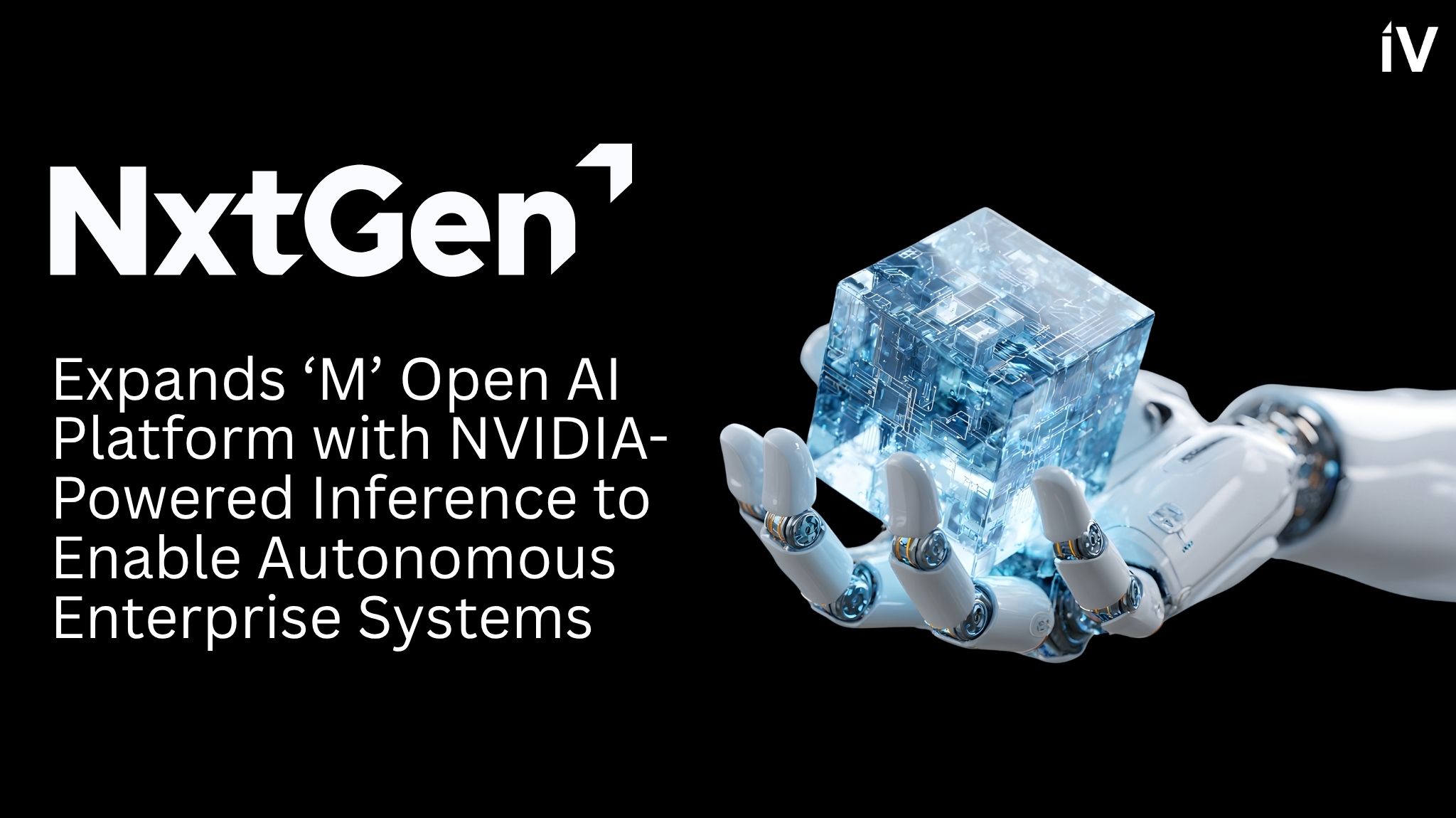
NxtGen, India, has introduced its first sovereign, enterprise-grade agentic AI inferencing platform designed to move businesses beyond AI-assisted insights to fully autonomous decision-making. Built on open AI models and accelerated computing, the platform delivers production-scale reasoning capabilities while ensuring complete data residency and regulatory compliance within the country.
The key features are:
- Agentic AI inferencing for autonomous decision-making
- Integration with enterprise systems (ERP, CRM, HRMS, ITSM)
- Multimodal AI with language, vision and speech capabilities
- Sovereign cloud deployment with full data residency control
- GPU-optimised, low-latency inference for large-scale workloads
At its core, the platform serves as an intelligent inference layer that integrates AI models directly with enterprise systems, including ERP, CRM, HRMS, and IT service platforms. This allows organisations to translate natural-language intent into structured actions, enabling AI-driven workflows that can execute tasks, make decisions, and continuously learn from enterprise data.
Unlike traditional AI copilots that focus on recommendations, the platform is designed for agentic execution. It combines large language models (LLMs), vision-language models (VLMs) and speech AI to support multimodal interactions, including voice-driven commands in multiple regional languages. The system also leverages open-source frameworks, giving enterprises flexibility, transparency and freedom from vendor lock-in.
A key differentiator is its sovereign architecture. The platform operates entirely within India-based cloud environments, ensuring that enterprises retain full control over their data, models and inference pipelines. This aligns with growing regulatory requirements around data localisation and security, particularly for sectors such as finance, government and healthcare.
The platform also introduces verticalized AI applications, with travel being an early use case. Here, the system can convert user intents, such as planning a business trip with specific constraints, into executable itineraries by connecting to real-time global travel inventory. This demonstrates how agentic AI can bridge the gap between planning and transaction-ready outcomes.
Supporting this capability is a high-performance AI infrastructure stack designed for population-scale workloads. It enables large-scale model training, fine-tuning, and low-latency inference, making it suitable for enterprise, startup, and government deployments.
As enterprises increasingly seek to operationalise AI, this launch signals a shift toward secure, scalable and autonomous AI systems built within national digital ecosystems.