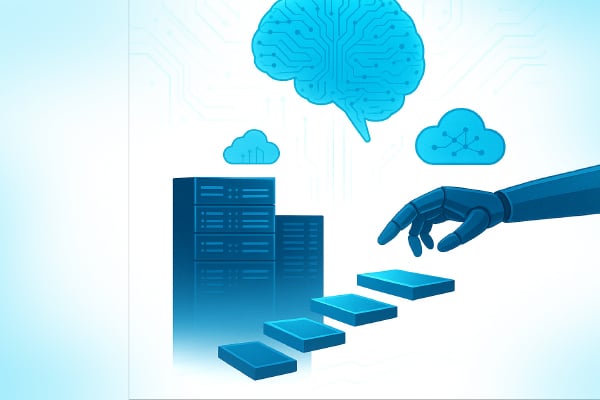
Today’s complex IT environments are best managed by AIOps, which does not replace but adds an intelligence layer to traditional DevOps.
In today’s world of ITOps, DevOps, SRE (site reliability engineering), and platform engineering, one trend is impossible to ignore — our systems are getting more complex and faster than we can manage manually.
Applications are no longer simple workloads on a single server. They’re built from microservices, deployed across hybrid clouds, run in containers, and are sometimes even pushed to edge devices. This interconnected web of technology generates a constant flood of logs, metrics, and alerts — a scale of information that’s overwhelming traditional operations teams.
For years, DevOps has been our go-to approach for delivering software faster and more reliably, thanks to automation, CI/CD, and improved collaboration. But let’s face it — staring at dashboards 24/7 and chasing alerts has become unsustainable.
This is where AIOps steps in.
What is AIOps?
Think of AIOps — artificial intelligence for IT operations — as an AI-powered co-pilot for your ops team.
Instead of waiting for something to break and then scrambling to fix it, AIOps platforms:
- Monitor systems in real time
- Detect problems before they escalate
- Pinpoint root causes instantly
- And sometimes fix issues automatically
The aim isn’t to replace people, but to augment them. Teams set the strategy and guardrails, while AI handles the heavy lifting of analysing huge volumes of data and highlighting what matters most.
From DevOps to AIOps: An upgrade, not a replacement
AIOps doesn’t replace DevOps — it evolves it.
With traditional DevOps, automation and collaboration are in place, but incident detection and decision-making remain human-led and reactive. AIOps adds an intelligence layer — spotting patterns, predicting scaling needs, and even executing fixes before problems hit production.
Where AIOps makes an impact
Some of the most valuable applications of AIOps include:
- Root cause analysis: Reduces mean time to resolution (MTTR) by finding the exact source of problems.
- Proactive monitoring: Spots anomalies before they affect users.
- Predictive scaling: Anticipates demand and adjusts resources automatically.
- Anomaly detection: Flags unusual patterns in applications or infrastructure.
- Agentic AIOps for on-call: Guides engineers during incidents with runbook and log analysis.
- Change impact prediction: Highlights risks from code, configuration, or infrastructure changes.
The players to watch
AIOps is being shaped by both established platforms and custom solutions.
- Datadog AIOps: Strong anomaly detection and incident insight.
- New Relic Applied Intelligence: AI-driven data correlation.
- Moogsoft: Reduces alert noise through intelligent event correlation.
- IBM Watson AIOps: Natural language processing for smarter incident handling.
- ServiceNow AIOps: Built directly into ITSM (IT service management) workflows.
- Custom implementations: Combining GPT, Grafana, Prometheus, and runbooks for tailored automation.
Comparing traditional DevOps and AIOps-driven DevOps
| Aspect | Traditional DevOps | AIOps-driven DevOps |
| Focus | CI/CD, automation, collaboration | Intelligent automation, proactive action |
| Data handling | Manual analysis, dashboards | AI-driven, real-time correlation |
| Incident response | Reactive | Predictive and autonomous |
| Scalability | Limited by human capacity | Grows with data volume and complexity |
| Decision-making | Human-led | AI-assisted or AI-led |
Adoption challenges
As promising as it is, AIOps isn’t a plug-and-play solution.
- Data quality: AI’s accuracy depends on clean, well-integrated data.
- Skills gap: Teams may need to upskill in AI, ML, and analytics.
- Cultural shift: Building trust in AI-driven decisions takes time.
The takeaway
AIOps is more than a buzzword — it’s the natural next step in managing increasingly complex IT environments. It moves us from reactive firefighting to predictive prevention, from responding to alerts to addressing problems before they happen.
For organisations willing to invest now, the payoff is significant: reduced operational strain, faster resolutions, and a competitive edge in delivering reliable, high-performing services at scale.