


























































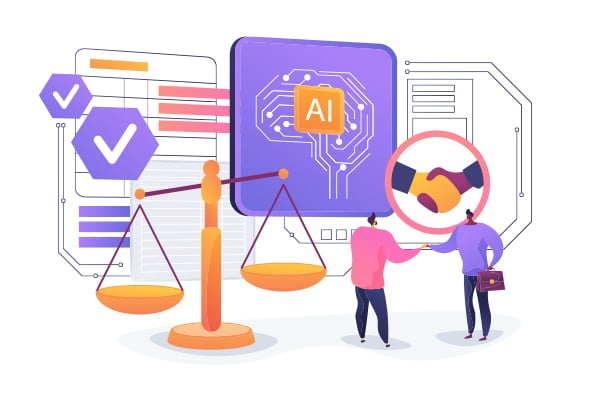

Small businesses tend to think an AI and data governance policy is unnecessary and unimportant for their scale of work. They couldn’t be more wrong…
AI and data governance have largely been positioned as priorities for large enterprises, especially with regulatory frameworks tightening globally. Hence, many large enterprises have developed a detailed AI and data governance policy. However, small and medium enterprises are not that keen to enforce strict policies regarding AI and data governance; they seem to think that their business size and reach make them immune to the consequences of the changing digital world. However, the fact is that due to their limited size and capital, SMEs are even more vulnerable to bias, breaches and other cyber threats. Moreover, unlike large companies they don’t have the cushion to cover the damage and bounce back from a breach — a key point to focus on as AI misuse has increased the scope of cybercrime multifold.
Why SMBs should be serious about data governance
While small businesses are increasing the use of AI tools like AI agents, recommendation engines, email automation, or predictive analytics for their in-house as well as customer facing operations, they lack robust internal frameworks to evaluate the logic behind how their AI tools work. They aren’t keen to know how AI gathers the data, processes it, or makes decisions that will impact their customers. This can lead to bias, operational discrepancies and privacy violations.
Proper governance helps SMEs to build the scaffolding to safeguard their brand, ensure uniform customer experience and gain clients’ trust. This is more than about mere compliance. It is an opportunity to enhance your organisation’s reputation and revenue potential while avoiding pitfalls.
How to implement AI and data governance in small or medium enterprises
Many small businesses look at an AI and data governance policy as a complex document with jargon-rich language. This is not true. You can easily draft a policy by following these basic steps.
Prepare a simple policy in plain language: Write a simple, jargon-free draft defining the volume and type of collected data, its usage, storage location, and the specific AI tools employed. Then clearly define the acceptable use cases. Keep in mind that not all the employees will be able to decipher the meaning behind technical terminology. So, use plain, comprehensible language.
Refer to publicly available frameworks: If you are struggling to draft the initial AI policy framework, refer to similar frameworks that are publicly available like:
- NIST AI Risk Management Framework
- Singapore’s Model AI Governance Framework
- ISO/IEC 42001 (AI Management System Standard)
- These provide ready-to-use checklists and guiding principles without cost.
Embed with current processes: To keep the process simple, just add AI/data policies into existing policies for HR, IT, or procurement policies. You may appoint an internal IT team member to check basic data quality and outputs of the AI model.
Define accountability of vendor/tool if using third-party solutions: If you are using third-party AI solutions, ask vendors about the source they use to collect the data, privacy protocols, model training process, and how they mitigate the bias. You can draft your own framework based on that information.
Ensure transparency: When integrating AI on your site, clearly mention the specific features powered by AI. Also publish how the customer’s data will be used. Provide easy opt-out provisions for customers unwilling to share their data. This transparent approach will help gain the confidence of your customers.
Periodical auditing and updating: Review your AI/data policy on a half-yearly basis. Based on the latest versions or updates of the AI model, optimise the rules pertaining to fairness, privacy, relevance, and accuracy. Regular auditing can help evolve the policy with time.
Here are some use cases of how an SMB can benefit from regular reviews of its AI and data governance policy.
- If the algorithm in a food delivery app, which uses an AI-based model for recommendations, is set to push only high-margin items it will restrict the organisation’s sales opportunities. Through regular auditing the algorithm can be optimised to include items across diverse price points, which will attract customers that have different budgets.
- A gym employing AI-based attendance analytics may discover that RFID data has led to an incorrect no-show report. When the flaw is revealed in periodical reviews, the gym can optimise the rule logic to ensure accuracy.
AI and data governance empower small businesses to adopt sustainable and responsible digital practices. While these enterprises may see this as unnecessary and complex, the reality is that data governance can strengthen their business. SMEs just need to draft a simple framework by leveraging the publicly available policies and moving in small but consistent steps. A well-drafted AI and data governance policy can help SMEs defend their organisations against vulnerabilities, avoid compliance issues, and ensure efficiency of their AI models.