



















































Constant evolution in the Python programming language has made it a coveted language for AI / ML application development.
Python is perhaps the most popular language for AI and ML application development. Its rich libraries and tooling streamline everything from rapid prototyping to production deployment, while built-in data structures and libraries make preprocessing, exploration, and manipulation of datasets straightforward and efficient.
Python streamlines rapid AI/ML application development, automates machine learning workflows, and supports innovation and integration with cloud platforms and IoT for AI/ML applications. For developers, Python combines productivity, community support, and production-grade capabilities, making it the natural choice for building, training, and deploying intelligent systems.
Python continues to evolve, yet many developers still rely on the techniques they first learned. Those legacy approaches are not inherently wrong, but can hide newer, more efficient patterns, libraries, and idioms that improve performance, readability, and maintainability. Regularly updating skills, adopting modern libraries, idiomatic constructs, and contemporary tooling reduces bugs, speeds development, and smooths the path from prototype to production.
Python adoption in the industry
Python powers over half of global data science projects and holds a commanding lead in industry adoption. The TIOBE Programming Community Index (December 2025) shows Python ranked #1 with a 23.64% share, ahead of C (10.11%) and C++ (8.95%), making it the most popular programming language for AI and ML. Over 51% of all data science projects worldwide are built with Python. More than 1.25 million open positions globally require Python skills, with senior ML developers earning up to $200,000 in the US.
Python powered 41% of all AI-generated code in 2025, with 256 billion lines written by AI assistants like GitHub Copilot. The Python IDE market was valued at US$ 559 million in 2025 and is expected to grow at 8.1% CAGR through 2033.
Netflix’s recommendation algorithm processes over 1 billion hours of content using Python-based machine learning models.
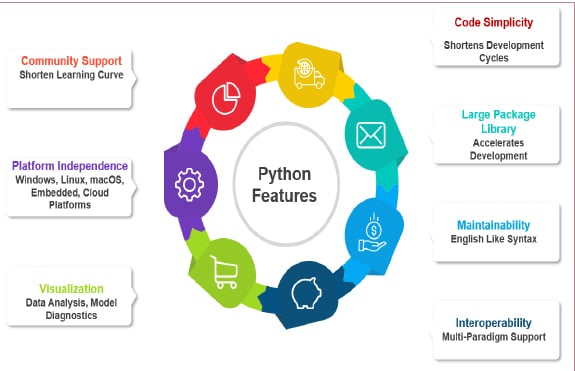
The characteristics of Python are:
- Processed at runtime by the interpreter. No need to compile the program before executing it.
- Can run in an interactive mode, i.e., program can be written in a command line shell, which gives immediate output for each statement.
- Cross-platform — works on different platforms like Windows, Linux, Mac, etc.
- Easy to learn and use; developer-friendly.
- Easy to read and understand; the syntax of Python is like English statements.
- Libraries offer a wide range of modules and functions that support fast application development.
- Easily integrated with other languages like Java, C/C++, etc.
- Provides interfaces for a large set of databases.
- Supports object-oriented style of programming that encapsulates code within the object.
- Has a variety of basic data types like integer, floating point number, string (both in ASCII and Unicode), list, dictionaries, etc.
- Code can be grouped into packages and modules.
- Automatic memory management deallocates the memory instead of manually handling it in the code.
- Web applications can be developed using Python. It provides libraries to handle protocols like HTML, XML, JSON, requests, etc. Various frameworks such as Django, Pyramid, etc, are available for web application development.
- Provides various libraries and packages like SciPy, Pandas, IPython, etc, for developing numeric and scientific computations using Python.
Python libraries for AI/ML
The most popular Python libraries for AI/ML development are:
- Scikit-learn for data mining and analysis, which optimises Python’s machine learning usability.
- NumPy, which is used for scientific calculations.
- SciPy, which is used for advanced computation covering natural language processing (tokenization, named entity recognition, parsing).
- Pandas offers developers high-performance structures and data.
- TensorFlow for building an end-to-end deep learning platform for production tools and the deployment ecosystem.
- PyTorch, a deep learning library with strong production tooling used to build deep learning models.
- MLflow, which is used for model registry and deployment tooling for ML lifecycle management.
- LightGBM, a memory-efficient gradient-boosting library from Microsoft with GPU support.
- Keras, a high-level deep learning API used in model prototyping and training.
Best practices for using Python
Many seasoned Python developers find themselves coding on autopilot—relying on patterns learnt years ago simply because they still “work.” Yet, while those habits persist, Python has quietly evolved, introducing subtle but powerful conveniences that often go unnoticed.
The following table describes the usage of Python operators/features in the old and the new patterns, and when to use them.
| Operator/Feature | Old pattern | New pattern | Usage scenario |
| Walrus Operator (: =) | line = f.readline()
while line: process(line) line = f.readline() |
while (line := f.readline()):
process(line) |
Reading files, sockets, or buffers;
Reduces duplication and prevents subtle bugs during refactoring |
| pathlib | import os
p = os.path.join(“data”, “logs”, “2024”, “today.txt”) |
from pathlib import Path
p = Path(“data”) / “logs” / “2024” / “today.txt” |
Any script that manipulates files or folders;
Cross-platform projects |
| Dictionary Merge (|) | merged = base.copy()
merged.update(overrides) |
merged = base | overrides | Config layering;
Merging dictionaries without mutating originals |
| f-String Debugging | print(“result =”, result) | print(f”{result=}”) | Removes small but frequent debugging annoyances;
Logging temporary values; Printing multiple variables |
| Dataclasses | class Product:
def __init__(self, name, price): self.name = name self.price = price |
from dataclasses import dataclass
@dataclass class Product: name: str price: float |
Data containers (ETL rows, JSON models, config objects);
Cases where you want readable print/debug outputs |
| perf_counter() | import time
start = time.time() |
from time import perf_counter
start = perf_counter() |
Comparing two algorithms, measuring database calls, or tuning ML preprocessing;
Performance diagnostics |
| Structural pattern matching | if event[“type”] == “login”:
… elif event[“type”] == “logout”: … |
match event:
case {“type”: “login”, “user”: u}: handle_login(u) case {“type”: “logout”, “user”: u}: handle_logout(u) |
Handling multiple event types;
Parsing structured data (JSON, logs); Readability is collapsing under if/elif chains |
| DuckDB | import pandas as pd
df = pd.read_csv(“large.csv”) |
import duckdb
df = duckdb.query(“SELECT * FROM ‘large.csv’”).df() |
Loading large CSVs or Parquet files;
Running analytics without putting strain on memory; Exploratory work where SQL is more natural than Pandas |
| with statements | f = open(“data.txt”)
data = f.read() f.close() |
with open(“data.txt”) as f:
data = f.read() |
File handles, DB connections, sockets, locks |
| enumerate() | i = 0
for item in items: print(i, item) i += 1 |
for i, item in enumerate(items):
print(i, item) |
Listing items, debugging loops, generating numbered outputs |
Key open source packages in Python for machine learning
There are many open source packages in Python for addressing ML problems, and can be used based on the nature of the issue.
NumPy
This library provides support for large, multi-dimensional arrays and matrices, along with a large collection of high-level mathematical functions to operate on these arrays.
It handles linear algebra, Fourier transforms, and random numbers. It interoperates with other libraries like Mat-plotlib, SciPy, scikit-learn and TensorFlow. NumPy is widely used for handling sound waves, images, and other binary functions
Scikit-learn
This provides a broad range of machine learning functions like classification, regression, clustering, dimensionality reduction, model selection, and preprocessing.
The scikit-learn developer team maintains a strong focus on code quality and comprehensive documentation with the help of the open source community. It can interoperate with the numeric and scientific libraries of Python like NumPy and SciPy.
Theano
This scientific computing library allows defining, optimising, as well as evaluating mathematical expressions. Theano helps make data-intensive calculations up to a hundred times faster than when executing these on the CPU alone.
Well-optimised for GPUs, it offers effective symbolic differentiation and includes extensive code-testing capabilities. Theano can automatically avoid errors and bugs when dealing with logarithmic and exponential functions, and has built-in tools for unit testing and validation.
TensorFlow
An end-to-end library for performing high-end numerical computations, it can handle deep neural networks for image recognition, handwritten digit classification, recurrent neural networks, NLP (natural language processing), word embeddings and PDE (partial differential equation).
It supports a variety of different toolkits for constructing models at varying levels of abstraction. Its flexible architecture helps it run on CPUs, GPUs, and TPUs.
Keras
Used for constructing neural networks and machine learning projects, Keras interoperates with TensorFlow, Theano and R, and can run efficiently on CPUs and GPUs.
It offers standalone modules including optimisers, neural layers, activation functions, initialisation schemes, cost functions, and regularisation schemes. Keras functions as a user-friendly, extensible interface that enhances modularity and total expressiveness.
PyTorch
This supports computer vision, machine learning, and natural language processing. It integrates well with the Python data science stack, including NumPy.
It has a robust framework to build computational graphs on the go and even change them in runtime. It supports Tensor computations with GPUs, and helps with performance optimisation and scalable distributed training in research as well as production.
Pandas
It offers a wide range of tools for data manipulation and analysis. Using this highly stable library, we can read data from various data sources like CSV, SQL databases, JSON files, and Excel. It can handle tabular data, time series data, matrix data, etc, and has two types of data structures — data frames and series.
XGBoost
This optimised gradient‑boosting library for tabular data delivers strong performance and scalability in classification and regression tasks.
MLflow
This tool for the ML lifecycle is used for experiment tracking, model registry, and deployment workflows.
ONNX
This is another tool for the ML lifecycle, which is used for model interchange and runtime portability across frameworks.
Industry use cases of Python-based AI/ML
Healthcare
Python-based ML applications help to monitor and predict diseases, detect injuries, scan health parameters of patients regularly, etc. ML is used to discover new drugs and help diagnose diseases more accurately, apart from the automation of administrative tasks and patient management systems.
Banking and finance
Fintech industries stand to gain much by using AI and ML applications because these can help in customising the user experience and detecting fraud, two major concerns of this industry.
In addition, ML is used to detect customer attrition, loan defaulter prediction, fraud detection, credit scoring, money laundering prevention, and portfolio management.
E-commerce
AI and ML-based solutions help businesses to create a better customer experience and increase their sales revenue. ML helps in content personalisation, chatbots for improving performance, dynamic pricing, identifying shoppers’ data patterns, and predicting how responsive they may be to new prices.
Insurance
Python can help insurance companies provide robust solutions for risk management, fraud management, personalised services, automation, customer support, etc.
Quantum computing
Organisations are leveraging quantum algorithms for complex problem-solving in cryptography and drug discovery, with Python serving as the primary interface for quantum programming.
Tech giants like Google, Netflix, Instagram, and Dropbox rely heavily on Python for ML and backend systems.
Innovative services powered by machine learning are already reshaping industries. Python developers have kept pace with this disruption by introducing cutting-edge libraries, frameworks, and approaches that simplify the adoption of advanced machine learning techniques. Businesses can now harness these tools to enhance performance, optimise operations, and deliver superior customer experiences with greater ease.
In essence, Python’s steady evolution paired with its thriving ecosystem ensures that developers remain equipped to tackle modern challenges, from everyday coding efficiency to industry-scale innovation. Not only is Python part of the AI revolution, but it’s also setting the pace.
Disclaimer: The views expressed in this article are that of the authors and Tricon Solutions LLC and Gspann Technologies, Inc., do not subscribe to the substance, veracity or truthfulness of the said opinion.