




























































This overview of the differences between Kubernetes and Docker Swarm will help DevOps developers determine the right container orchestration tool for their project.
Let’s assume your app is a huge success with many people using it, and you need to run it on multiple servers to handle the large usage. This means there will be a lot of containers to manage and doing so manually could be a problem moving forward.
This is where container orchestration is useful as it helps automate various tasks such as setting up containers, scaling them up and down, connecting them to each other, and ensuring everything is operating well.
Kubernetes and Docker Swarm are two of the most popular container orchestration tools. Both assist you in many ways to manage containers, but they are different and are built for different use cases.
So, which one should you choose? Let’s find out.
What is container orchestration and why is it important?
Developing applications using containers is normally straightforward at the start. You typically have only a couple of containers on your local machine, or on one server, using tools like the one provided by Docker to manage them. However, as you build your application, you may have dozens, or hundreds, of containers distributed across multiple servers. When you get to that stage, it is impractical to work through everything manually, as it is too time-consuming and mistakes are easy to make.
This is where the concept of container orchestration comes into play. This is a system that helps to automate the entire process of deploying containers — starting them, connecting them together, scaling them according to demand, and keeping them running. Instead of deploying each aspect manually, orchestration will ensure your container deployments are done in an intelligent, cost-effective, and uniform way.
DevOps workflows are about achieving everything at speed with consistency and reliability. Orchestration tools help the team to:
- Eliminate manual deployment of containers on all environments for every release.
- Scale up or down based on traffic demand and requirements.
- Load balance between containers so that no container gets overworked with too much traffic.
- Manage the networking environment regardless of the number or type of containers.
- Monitor the health of each container and restart or replace any failed containers.
Initially, a straightforward tool like Docker Compose will suffice if you’re managing a small number of containers. But as soon as you start dealing with many servers, regular coding updates, increased traffic, or a microservices-based architecture, container orchestration will be more than something nice to have — it will be necessary. Without it, it will be hard to have complex applications run reliably, even when you start things small and scale from there.
Key differences between Kubernetes and Docker Swarm
| Feature | Kubernetes | Docker Swarm |
| Ease of setup and configuration | Complex setup; requires deep configuration | Quick and easy to set up with docker swarm init |
| Scalability and high availability | Designed for massive scale with robust high availability features | Can scale, but with limitations in complex topologies |
| Load balancing and networking | Advanced network management with built-in DNS and Ingress controllers | Simpler overlay network with basic load balancing |
| Deployment and rollback | Declarative deployments with rollout and rollback | Rolling updates with less control over state transitions |
| Storage management | Persistent volumes, storage classes, dynamic provisioning | Limited storage drivers and persistent volume support |
| Monitoring and logging | Rich ecosystem including Prometheus, Grafana, Fluentd | Requires external tooling, limited built-in options |
What is Kubernetes?
Kubernetes, abbreviated as K8s, began as a Google-propelled project. It is derived from the internal Google container orchestration system, Borg, which manages containers at scale. In 2014, Google open sourced Kubernetes. Now Kubernetes is maintained by the Cloud Native Computing Foundation (CNCF) and has become the leading container orchestration system in the world.
So, what makes Kubernetes so powerful?
The architecture of Kubernetes is the foundation of the platform. The smallest unit you can deploy is a pod, which is deployed on nodes (the worker machine in the cluster). The control plane is where all the magic happens — it tells pods where to run and monitors the system’s health, while ensuring the latter is always in sync with the desired state.
Kubernetes is feature-rich. You have kubectl for managing things via the command line, kubelet for some node-level management, Helm for managing complex applications, and Operators for automating lifecycle management tasks. All these tools give developers and DevOps teams the confidence to develop and manage even the most complex systems.
Kubernetes can be used in large-scale, production-grade environments. It is used in multi-cloud setups, distributed applications, as well as enterprises that require a highly automated, highly available and highly customisable environment.
Decision factors by use case
| Use case | Kubernetes | Docker Swarm |
| Scale | Handles thousands of containers and nodes | Best for small to medium-sized setups |
| Complexity | Great for complex microservices | Ideal for simpler applications |
| Setup and maintenance | Requires expertise and time | Easy and quick to set up |
| Ecosystem and tooling | Large ecosystem, many integrations | Smaller ecosystem, fewer integrations |
| Cloud environment | Supports multi-cloud and hybrid environments | Mostly suited for simpler cloud/on-prem |
| Operational overhead | Higher, needs dedicated DevOps/SRE | Lower, simpler to manage |
What is Docker Swarm?
Docker Swarm is Docker’s native container orchestration tool. In contrast to K8s which began as a larger, more complex project, Swarm was natively integrated into Docker from the start to keep its architecture simple and user-friendly.
Essentially, Docker Swarm allows you to virtualise a group of Docker hosts into a single Docker engine. Swarm implements a simple architecture. Its managers control a cluster and schedule tasks, and workers run the actual containers. What you’ll hear about in Swarm are services, which define what to run, and tasks, which are the individual containers that run on nodes (Figure 1).
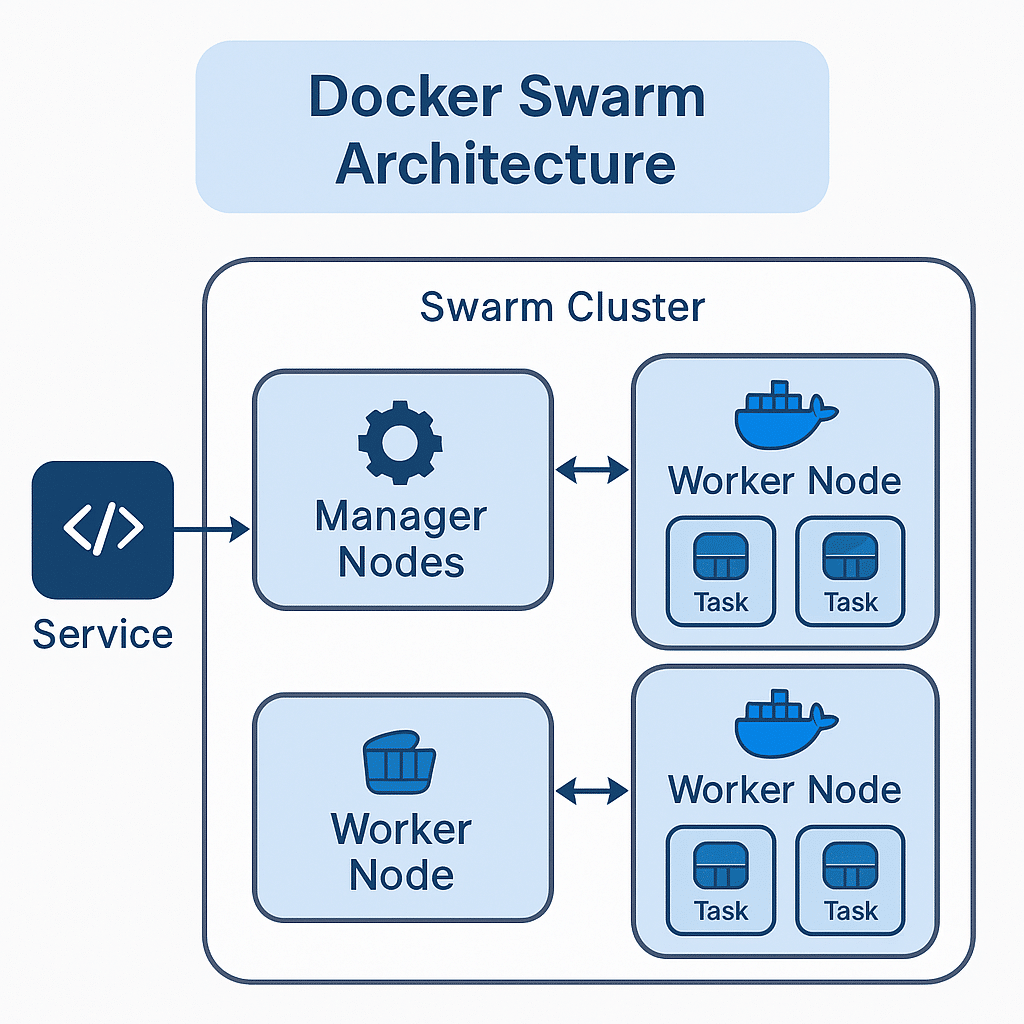
One of the primary benefits of Docker Swarm is its simplicity of setup. You can turn most Docker environments into a Swarm cluster with a command like docker swarm init. That’s particularly attractive for smaller teams or projects focused on getting up and running quickly and that don’t require complex feature sets.
Docker Swarm fits well into small to medium environments, development pipelines, or startups where simplicity and iteration speed outweigh complexity and feature richness. It complements existing Docker tooling, so if your team already uses Docker, it feels very natural and intuitive.
Docker Swarm doesn’t have the level of ecosystem or depth of features that Kubernetes provides but it can be a practical, lightweight solution for orchestrating containers with little complexity.
When to choose Kubernetes
Kubernetes is an advanced tool that is typically used when you have quite advanced needs. Using Kubernetes is justified:
- When you need to orchestrate large-scale deployments, managing hundreds or thousands of containers on many servers.
- When you have a complex microservices architecture where services need advanced orchestration to stay connected, talk to each other, and function harmoniously.
- When your application has a multi-cloud or hybrid cloud environment, with your application residing across different cloud providers or a mixture of cloud and on-prem infrastructure.
- When you have a solid DevOps team or SRE support to manage the learning curve associated with Kubernetes and are prepared to take advantage of its advanced features’ as they are needed.
When to choose Docker Swarm
Docker Swarm is a great option when your project needs speed and simplicity. You should consider Docker Swarm if you have:
- Less complex projects, or are part of a startup, and want to act fast while avoiding the complexities of setup.
- Development and testing cycles that need to be quick and efficient, which allows for fast container deployments and updates.
- Teams that have some experience with Docker, and you want to build off their previous knowledge without bringing in a new system.
- A need for a low operational overhead, and want to spend less time managing the orchestration tool itself.
Companies like Netflix and Spotify run massive, complex applications with millions of users worldwide. They need to manage thousands of containers across multiple data centres and clouds. Kubernetes helps them by automating deployment, scaling services up or down based on demand, and keeping the system highly available. Its strong ecosystem and flexibility make it ideal for these large-scale, mission-critical systems.
Final verdict
There’s not one perfect tool for every situation. Which one is best for you will depend on the size and complexity of the project, proficiency of your team, and future objectives.
If you’re taking on something huge and/or complex, Kubernetes is the best tool for the job. It was designed for large scale workloads across clouds and clusters, and although it can make your deployments more complex and take longer to learn, that cost may be justifiable.
If you want simplicity and speed, and your project is smaller, or you’re just getting started, Docker Swarm can get you started with very little overhead.
Always consider:
- How steep the learning curve is.
- How much time your team can spend managing infrastructure.
- Whether your app is likely to grow in scale or complexity.
The best way to decide? Test both in a sandbox environment and see what works best for your workflow.