


















































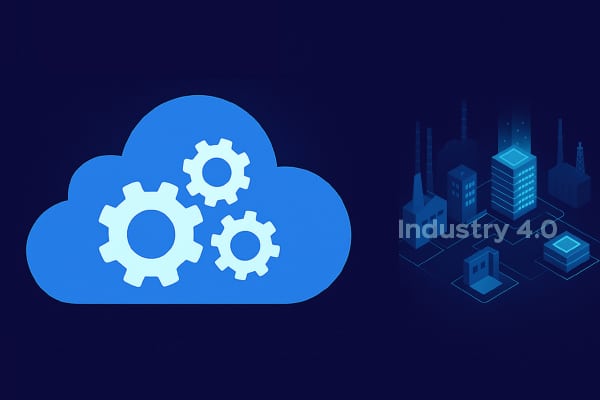

Microsoft, Amazon and Google have introduced industrial clouds to fulfil the demands of Industry 4.0. These cloud services meet the special requirements of industrial companies in the AI age.
Industry 4.0, the fourth industrial revolution, is reshaping the way organisations design, manufacture, operate, and service their products and processes. To thrive in this new era, industrial organisations need to leverage the power of cloud computing, artificial intelligence (AI), and the Internet of Things (IoT) to optimise their operations, enhance their productivity, and innovate faster.
However, the industrial sector also faces unique challenges and has requirements that demand a specialised and tailored approach to cloud computing. These include:
- The need to integrate and manage heterogeneous and legacy systems, devices, and data sources across different locations and environments, such as factories, warehouses, offices, and field sites.
- The need to ensure high levels of security, privacy, compliance, and reliability for sensitive and mission-critical industrial data and applications, especially in regulated and complex industries, such as manufacturing, energy, healthcare, and transportation.
- The need to address the skills gap and talent shortage in the industrial workforce, as well as to empower and enable workers with the right tools and information to perform their tasks more efficiently and effectively.
- The need to deliver scalable, flexible, and cost-effective solutions that can adapt to the changing and dynamic needs and demands of the industrial market and customers.
Industrial clouds
To address these requirements, Microsoft, Google and Amazon have developed the industrial cloud (Table 1), which enables industrial organisations to:
|
Cloud service provider |
Options and capabilities for training |
Options and capabilities for accuracy and precision |
Options and capabilities for NLP |
|
Microsoft |
Advanced and flexible options and capabilities for training, using various methods and modes, such as supervised, unsupervised, semi-supervised, and reinforcement learning, as well as various degrees of automation, such as manual, automated, and hybrid. |
A limited and nascent portfolio of options and capabilities for providing and ensuring high levels of accuracy and precision, mainly focused on data and model management, using various types of data and information, such as text, speech, image, video, and audio. |
A unified and simplified way of building, deploying, and managing large language models and natural language processing technologies and services, such as AutoML, AI Platform Text, AI Platform Speech, and Cloud Translation, which can generate and process various types of natural language, such as text and speech. |
|
Amazon |
A moderate and diverse portfolio of options and capabilities for training, using mainly supervised and unsupervised learning, as well as some degree of automation, such as semi-automated and fully automated. |
A comprehensive and mature portfolio of options and capabilities for providing and ensuring high levels of accuracy and precision, using various types of data and information, such as text, speech, image, video, and audio, as well as various methods and techniques, such as data labelling, data quality, data augmentation, and model testing. |
A fragmented and complex way of building, deploying, and managing large language models and natural language processing technologies and services, such as Amazon Comprehend, Amazon Polly, Amazon Transcribe, and Amazon Translate, which can generate and process various types of natural language, such as text and speech, but require more integration and configuration efforts. |
|
|
A limited and narrow portfolio of options and capabilities for training, using mainly supervised learning, but with a high degree of automation. |
A moderate and emerging portfolio of options and capabilities for providing and ensuring high levels of accuracy and precision, using mainly text and speech data and information, as well as some methods and techniques, such as data labelling, data quality, and model testing. |
A comprehensive and advanced way of building, deploying, and managing large language models and natural language processing technologies and services, such as Google Cloud AutoML Natural Language, Google Cloud Natural Language API, Google Cloud Speech-to-Text, and Google Cloud Translation API, which are capable of generating and processing various types of natural language, such as text and speech, but require more technical and domain expertise. |
- Build, deploy, and manage large-scale and complex industrial solutions using various methods and modes of training, such as supervised, unsupervised, semi-supervised, and reinforcement learning, as well as various levels and degrees of automation, such as manual, automated, and hybrid.
- Provide and ensure high levels of accuracy and precision for industrial solutions, mainly focused on data and model management, using various types of data and information, such as text, speech, image, video, and audio.
- Simplify and unify the development and deployment of natural language processing (NLP) technologies and services.
Cost benefits of using the industrial cloud
Industrial cloud solutions offer a range of cost benefits that can significantly impact the financial health and operational efficiency of industrial companies.
Reduced infrastructure costs
- Hardware savings: By moving to the cloud, companies can avoid the substantial upfront costs associated with purchasing and maintaining hardware. Cloud providers manage the infrastructure, reducing the need for on-premises servers and data centres, which cuts down on power costs and the requirement for physical space.
- Lower maintenance costs: Cloud providers handle maintenance, repairs, and upgrades, freeing up in-house IT staff to focus on more strategic initiatives rather than routine maintenance tasks.
Enhanced scalability at lower costs
- Pay-as-you-go model: Cloud computing offers a pay-as-you-go pricing structure, allowing companies to pay for services only when they are used. This model eliminates the need for overprovisioning and reduces costs associated with unused capacity.
- Scalability: Companies can quickly scale up or down to meet changing business demands without the need for significant capital investments in hardware or software.
Labour efficiency
- Reduced IT staff: With cloud providers managing the infrastructure, companies can reduce their IT staff size or reallocate personnel to more valuable tasks, leading to lower labour costs.
- Increased productivity: Cloud solutions can be deployed quickly, reducing the time employees spend on setup and configuration, thus increasing overall workforce productivity.
Improved operational efficiency
- Automated processes: Cloud-based solutions can automate various processes, such as supply chain management and production planning, reducing the need for manual interventions and associated costs.
- Real-time data access: Cloud computing enables real-time data access and monitoring, which can lead to better decision-making and reduced downtime, ultimately saving costs.
Capital expenditure reduction
- No upfront costs: Cloud solutions often do not require significant upfront capital expenditures, as companies can subscribe to services on a pay-as-you-go basis.
- Lower risk: The pay-as-you-go model reduces the financial risk associated with software that may not meet business needs, as subscriptions can be cancelled at any time.
Innovation and growth
- Access to advanced technologies: The cloud provides access to advanced technologies like AI, machine learning, and IoT, which can drive innovation and growth without the need for significant investment in infrastructure.
- Faster time-to-market: Cloud computing facilitates faster experimentation with new products and features, enabling companies to bring innovations to market more quickly and efficiently.
Security measures in an industrial cloud
Implementing robust security measures in industrial cloud environments is critical for protecting sensitive data, maintaining operational integrity, and ensuring compliance with stringent industry regulations.
Data protection
Data protection is a critical aspect of industrial cloud security, given the sensitive nature of industrial data and its potential value to competitors or malicious actors.
Encryption:
- ‘Industrial clouds implement’ end-to-end encryption for data both at rest and in transit.
- Utilise strong encryption algorithms (e.g., AES-256) and proper key management practices.
- Employ hardware security modules (HSMs) for secure key storage and management.
Access control:
- They implement role-based access control (RBAC) to ensure users have access only to the data necessary for their roles.
- Utilise multi-factor authentication (MFA) for accessing sensitive data and systems.
- Employ the principle of least privilege to minimise unnecessary data exposure.
Data loss prevention (DLP):
- Implement DLP solutions to monitor and prevent unauthorised data transfers.
- Use data classification tools to categorise data based on sensitivity and apply appropriate protection measures.
Backup and recovery:
- Maintain regular, encrypted backups of critical data.
- Implement and test disaster recovery plans to ensure data can be restored in case of breaches or system failures.
Network security
Securing the network infrastructure is crucial in industrial cloud environments to prevent unauthorised access and protect against cyber threats.
Segmentation:
- Implement network segmentation to isolate critical systems and limit the potential spread of breaches.
- Use virtual private networks (VPNs) for secure remote access.
Firewalls and intrusion detection/prevention systems (IDS/IPS):
- Deploy next-generation firewalls to monitor and control network traffic.
- Implement IDS/IPS to detect and prevent potential security threats in real-time.
Secure communication protocols:
- Use secure protocols such as HTTPS, SFTP, and TLS for data transmission.
- Implement secure API gateways for managing and securing APIs used in cloud services.
Zero trust architecture:
- Adopt a zero trust model, which assumes no user or device is trustworthy by default.
- Implement continuous authentication and authorisation for all network resources.
Compliance with industry regulations
Adherence to industry-specific regulations is crucial for industrial cloud environments to maintain legal and operational integrity.
Regulatory frameworks:
- Ensure compliance with relevant regulations such as GDPR, HIPAA, or industry-specific standards like IEC 62443 for industrial control systems.
- Implement regular audits and assessments to maintain compliance.
Data governance:
- Establish clear data governance policies that align with regulatory requirements.
- Implement data retention and deletion policies in accordance with regulations.
Incident response and reporting:
- Develop and maintain incident response plans that comply with regulatory reporting requirements.
- Conduct regular drills to ensure readiness for potential security incidents.
Current best practices for security
To stay ahead of evolving threats, industrial cloud environments adopt best practices and leverage emerging technologies.
Artificial intelligence and machine learning:
- Utilise AI/ML-powered security tools for anomaly detection and predictive threat analysis.
- Implement behavioural analytics to identify unusual patterns that may indicate security threats.
Containerisation and microservices security:
- Secure containerised applications and microservices architectures using specialised tools and practices.
- Implement runtime application self-protection (RASP) for containerised environments.
Cloud security posture management (CSPM):
- Employ CSPM tools to continuously monitor and manage cloud security risks.
- Automate security policy enforcement across multi-cloud environments.
Quantum-safe cryptography:
- Plan for the transition to quantum-safe cryptographic algorithms to protect against future quantum computing threats.
Automated compliance and security testing:
- Implement automated compliance checks and security testing as part of the CI/CD pipeline.
- Utilise Infrastructure as Code (IaC) security scanning tools to identify misconfigurations before deployment.
Edge computing security:
- Extend security measures to edge devices and gateways in industrial IoT environments.
- Implement secure boot and trusted execution environments for edge devices.
Blockchain for supply chain security:
- Explore blockchain technology for enhancing supply chain transparency and security in industrial settings.
The industry cloud from Microsoft
Microsoft’s industry cloud is an excellent solution for industrial companies that want to leverage the power of cloud computing, artificial intelligence, and the Internet of Things to optimise their operations, enhance their productivity, and innovate faster. It offers the following benefits:
- Provides a seamless and consistent experience across different devices, platforms, and environments, such as Windows, Linux, iOS, Android, and Azure.
- Supports a wide range of industrial scenarios and use cases, such as predictive maintenance, quality control, asset management, process optimisation, worker safety, and customer service.
- Integrates with various Microsoft products and services, such as Microsoft 365, Dynamics 365, Power Platform, Azure IoT, Azure Synapse Analytics, Azure Machine Learning, and Azure Cognitive Services, as well as third-party solutions and partners, to deliver a comprehensive and end-to-end industrial solution.
- Empowers and enables industrial workers with the right tools and information to perform their tasks more efficiently and effectively, such as digital twins, mixed reality, chatbots, voice assistants, and intelligent recommendations.
- Ensures high levels of security, privacy, compliance, and reliability for industrial data and applications, using various features and capabilities, such as encryption, authentication, authorisation, auditing, backup, recovery, and resilience.
- Leverages the power of artificial intelligence, machine learning, and data analytics to optimise industrial processes, improve product quality, enhance customer satisfaction, and generate new business insights and opportunities.
- Supports the development and deployment of innovative and scalable industrial applications and solutions, using various services and tools, such as Azure IoT, Azure Synapse, Azure Machine Learning, and Azure DevOps.
- Fosters a culture of innovation and collaboration among industrial organisations and their ecosystem partners using various platforms and communities, such as GitHub and Microsoft Learn.
This future-ready solution can help industrial companies achieve their digital transformation goals and stay ahead of the competition.