





















































Hermes is an open-source voice assistant that connects an ESP32 to a Windows PC, enabling voice-controlled web searches, computer operations and smart-home automation using published firmware and wiring instructions.
The Open-Source Project Hermes utilizes low-cost hardware from an ESP32 Development Board to develop a push-to-talk Voice Assistant for controlling your windows-based machine as well as other connected smart home devices. The Developer of this project is ROHITCRAFTSYT and uses both Microcontroller Firmware as well as a Python Application on the Computer for Processing Speech Recognition/AI tasks. The Developer has made all Source Code, Wiring Specifications and Setup Instructions available via the MIT Licence, allowing makers to examine the implementation and adapt it for their own projects. The listed build cost is approximately ₹1,500–3,000, depending on the components used.
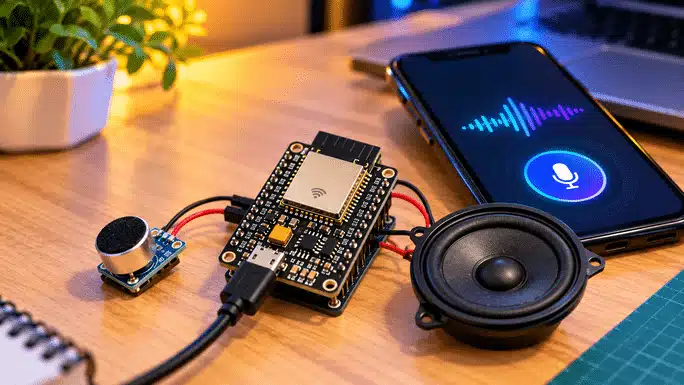
The hardware functions as a microphone as well as an audio interface to the assistant. It consists of an ESP32 development board, INMP441 digital microphone, PTT button, and a MAX98357A I²S amplifier with an 8Ω speaker as an optional component. Pressing the PTT button triggers audio input; releasing it sends the captured sound over Wi-Fi to the computer. The computer processes the request and gives back a voice response either through the computer’s speakers or through the optional ESP32-connected speaker. The firmware currently documented is designed for the standard ESP32. There is also a schematic design for ESP32-S3 in the repository.
In the case of the PC platform, the Hermes application works with Python 3.11 or higher versions for speech recognition, AI model, and text-to-speech services. According to its integration documentation, the application uses Groq for transcription and AI model processing with NVIDIA as the alternative option, whereas voice responses are generated via online speech services. The app can recognize the voice commands for opening apps and web sites and communicating with smart home devices. Additionally, it is able to exchange data with other computers via the optional companion agent.
In terms of documentation, this repository contains the bill of materials, pin-by-pin wiring details, firmware and config templates, Python bridge, and the setup process of the device. Makers have an opportunity to edit configuration files, GPIO pins, and to integrate other hardware components without reinventing the wheel. However, the traditional ESP32 approach lacks the ability to do wake-word detection on the device itself. The main voice processing algorithm is not offline-based either.
Hermes makes available the embedded firmware and software on the computer side, which makes it a customizable version of proprietary voice assistant hardware. The hardware is covered by the MIT licence and can thus be modified according to the conditions of the licence. In addition, it is described how to put together the hardware using common components. Developers need to think about security before providing any kind of access to it remotely or from the computer.
For more information, click here.