















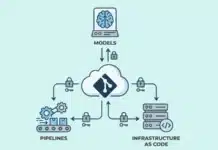


























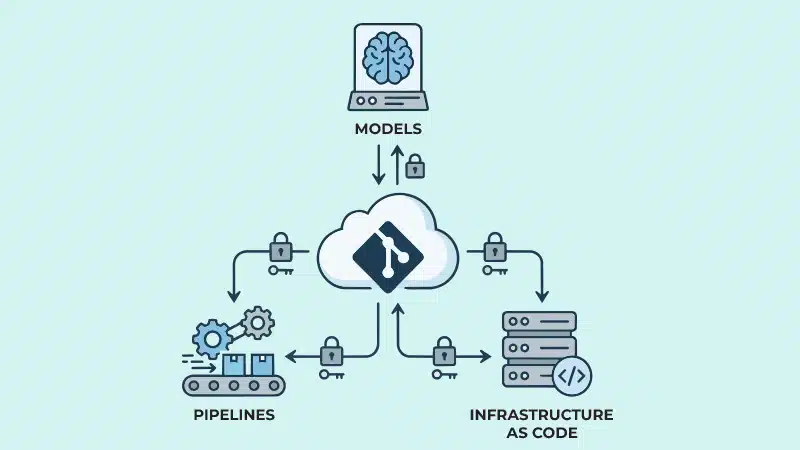

GitOps helps to deal with the complexity of modern AI workloads, with Git serving as the single source of truth for models, pipelines, and infrastructure configurations.
Artificial intelligence and machine learning applications are vital for today’s business operations. Nevertheless, deploying an AI model is a complicated process due to many connected components, such as training code, datasets, model files, data processing pipelines, deployment configurations, and computing infrastructures. The human-centred management of these components can be fraught with configuration mistakes, absence of consistency in environments, and difficulties in getting results.
GitOps introduces a new approach to this process whereby Git functions as the main source of truth for application code, infrastructure configurations, and deployment instructions. After an approved change is submitted to Git, the changes are verified and the required target environment is updated automatically. Therefore, every modification is traceable and reversible.
With Infrastructure as Code, continuous integration, and continuous delivery, the use of GitOps ensures the automated training, testing, deployment, and monitoring of machine learning models and software used in production.
GitOps fundamentals
GitOps is a procedure to deploy applications and manage infrastructure using Git repositories. Git acts as the main reference document. The expected state of the system, application, and infrastructure is included in the version-controlled system files. The files can include descriptions about containers, computing resources, networking specifications, storage requirements, and application versions.
GitOps consists of four main principles. First, the entire system is defined in a declarative way. This means that the configuration files define the desired state, rather than listing the steps needed for the setup. Second, any approved change is kept in the Git repository. This enables creating a full record of what changes have been made, when, and why. Third, automated systems implement the approved amendments. Finally, software programs check the actual state of the system in comparison to the state registered in Git continuously.
The process of checking is known as reconciliation. The GitOps controller reconciles the current state against the approved state and restores the original version if the two do not match.
A typical GitOps workflow starts when a developer updates a configuration file and creates a pull request. Team members review and approve the proposed change before it is merged. An automated controller, such as Argo CD or Flux, then detects the updated repository state and applies it to the Kubernetes environment. If a deployment fails, the team can roll back to a previously stable version stored in Git. Therefore, GitOps provides automation, traceability, consistency and controlled collaboration throughout the deployment process.
Why GitOps for AI workloads?
Unlike conventional computer programs, managing AI workloads is more complex because their performance is influenced not only by software but also by datasets, configuration of models, training flows, and computing environment. A tiny change in data preprocessing, model formulation, or library dependencies can lead to a totally different result. Manual work with these components makes it impossible to replicate a previous experiment or deployment.
GitOps solves this problem by using version-controlled repositories to store configuration files of the AI services. With the help of Git, teams track model configurations, definitions of workflows, versions of containers, deployment instructions and requirements for infrastructure. Everything is recorded in commits and pull requests, which helps track the process better.
Moreover, GitOps ensures uniformity in the development, testing and production stages. For example, a model tested with specific dependencies and resources can be deployed using the same configuration. Thus, problems caused by the difference in environments are eliminated. Once the updated model has been developed, an automated scheme can check its performance, modify deployment configuration, and deploy it.
Another important advantage is controlled model rollback. If a newly deployed model produces inaccurate predictions, excessive latency or unexpected behaviour, the team can restore a previously stable configuration from Git. GitOps controllers also detect unauthorised or accidental changes in the live environment and reconcile it with the approved state.
Therefore, GitOps provides the traceability, reproducibility and automation needed for reliable AI operations. It connects model development with deployment management and helps different teams manage complex AI systems through a common, auditable workflow.
Infrastructure as Code for AI
Infrastructure as Code, or IaC, entails defining and provisioning computing infrastructure via configuration files as opposed to executing it manually. AI applications generally need specialised resources like GPUs or technical infrastructure comprising high-performance storage, container clusters, and scalable computing environments. Manually configuring these resources tends to be tedious and results in inconsistent environments. However, IaC leads to repeatable, versioned, and relatively easy-to-manage infrastructure.
For instance, tools such as Terraform and OpenTofu can describe cloud resources like virtual machines, networks, storage resources, and Kubernetes clusters, while Kubernetes manifests, as well as Helm charts, can specify resources for training ML models, including container image URLs, and CPU and GPU limitations. Such configuration files can be stored in Git for future review before any infrastructure changes are performed.
An AI project may necessitate distinct environments for experimentation, model testing, and real-world deployment. Infrastructure as Code (IaC) allows teams to establish these environments using uniform reusable templates while modifying only certain parameters, thus minimising configuration discrepancies and ensuring consistent behaviour of the model.
The combination of IaC with GitOps means that infrastructure amendments follow a planned process. One member of the team proposes a change by means of a pull request, and the configuration in question is verified automatically. Approved modifications are automatically made in the environment. Previous versions are preserved in Git, which makes revoking changes possible.
So, by regarding computing resources and deployment environments as versioned software components, IaC provides a reliable and replicable base for AI systems.
GitOps workflow for AI pipelines
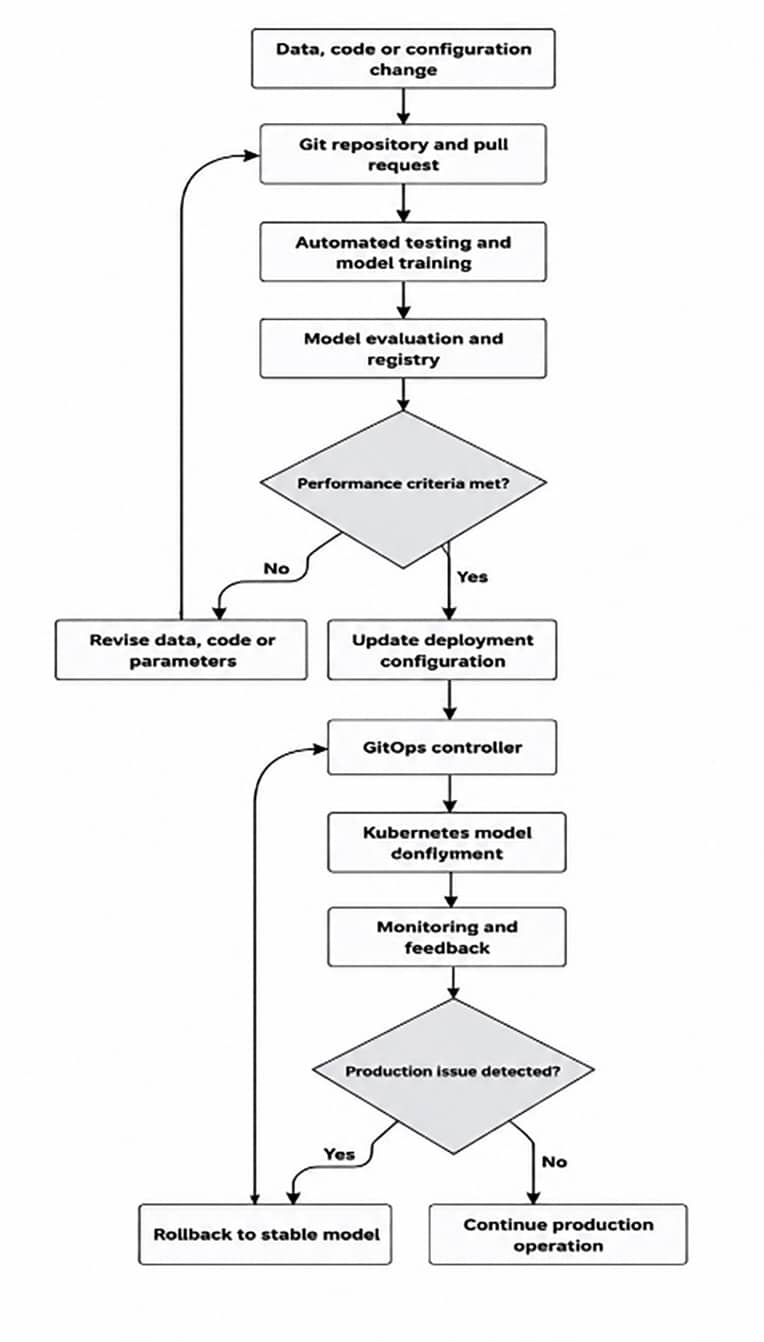
A GitOps workflow for AI pipelines links the process of developing models, conducting automated validation, and deploying the models through repositories under version control. A data scientist starts the process by changing the preprocessing code, the model structure, the parameters of the training, or the configuration of the pipeline. Rather than making the changes straight away in the production setting, the new files are registered in a new branch in Git, and a pull request is created.
The creation of a pull request instigates a process of continuous integration, which involves carrying out all kinds of automated verifications. These checks may consist of code quality checks, validation of data schema, checks for dependencies, unit tests, etc. Once initial checks are completed successfully, the pipeline trains the model based on the approved version of the dataset and creates logs with key training characteristics, such as parameters of the model, duration of the training, quality metrics, and the artifacts generated.
The assessed model is then put to the test according to preset criteria of acceptance. For instance, the system could necessitate minimum accuracy and F1-scores, tolerated inference time, and no considerable decrease in performance compared to the model that is currently used. If the model does not satisfy any required condition, it will be denied, and the development team will receive recommendations for improvement. Otherwise, the successful model will be stored in a model registry with its deployment being updated in Git.
The GitOps controller keeps checking the deployment repository all the time. Once it sees the approved configuration has changed, it synchronises the target Kubernetes environment with the new desired state. The model can be released in a controlled way – for example, canary deployment with only a part of the requests sent to the new model.
After being deployed, the model is monitored with respect to prediction quality, delay, resource usage, data drift, and model drift. If any critical problem arises, the earlier stable version can be reverted via a Git rollback.
Version control and model lifecycle management
Version control is a crucial element of the entire lifecycle of an artificial intelligence model. An AI system features various changing elements, including source code, datasets, preprocessing, model parameters, data obtained because of training, and configuration files that were used for deployment. If these are not stored, the process of recreating the process of experimentation or finding out which version of the model is currently being used becomes almost impossible.
Git manages source code, pipeline definitions and configuration files, and data version control is used for controlling massive datasets and model files. For example, MLflow allows to keep a record of the parameters of the model, evaluation metrics, and results of the experiments.
Successful models can be recorded in the model registry once they are trained. Models that are recorded in this system can be considered belonging to a certain stage of the lifecycle (such as development, validation or staging). A model can be included in production only if it provided positive results during the tests.
When the production version undergoes a declining performance level, uncontrollable delays, or model shift, the team can determine the specific version of the product in question and access its older versions. Once this is successful, it becomes easy to get back to the appropriate model by returning the needed Git settings. This version-controlled lifecycle provides improved reproducibility, management, and responsibility, and includes an accurate log of how each model was made, evaluated, approved, implemented, and substituted.
Comparison of open source tools for AI GitOps
| Tool | Category | Primary purpose | Role in AI workloads | Key strength |
| Git | Version control | Tracks code and configuration changes |
Maintains pipeline and deployment definitions |
Complete change history |
| DVC | Data versioning | Tracks datasets and large model files | Connects data versions with experiments | Reproducible datasets |
| MLflow | ML lifecycle management | Tracks experiments and model versions | Records metrics, parameters and model stages | Central model registry |
| Kubeflow | ML pipeline orchestration | Builds and executes ML workflows | Automates training, evaluation and serving | Kubernetes-native scalability |
| Argo CD | GitOps deployment | Synchronises Git with Kubernetes | Deploys approved model configurations | Continuous reconciliation |
| Flux | GitOps deployment | Automates Kubernetes configuration updates | Maintains the desired deployment state | Lightweight automation |
| Terraform/OpenTofu | Infrastructure as Code | Provisions computing infrastructure | Creates clusters, storage and GPU resources | Repeatable infrastructure |
Open source GitOps ecosystem
The GitOps open source community consists of tools that can assist in various tasks throughout the lifecycle of artificial intelligence — from source code management to infrastructure provision of models. Organisations no longer need to rely solely on a single platform to do their work. They can combine as many tools as their technical needs require.
Git repositories are the basis for this process because they contain the code, pipelines, and deployments in a version-controlled format. DVC expands upon this by keeping track of huge datasets and any other items that can’t be stored inside Git. MLflow, on the other hand, is designed for experiment tracking and model management. Kubeflow allows teams to create scalable machine learning pipelines in Kubernetes. It can perform tasks such as preprocessing, training, validation, and serving of models automatically. Argo CD and Flux serve as GitOps controllers. They are constantly comparing configurations stored inside Git and applied to the Kubernetes environment. Terraform and OpenTofu allow organisations to practice Infrastructure as Code (IaC) by providing cloud resources, networks, storage, and Kubernetes clusters. This way, organisations can use GitOps and create modular AI.
Real world AI GitOps workflow
The real world AI GitOps workflow commences with the data scientist making changes to either the training code, the reference to the dataset, the logic used for the preprocessing, or the parameters of the model. The updated work is committed to a new feature branch, and a pull request is initiated. Before the new changes are merged into the main branch, an automated CI (continuous integration) pipeline has to check the code for correctness, its compliance with the data schema, and its validity with regard to the logical flow of the pipeline.
After the check is finished, the training pipeline loads the appropriate dataset version and executes the training process. Information such as the hyperparameters, the duration of training, the dataset version, and other metrics is collected through a tool for tracking experiments. The trained model is subsequently subjected to evaluation, and it has to meet certain benchmarks.
If the evaluation fails, it is deemed invalid and must be improved. Otherwise, the model is archived in a model registry and assigned a new version. The deployment repository is updated with the information regarding the new model, its image, and the necessary computational resources.
A GitOps controller like Argo CD or Flux finds out about the change and synchronises it with the Kubernetes environment. The new model may first see the light of day through a canary deployment, meaning that it will get only a small share of prediction requests. The monitoring solutions observe its performance in terms of the quality of predictions, latency and health of the system, along with the number of resources used. If the new model performs correctly, it is gradually promoted to be used in production. If there is a major issue, the team can restore the previous working model by reverting the Git configuration.
Benefits, challenges, and best practices
GitOps is advantageous for the management of AI workloads in many ways. It ensures reproducibility by placing model configurations, pipeline specifications and infrastructure configurations under version control, allowing easy tracking of every change in Git. Thanks to Git, it is easy to find out who has made a specific change and easily revert to a previous stable version if needed. Through automation, error during manual deployments is minimised, and all environments such as development, testing and production remain consistent.
On the other hand, there are many challenges associated with the implementation of GitOps for AI workloads. AI systems require the storage of huge datasets and model files which cannot be handled efficiently in regular Git repositories. For this reason, companies need additional tools (DVC, artifact storage, model registries, etc). Model performance can also be adversely affected by data drift even when the deployment settings are the same. Although GitOps controllers take care of achieving the desired settings of the system, separate monitoring is needed to assess the prediction performance of the model and its fairness, latency and evolving data patterns.
Security has become a prime concern. Git repositories can contain sensitive configuration data, access credentials, or infrastructure information. Secrets should not be stored in plain-text format. The best way to safeguard secrets is by using secret management systems combined with role-based access. The approval process for certain high-risk production deployments should also be automated.
Several best practices can improve implementation:
- Maintain separate repositories or clearly defined directories for application code, ML pipelines and deployment configurations.
- Assign unique versions to datasets, models, container images and infrastructure configurations.
- Define measurable acceptance criteria before promoting a model to production.
- Use pulls requests and peer reviews for production-related changes.
- Implement continuous monitoring for data drift, model drift, latency and resource usage.
- Use canary or gradual deployment strategies to reduce the risk of model updates.
- Maintain tested rollback procedures for restoring a stable model quickly.
By combining these practices with appropriate governance, organisations can build AI deployment systems that are automated, secure, traceable and reliable.
The application of GitOps in AI will involve the increased use of automation, scalability and governance in model management in the future. GitOps platforms will have the ability to detect data drift or model drift autonomously, retrain models, assess models, and eventually implement them once particular performance, safety, and ethical standards are met. Moreover, the GitOps model will be needed for the consistent implementation of models in all the cloud, hybrid and edge scenarios. Due to enhanced governance and monitoring based on policies, organisations will be able to connect every model action to its data, code, configuration and deployment log.