























































There are quite a few open source libraries and frameworks available for quantum machine learning, and most of them are compatible with Python programming.
Quantum computing is based on the concept of superposition, in which 0 and 1 can both occur at the same time — something not possible in classical computers. Its high-performance supercomputing capabilities can solve problems in multiple domains including healthcare, finance, cyber security and education.
Realising the importance of quantum computing, the National Quantum Mission (NQM) of India is focusing on quantum communications, quantum sensing, quantum metrology, quantum materials, and quantum devices. It has set up four Thematic Hubs (T-Hubs) at leading institutions in the country for this purpose.
Table 1: Implementation of quantum computing in different domains
| Domain | Implementation areas |
| Defence and strategic operations | Cryptanalysis operations, Simulation, Battle modelling, Communication security, Resource allocation, Strategy testing, Threat analysis and modelling, Radar enhancement, Secure communications, Simulation training |
| Materials science and chemistry | Material design, Nanostructures study, Crystal analysis, Magnetic properties, Molecule simulation, Drug design, Protein folding, Reaction prediction, Catalyst discovery, Thermal conductivity |
| Artificial intelligence, Machine learning, Deep learning | Quantum classifiers, Pattern recognition, Feature extraction, Data clustering, Neural networks, Object recognition, Natural language processing (NLP) |
| Energy, oil and gas | Battery optimisation, Grid management, Solar simulation, Oil exploration, Fuel efficiency, Reservoir simulation, Risk assessment, Pipeline monitoring, Drilling optimisation, Refinery control |
| Space exploration and aerospace | Flight simulation, Materials testing, Satellite routing, Trajectory optimisation, Sensor fusion, Orbit simulation, Resource analysis, Rover navigation, Planet mapping, Asteroid tracking |
| Sensors and climatic analysis | Quantum imaging, Weather modelling, Energy forecasting, Ocean simulation, Emission tracking, Disaster prediction, Temperature measurement, Chemical detection, Magnetic sensing, Pressure monitoring |
| Healthcare and pharmaceuticals | Drug discovery, Disease simulation, Protein modelling, Genome analysis, Diagnostic tools, Molecular docking, Disease modelling, Drug testing, Trial simulation, Compound screening |
| Manufacturing | Process optimisation, Quality assurance, Robotics control, Defect detection, Materials testing |
| Automotive | Traffic optimisation, Crash simulation, System testing, Path planning, Sensor fusion, Emission analysis, Sensor analysis, EV battery, Autonomous navigation, Vehicle design |
| Telecommunications | Signal processing, Quantum repeaters, Error correction, Network routing, Spectrum allocation |
| Agriculture and food | Crop prediction, Yield optimisation, Pest management, Soil analysis, Irrigation planning, Recipe optimisation, Nutrition analysis, Quality control, Supply prediction, Preservation modelling |
| Quantum internet | Entanglement distribution, Network scaling, Node routing, Secure channels, Error correction |
| Education | Quantum teaching, Student assessment, Algorithm training, Lab simulations, Curriculum design |
| Smart cities and environment | Traffic modelling, Pollution monitoring, Climate modelling, Water quality, Habitat simulation, Resource management, Sensor networks, Waste management, Energy optimisation, Public safety |
| Entertainment and gaming |
Level optimisation, Multiplayer synchronisation, Physics simulation, AI opponents, Movie rendering, Content generation, Virtual reality (VR) simulation, Game physics, Sound optimisation, Procedural generation |
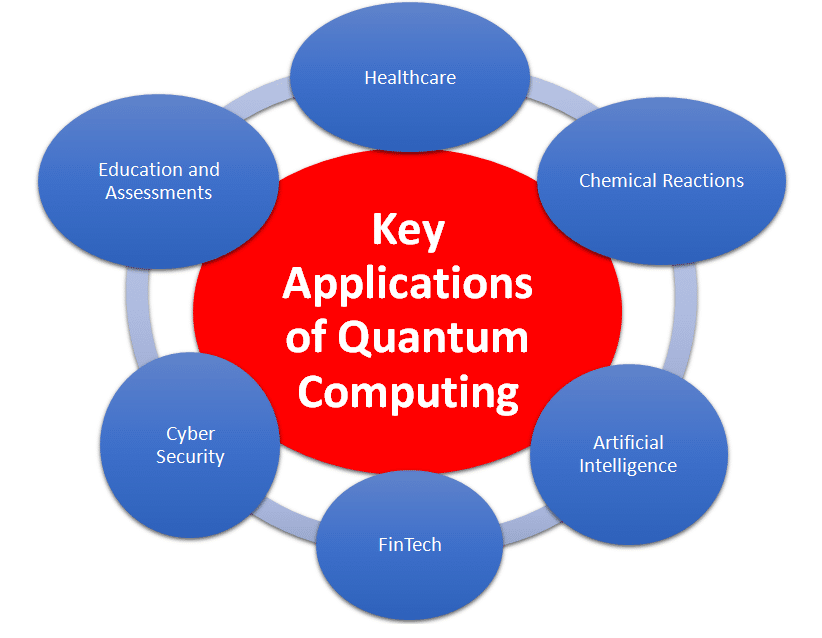
Quantum machine learning: Application areas
Quantum machine learning (QML) replaces classical machine learning applications with quantum implementations, helping optimise mammoth computations in fields like fintech (integration of finance and technology), blockchain, cryptography, logistics, and supply chain management. Here are some examples of how QML helps in different domains.
Fintech and blockchain
Transaction validation, banking token generation, smart contracts, consensus optimisation, security auditing
Finance
Portfolio optimisation, fraud detection, asset allocation, risk analysis, option pricing
Supply chain management
Demand forecasting, inventory optimisation, supplier evaluation, shipment tracking, route planning
Cryptography
Secured key generation, encryption analysis, quantum hashing, code breaking, secure protocols
Insurance
Customer analysis, risk evaluation, claim prediction, fraud detection, policy pricing
Logistics
Route optimisation, traffic modelling, inventory management, fleet scheduling, supply prediction
Retail
Demand forecasting, customer segmentation, inventory planning, pricing analysis, recommendation systems
A number of free and open source libraries and frameworks are available for implementing the algorithms and circuits of quantum machine learning. Most of these are compatible with Python programming. Table 2 lists some of these.
Table 2: Free and open source libraries for QML
| Library | Programming language |
URL |
| PennyLane | Python | pennylane.ai |
| Qiskit Machine Learning | Python | qiskit.org/ecosystem/machine-learning |
| TensorFlow Quantum | Python | tensorflow.org/quantum |
| TorchQuantum | Python | github.com/mit-han-lab/torchquantum |
| Cirq | Python | quantumai.google/cirq |
| MindQuantum | Python | github.com/mindspore-ai/mindquantum |
| Yao.jl | Julia | github.com/QuantumBFS/Yao.jl |
| QuTiP | Python | qutip.org |
| lambeq | Python | github.com/CQCL/lambeq |
| QuCumber | Python | github.com/PIQuIL/QuCumber |
| NetKet | Python | netket.org |
| OpenFermion | Python | github.com/quantumlib/OpenFermion |
| QGOpt | Python | github.com/LuchnikovI/QGOpt |
| Tequila | Python | github.com/tequilahub/tequila |
| Qibo | Python | qibo.science |
| D-Wave Ocean (dimod, dwave-networkx) | Python | docs.ocean.dwavesys.com |
| Strawberry Fields | Python | strawberryfields.ai |
| ProjectQ | Python | projectq.ch |
Variational quantum classification using PennyLane on a fintech application
The following example uses a sample dataset of cryptocurrencies. Using QML, the aim is to predict if the closing value of the cryptocurrency the next day will be higher than its price today. The quantum circuit of 1 qubit is taken with a small variational block.
To install PennyLane, type:
$ pip install pennylane
The quantum machine learning-based binary classification is as follows:
import pandas as pd

from pennylane import numpy as np

import pennylane as qmllib

from sklearn.preprocessing import StandardScaler

from sklearn.model_selection import train_test_split

# 1. Upload dataset

from google.colab import files

files.upload()

# Example: cryptoprices.csv should have columns: Date, Close

cryptodataframe = pd.read_csv(“cryptoprices.csv”)

# Create a simple “up or down” label

cryptodataframe[“Target”] = (cryptodataframe[“Close”].shift(-1) > cryptodataframe[“Close”]).astype(int)

cryptodataframe = cryptodataframe.dropna()

X = cryptodataframe[[“Close”]].values # using only ‘Close’ for simplicity

y = cryptodataframe[“Target”].values

# Normalize features

scaler = StandardScaler()

X = scaler.fit_transform(X)

# Train-test split

X_train, X_test, y_train, y_test = train_test_split(X, y, test_size=0.25, random_state=9)

# ---------------------------

# 2. Formation of Quantum circuit

# ---------------------------

n_qubits = 1

cdev = qmllib.cdevice(“default.qubit”, wires=n_qubits)

def myfeature_encoding(x):

“””Encode classical data into qubit rotation.”””

qmllib.RX(x[0], wires=0)


def myvariational_block(weights):

“””Simple variational layer.”””

qmllib.RY(weights[0], wires=0)

qmllib.RZ(weights[1], wires=0)

@qmllib.qnode(cdev)

def myquantum_circuit(x, weights):

feature_encoding(x)

variational_block(weights)

return qmllib.expval(qmllib.PauliZ(0))

# --------------------------

# 3. Model + Training loop

# --------------------------

def myquantum_model(x, weights):

return myquantum_circuit(x, weights)

def cost(weights, X, y):

pred = [myquantum_model(x, weights) for x in X]

pred = np.sign(pred) # convert to {-1,1}

y_mod = 2*y - 1 # convert labels {0,1} -> {-1,1}

return np.mean(pred != y_mod)

# ----------------------------

# Initialize weights

# ----------------------------

myweights = np.random.randn(2, requires_grad=True)

myopt = qmllib.GradientDescentOptimizer(stepsize=0.1)

# ----------------------------

# Training

# ----------------------------

for epoch in range(15):

myweights, _ = myopt.step_and_cost(lambda w: cost(w, X_train, y_train), weights)

train_loss = cost(weights, X_train, y_train)

test_loss = cost(weights, X_test, y_test)

print(f”Epoch {epoch+1:2d}: Train Error={train_loss:.3f}, Test Error={test_loss:.3f}”)

# ----------------------------

# 4. Analytics and Inference

# ----------------------------

pred = [myquantum_model(x, myweights) for x in X_test]

pred_labels = (np.sign(pred) + 1)//2

print(“\n Outcome Predictions:”, pred_labels[:10])

print(“Outcome True labels: “, y_test[:10])
The output is:
Sample predictions: [0. 1. 1. 1. 1. 1. 1. 1. 1. 0.]

True labels: [1 0 1 1 1 1 1 1 0 1]
In sample predictions, the output depicts either 1 or 0, where 1 predicts the price will go up and 0 predicts it will fall. ‘True labels’ gives the actual price increase and fall. This value is used to verify the accuracy of the model.
Student assessments using QML
The quantum machine learning code given below helps assess the knowledge of students in three different subjects. It uses quantum classifiers to predict whether they will pass or fail tests in these subjects.
from pennylane import numpy as np

import pennylane as qml

# QML Device Circuit Formation: 3 qubits for 3 subjects

mydev = qml.device(“default.qubit”, wires=3)

@qml.qnode(dev)

def studentcircuit(sscores, sweights):

# Encoding of score of subject in a qubit

for i, sscore in enumerate(sscores):

qml.RX(sscore, swires=i)

# Variational layer

for i in range(3):

qml.RY(sweights[i], wires=i)

return qml.expval(qml.PauliZ(0))

# Student Data

sscores = np.array([0.7, 0.6, 0.9])

sweights = np.array([0.2, 0.4, 0.7], requires_grad=True)

sprediction = studentcircuit(sscores, sweights)

print(“Prediction:”, “Pass” if sprediction > 0 else “Fail”)
This QML-based approach helps assess teaching and learning processes with a higher degree of performance and accuracy.
A few key use cases of QML-based quantum computing for academics are:
- Optimisation of grading rubrics
- Weighing of questions
- Personalised feedbacks
- Hidden patterns analysis in attendance, grades and participation
- Performance predictions
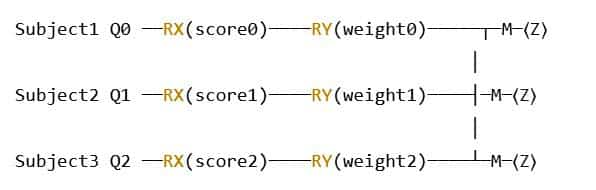
There is huge scope for research in quantum data science, quantum machine learning and quantum deep learning. Traditional implementations of classification, regression, and clustering can be improved using quantum circuits. Quantum computing enables multi-dimensional analytics in minimum time with maximum accuracy. Researchers can develop and simulate novel quantum circuits for solving real world problems including portfolio optimisation in investments (banking and finance), prediction of protein folding (disease research), quantum key distribution (secured communications), traffic management (smart cities), and climate modelling (disaster prediction).