



























































Here’s how you can build a recommendation system from scratch for Audible, Amazon’s subscription-based audiobook platform.
Recommendation systems have become one of the most impactful applications of machine learning in the real world. Whether it is Netflix suggesting movies, Spotify recommending music, or Amazon predicting what product you may want next, these intelligent engines shape how users interact with massive digital libraries. The same challenge exists in the world of audiobooks.
Platforms like Audible contain thousands of books across genres such as self-help, fiction, business, fantasy, technology, history, and more. With such a huge catalogue, users often face the problem of too much choice. Searching manually for the next audiobook can quickly become overwhelming.
This is where recommendation engines play a key role:
- Helping users discover books similar to their interests;
- Improving engagement and listening time; and
- Providing personalised suggestions instead of generic bestsellers.
So let’s learn how to build an end-to-end hybrid book recommendation system using:
- Natural language processing (NLP)
- Clustering techniques
- Content-based similarity
- Hybrid recommendation logic
- Streamlit deployment for real-time recommendations
The FOSS (free and open source) tools I used for this are Python, Pandas, Scikit-learn, Matplotlib and Streamlit.
This workflow is highly useful for students, developers, and open source administrators who want to understand how modern recommender systems are built from scratch.
Understanding recommendation systems
Broadly, recommendation systems fall into three categories.
Content-based recommendations: These suggest items similar to what the user liked before, using features like description, genre, or keywords.
Collaborative filtering: Here, recommendations are based on other users’ behaviours and patterns, such as ‘People who listened to this also listened to…’
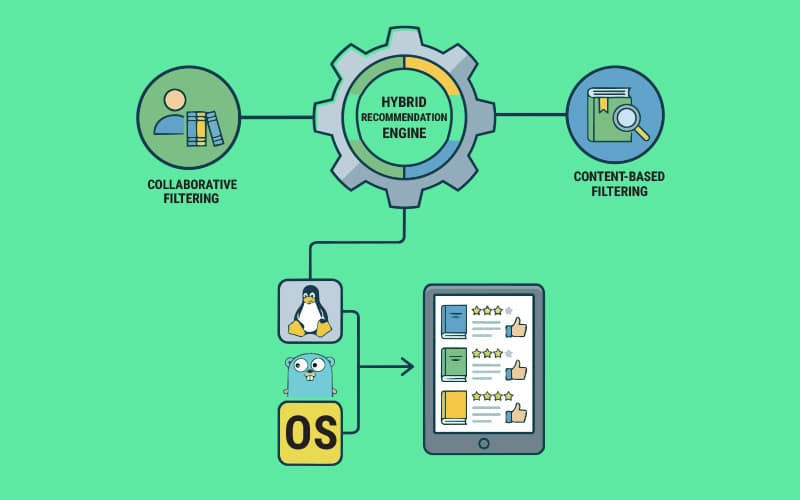
Hybrid recommendations: These combine multiple strategies to improve both the accuracy and diversity of recommendations.
In this project, I will focus mainly on content + clustering hybrid recommendations, which work very well even without user history.
Dataset preparation
The first step is to collect and prepare the dataset. I worked with two publicly available datasets from Audible.
Audible_Catalog.csv : This contains basic information such as book name, author, genre, rating, number of reviews, price and listening time.
Audible_Catalog_Advanced_Features.csv: This contains richer metadata such as book description, narrator details, extended genre labels, and additional textual features.
Since both datasets share common columns, I merged them using ‘book name’ and ‘author’. This produced a unified dataset that contains both structured numerical features and unstructured textual data.
This combination is essential because recommendation engines perform best when they have access to both quantitative engagement metrics and semantic meaning from descriptions.
Data cleaning and preprocessing
Real-world datasets are never clean. The Audible dataset had issues such as:
- Missing ratings
- Incomplete genres
- Duplicate book entries
- Inconsistent formatting of listening time
Using Pandas, I applied the following preprocessing steps.
Handling missing values: Numerical fields were filled with median values, and categorical fields were replaced with ‘Unknown’.
Removing duplicates: Books with the same title and author were deduplicated to avoid repeated recommendations.
Standardising listening time: Listening time was converted into consistent minutes so it could be compared properly.
Genre normalisation: Genre labels were cleaned so that, for example, ‘Self Help’ and ‘Self-Help’ were treated the same way.
Data preprocessing is a crucial stage, because poor quality data produces poor recommendations.
Exploratory data analysis (EDA)
Before building models, the dataset should be explored to understand patterns. EDA helps answer questions like:
- Which genres dominate Audible’s catalogue?
- Do highly rated books always have more reviews?
- Are expensive audiobooks rated better?
- Which authors consistently receive good ratings?
Genre distribution: Certain genres, like fiction, self-help, business, and mystery, appeared far more frequently. This indicates Audible’s strong focus on mainstream listening categories.
Rating patterns: Most audiobooks were rated between 4.0 and 4.7, suggesting strong positivity bias in listener feedback.
Review count insights: Some books had thousands of reviews, while many had very few. This imbalance indicated the presence of popular blockbusters as well as lesser-known hidden gems.
Price vs rating: Interestingly, higher prices did not always mean better ratings. Many affordable audiobooks were equally well appreciated.
EDA gives valuable intuition and ensures that the recommendation engine is grounded in real data behaviour.
NLP feature extraction with TF-IDF
One of the most important parts of book recommendations is understanding the content of the book. Metadata alone (rating, price, genre) is not enough. Book descriptions carry semantic meaning, for example:
- ‘A guide to productivity and habit formation…’
- ‘A fantasy adventure set in a magical kingdom…’
To convert these descriptions into machine-readable form, I applied TF-IDF (Term Frequency-Inverse Document Frequency) vectorization. This assigns weights to important words — words common in every description get a low weight while rare but meaningful words get a high weight. For example:
- ‘the’, ‘and’ → low importance
- ‘neuroscience’, ‘dragon’, ‘entrepreneurship’ → high importance
Thus, every book description is transformed into a numerical vector. These vectors form the foundation of content similarity.
Clustering similar books
Once book descriptions are vectorized, we can group similar books together. This is done using clustering algorithms.
Clustering creates thematic groups such as:
- Productivity and leadership books
- Epic fantasy novels
- Crime thrillers
- Technology and programming
This improves recommendations by providing contextual neighbourhoods.
KMeans clustering: I used KMeans, one of the most popular unsupervised clustering methods. The steps to follow are:
- Choose number of clusters (k).
- Assign books to clusters.
- Books in the same cluster share similarity.
To select the optimal k, I applied the elbow method.
Dimensionality reduction for visualisation: Since TF-IDF vectors are high-dimensional, I used PCA (Principal Component Analysis). This allowed me to visualise clusters in a 2D space. Clustering provides structure to the recommendation space.
Building recommendation models
I implemented three recommendation approaches.
Content-based filtering: This uses cosine similarity between TF-IDF vectors.
The workflow is:
- User selects a book.
- Similarity with all other books is computed.
- The top N most similar books are recommended.
This method leads to highly relevant recommendations. However, the limitation is that these can become too narrow (only very similar items).
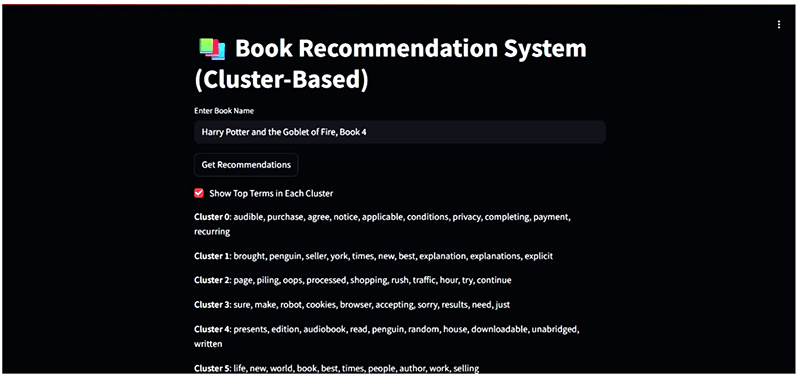
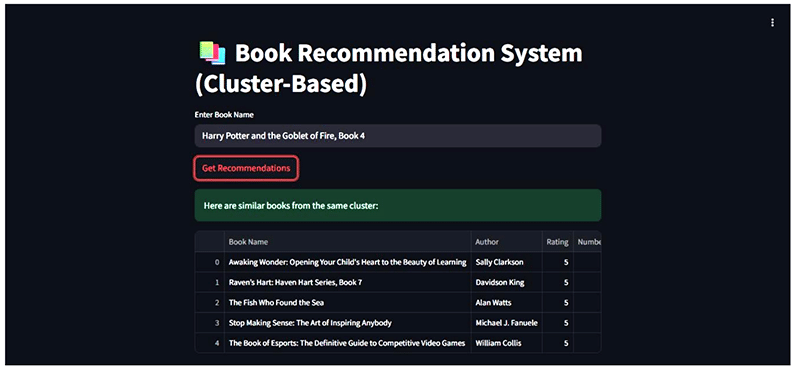
Cluster-based recommendation: In this method, books are recommended from within the same cluster.
The workflow is:
- Identify the cluster of the input book.
- Recommend popular/highly rated books in that cluster.
This method is fast and gives diverse recommendations within genre themes. A limitation is that cluster boundaries may be imperfect.
Hybrid recommendation model: The hybrid model combines both content similarity (precision) and cluster context (diversity).
Hybrid logic is:
- Top recommendations from cosine similarity.
- Additional recommendations from same cluster.
This balances relevance with discovery.
Hybrid models are used widely because they reduce the monotony in suggestions.

Evaluation of recommendation performance
To evaluate recommendation quality, I used metrics such as Precision@5, while Recall@5 was used to find out how many of the top 5 recommendations are truly relevant.
The Content model gave more precise recommendations, the Cluster model gave broader recall and the Hybrid model gave the best balance.
Evaluation ensures recommendations are not just visually appealing, but also statistically meaningful.
Streamlit deployment on Linux
A recommendation engine becomes truly useful only when users can interact with it. I built a lightweight frontend using Streamlit, an open source Python framework. Streamlit runs smoothly on Linux, needs minimal code, has a real-time interactive UI, and is easily deployable on servers.
The user experience is:
- Enter a book title.
- Choose model type.
- Get instant recommendations.
Streamlit turns ML projects into practical applications.
Deployment architecture
This project can be deployed on open source or cloud infrastructure. Deployment options include:
- Linux VPS server
- AWS EC2 instance
- Elastic Beanstalk
- Docker container
The architecture pipeline is: Dataset → Cleaning → NLP → Clustering → Recommendation Models → Streamlit UI → Deployment.
This modular design ensures scalability and maintainability.
You’ve learnt how open source machine learning tools can help to build a hybrid recommendation engine. Such recommendation systems are not only valuable in audiobooks but can also be extended to:
- Movie platforms
- News aggregators
- E-commerce catalogues
- Academic paper recommendations
The best part is, with open source tools, developers have the complete freedom to build, customise, and deploy intelligent systems without proprietary dependencies.