

























































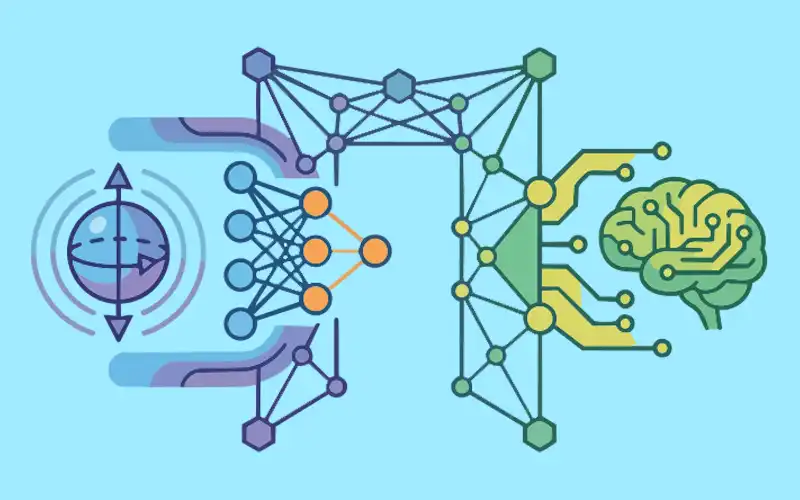

Quantum machine learning, an emerging discipline at the crossroads of quantum computing and artificial intelligence (AI), promises to revolutionise how machines learn and make decisions, unlocking computational capabilities once thought impossible.
Quantum computing is not just another step in the evolution of technology — it’s a leap. While traditional computers rely on bits to process information, quantum computers use qubits, which can represent multiple states simultaneously.
This unique property allows quantum systems to solve certain problems faster and more efficiently than their classical counterparts. When merged with machine learning, quantum computing opens the door to new algorithms that could redefine speed, accuracy, and scalability in AI applications. The fusion enables AI models to handle massive datasets and complex computations with unprecedented ease.
Quantum data structures and encoding
One of the most intriguing aspects of quantum machine learning is how data is represented and encoded within quantum systems. Unlike conventional approaches, quantum data structures leverage superposition and entanglement to store and manipulate information. Techniques such as amplitude encoding and quantum random access memory (QRAM) are being developed to ensure data is efficiently mapped onto quantum states. These novel methods facilitate the processing of high-dimensional data, enabling AI systems to extract richer patterns and insights than ever before.
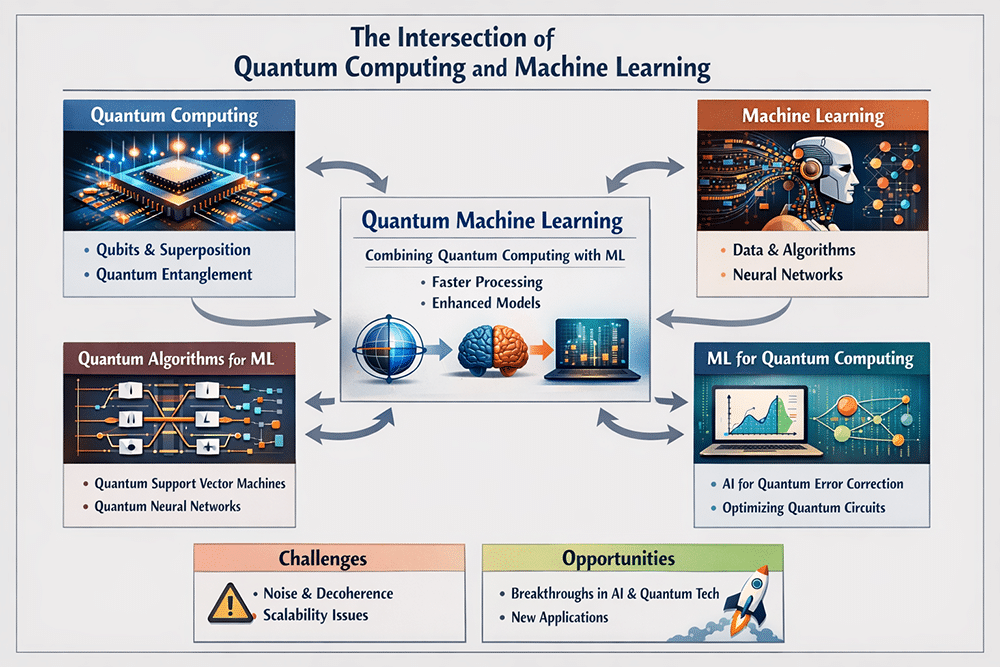
Speeding up AI: Quantum-enhanced algorithms
Quantum-enhanced algorithms have the potential to dramatically accelerate AI workflows. For example, quantum versions of classical machine learning algorithms—such as support vector machines and principal component analysis—can perform tasks in ways that outpace traditional methods. These advancements are not merely about speed; they also enable the tackling of previously unsolvable problems, especially in fields like optimisation and pattern recognition. As quantum computers become more accessible, AI practitioners will increasingly leverage these algorithms to gain a competitive edge, leading to faster innovation cycles and deeper analytical capabilities.
Quantum neural networks: Fact or fiction?
The concept of quantum neural networks (QNNs) sparks much debate within the scientific community. While the idea of combining neural networks with quantum computing is captivating, practical implementations remain in their infancy. Researchers are actively exploring how quantum properties might enhance learning processes, but most QNNs today are experimental rather than fully operational. Despite this, theoretical models suggest that quantum neural networks could offer significant improvements in how AI learns and generalises. The journey from fiction to fact is ongoing, and each breakthrough brings us closer to real-world applications.
Early quantum AI success stories
Several pioneering organisations have begun experimenting with quantum machine learning, yielding promising results. For instance, pharmaceutical companies are using quantum AI to accelerate drug discovery by analysing molecular structures at a level unattainable by classical computers. In finance, quantum algorithms are being tested for portfolio optimisation and risk assessment, offering more precise forecasts. Even sectors like logistics and supply chain management are witnessing early successes, where quantum-enhanced models streamline operations and enhance decision-making. These success stories underscore the transformative potential of quantum AI across industries.
Quantum AI in BFSI
When people in banking, financial services, and insurance (BFSI) talk about quantum AI, the conversation usually starts with one simple question: where would it help first? In BFSI, the pressure points are consistent—risk, fraud, pricing, and complex optimisation problems that classical systems can solve, but often only with trade-offs in speed or accuracy. Quantum-enhanced machine learning offers a different way to search huge solution spaces and spot patterns in noisy, high-dimensional data.
A common early use case is ‘portfolio optimisation and treasury decisioning’. Asset managers and bank treasury teams constantly balance return targets, liquidity needs, concentration limits, and regulatory constraints. Quantum optimisation (often combined with ML signals) can be explored for rebalancing, hedging, and asset–liability management scenarios where the number of possible allocations grows very quickly. In practice, many teams start with ‘quantum-inspired’ approaches on classical hardware and then pilot quantum runs on smaller, high-impact slices of the problem.
Another area is ‘risk analytics’. Market and credit risk teams run scenario analysis, stress testing, and simulation-heavy models (think VaR-style calculations and sensitivity analysis) under tight reporting timelines. Quantum approaches are being studied for faster sampling, more efficient optimisation, and better exploration of correlated risk factors. Similarly, ‘derivatives pricing and XVA’ can benefit from any improvement to Monte Carlo-style methods, especially when institutions need consistent pricing across large books with intra-day recalculation needs.
On the operational side, ‘fraud detection and AML’ are natural candidates because they combine pattern recognition with extremely large search spaces. Payment frauds, mule-account detection, and suspicious transaction monitoring often rely on graph-like relationships (accounts, devices, merchants, locations, and beneficiaries). Quantum machine learning is being explored for graph analytics and anomaly detection where subtle signals can get lost in the scale and imbalance of real-world data. Even if quantum hardware is not yet doing the full workload, hybrid pipelines—classical feature engineering plus quantum-assisted model components—are a practical way to experiment.
For lenders and insurers, the discussion often shifts to ‘credit underwriting and early-warning systems’. Institutions want decisions that are fast, explainable, and robust for changing economic conditions. Quantum-enhanced models may help with high-dimensional feature spaces, better clustering of customer segments, and optimisation of credit limits or pricing under policy constraints. Downstream, there is also potential in ‘collections strategy optimisation’—choosing the next-best action across channels while respecting affordability, compliance, and customer experience guidelines.
In insurance, quantum AI is frequently linked to ‘pricing and reserving’, where actuaries have to capture non-linear interactions across risk factors without overfitting. There is also growing interest in ‘catastrophe and climate risk modelling’, especially for portfolios exposed to correlated events and long-tail uncertainty. These are computation-heavy problems with complex dependencies, so even incremental improvements in simulation efficiency or optimisation can translate into better risk selection and capital planning.
From an implementation standpoint, most BFSI organisations treat quantum AI as a ‘measured, pilot-driven journey’ rather than a ‘big bang’ transformation. It usually starts with selecting one constrained use case, defining success metrics against a strong classical baseline, and building a hybrid architecture where classical systems handle data preparation, governance, and monitoring while quantum components are used where they add genuine value. Because BFSI is highly regulated, teams also need to think early about model risk management, auditability, data privacy, and third-party risk—especially when quantum compute is accessed through cloud services.
Obstacles: Data input, output, and interpretation
A central bottleneck in quantum machine learning is not only computation, but the full data pipeline surrounding it. Most enterprise and scientific datasets are born classical, whereas quantum processors operate on amplitude-encoded or basis-encoded quantum states. Loading high-dimensional data into qubits can itself dominate runtime, often eroding any theoretical speedup unless highly structured inputs or efficient state-preparation routines are available. Proposed enablers such as QRAM remain largely experimental, and current noisy intermediate-scale quantum (NISQ) devices still face severe constraints in qubit count, coherence time, connectivity, and gate fidelity.
Output is equally restrictive. Quantum systems do not reveal their full state directly; they provide samples from measurement distributions, meaning useful observables must be estimated over many circuit executions. This creates a measurement bottleneck, particularly for large feature spaces or deep variational circuits. In learning tasks, the challenge is compounded by barren plateaus, noise-induced gradient suppression, and the difficulty of extracting classically interpretable features from probabilistic quantum states. From an operational standpoint, model validation, reproducibility, and explainability are therefore harder than in conventional AI pipelines. Progress is being made through error mitigation, smarter ansatz design, shadow tomography, tensor-network surrogates, and hybrid quantum-classical workflows, but robust data ingestion and interpretable output remain among the decisive barriers to practical quantum AI deployment.
What’s next for quantum AI?
The next chapter of quantum AI will not be defined by a sudden replacement of classical machine learning, but by the gradual emergence of hybrid computational architectures in which quantum processors act as specialised accelerators for mathematically hard subroutines. In the near to medium term, the most realistic trajectory is not ‘quantum supremacy for AI’ in a broad sense, but targeted quantum advantage in carefully selected workflows involving optimisation, structured sampling, kernel estimation, probabilistic modelling, and simulation-driven learning. This distinction is important because the future of quantum AI will be shaped less by hype and more by where quantum hardware can demonstrably complement advanced classical systems.
A major direction is the rise of hardware-aware quantum machine learning. Early quantum AI research often focused on elegant theoretical formulations, but the field is now moving towards algorithms explicitly designed around the constraints of real devices: limited qubit counts, noisy gates, sparse connectivity, and restricted circuit depth. This has led to increased interest in shallow variational circuits, error-mitigated learning schemes, and hybrid training pipelines where classical optimisers manage parameter updates while quantum circuits evaluate highly non-classical feature maps or probability landscapes. In practical terms, this means the next generation of quantum AI systems will be engineered not as standalone quantum models, but as co-designed classical-quantum stacks integrated into broader data and MLOps environments.
Another decisive trend is the shift towards domain-specific quantum AI. The strongest near-term impact is expected in sectors where the underlying problem structure naturally aligns with quantum methods. In pharmaceuticals and materials science, quantum-enhanced models may improve molecular representation learning, Hamiltonian simulation, and generative design for candidate compounds. In finance, attention is centred on portfolio construction, scenario generation, derivatives pricing, and high-dimensional risk optimisation under constraints. In logistics, manufacturing, and energy systems, quantum AI is being explored for scheduling, routing, resource allocation, and digital-twin optimisation. The common thread across these domains is that they involve combinatorial explosion, non-convex search spaces, or complex probabilistic dependencies, areas where quantum-enhanced sampling or optimisation could eventually provide measurable value.
A particularly important frontier is the evolution of quantum-enhanced generative AI and probabilistic learning. While large language models and deep neural systems remain overwhelmingly classical, quantum computing may influence future AI through more efficient modelling of complex probability distributions, latent-variable structures, and correlated systems. Quantum Boltzmann machines, Born machines, tensor-network/quantum hybrids, and quantum diffusion-inspired frameworks are being studied as possible pathways towards richer generative modelling. Although these approaches remain largely experimental, they are scientifically significant because many real-world AI problems—from scientific discovery to financial stress simulation—depend less on deterministic prediction and more on accurate uncertainty representation, high-fidelity sampling, and probabilistic inference.
The long-term roadmap, however, depends critically on progress towards fault-tolerant quantum computing. Current NISQ devices are valuable for experimentation, benchmarking, and limited hybrid applications, but their noise levels and scale still prevent reliable execution of many algorithms that promise asymptotic advantage. As error correction matures and logical qubits become available, the scope of quantum AI could expand dramatically. At that stage, one could envision more powerful quantum linear algebra routines, more reliable quantum kernels, deeper quantum neural architectures, and advanced inference engines capable of addressing classes of learning problems that are prohibitively expensive on classical infrastructure. In other words, the true transformation in quantum AI may arrive not during the NISQ era, but in the transition to error-corrected, scalable quantum systems.
Equally important is the emergence of rigorous benchmarking and governance frameworks. The future credibility of quantum AI will depend on demonstrating advantage against strong classical baselines under realistic cost models, rather than against simplified or outdated comparisons. Metrics such as end-to-end runtime, data-loading overhead, energy efficiency, model robustness, and interpretability will become central. For regulated industries, especially BFSI, healthcare, and critical infrastructure, future adoption will also require strong controls around auditability, privacy, model risk management, and third-party cloud quantum dependencies. This means the next phase of quantum AI is as much about engineering discipline, validation methodology, and trust architecture as it is about algorithmic novelty.
Ultimately, what comes next for quantum AI is a transition from conceptual promise to specialised, evidence-driven deployment. In the short term, hybrid pilots and quantum-inspired methods will dominate. In the medium term, the field will likely mature through domain-focused applications and tighter integration with classical AI ecosystems. In the long term, if fault-tolerant hardware delivers at scale, quantum AI could become a foundational layer for solving optimisation, simulation, and inference problems beyond the practical reach of conventional computing. The future, therefore, is not one in which quantum AI replaces classical AI, but one in which it extends the computational frontier of intelligent systems into regimes that are currently inaccessible.
Despite the excitement surrounding quantum machine learning, substantial challenges persist. Data input and output remain major hurdles, as translating classical information into quantum states—and vice versa—is a complex process. Moreover, interpreting the results from quantum computations often requires specialised knowledge and sophisticated tools. The current limitations in hardware, software, and expertise highlight the need for continued research and investment. Addressing these obstacles will be crucial to unlocking the full promise of quantum AI and ensuring its practical adoption in real-world scenarios.
Looking ahead, the future of quantum machine learning appears both promising and unpredictable. As quantum hardware matures and new algorithms are developed, we can expect AI solutions to become more powerful, efficient, and adaptable. Collaborative efforts between academia, industry, and government will play a pivotal role in overcoming current barriers and driving innovation. Whether it’s creating smarter healthcare systems, optimising urban infrastructure, or discovering new scientific truths, quantum AI holds the potential to reshape our world in ways we are only beginning to imagine. For those in the tech community, staying informed and engaged with this evolving field is not just an opportunity—it’s a necessity.