




























































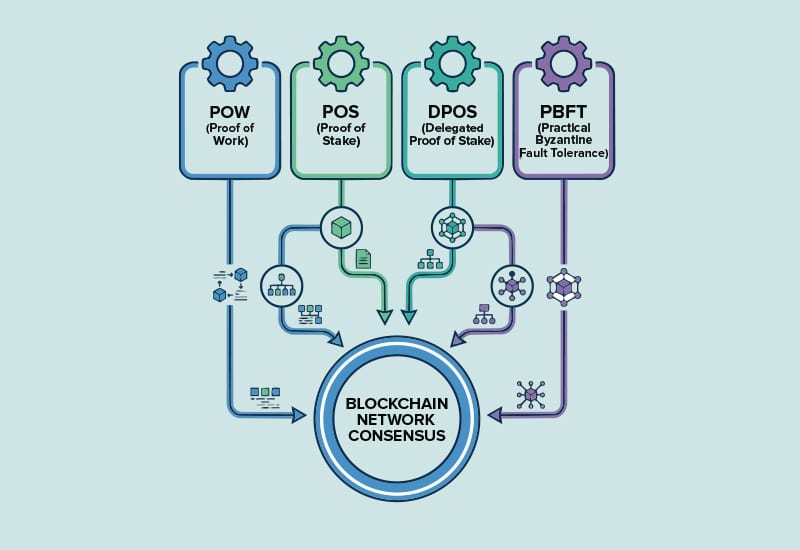

The primary consensus algorithms in blockchain have their tasks cut out, but they do have a few drawbacks.
A blockchain is a decentralised digital ledger technology that allows for secure and transparent record-keeping of transactions within a distributed network. Each block contains the data for the transactions occurring during a specific period, and because each block is securely linked to the previous block, both data integrity and immutability are preserved.
Trust, transparency, and security have made blockchain a fundamental technology in a range of industries including finance, healthcare, supply chain management, and digital identity systems.
Role of consensus in blockchain
In a distributed blockchain setting, there must be agreement among many nodes so that the ledger is kept up-to-date and consistent. Consensus protocols specify how transactions
must be validated before they can be added to the blockchain as part of a new block.
Various blockchains use consensus algorithms to ensure security, limit the likelihood of fraud, and maintain fault tolerance in the event there are fraudulent nodes or nodes that fail. Each consensus algorithm — Proof-of- Work (PoW), Proof-of-Stake (PoS), or Byzantine Fault Tolerance (BFT) — has its own pros and cons depending on the use case for which it is utilised.
In a decentralised blockchain framework, there is no centralised governing or validating authority that verifies and validates transaction data. So it is necessary to have a process in place that ensures all parties involved agree on one version of the truth based
on shared data. This need has given rise to consensus processes as a primary protocol to allow distributed systems to come to agreement with each other.
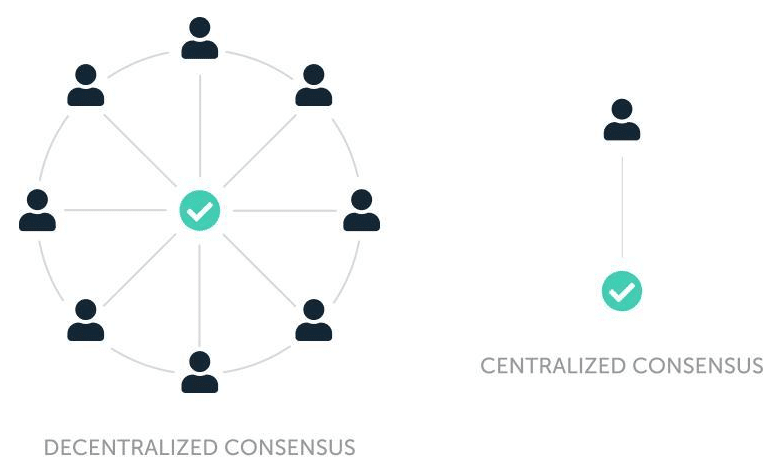
Consensus mechanisms ensure that:
- All nodes validate transactions correctly.
- Only legitimate transactions are added to the blockchain.
- The network remains secure against malicious activities.
- Data consistency is maintained across all nodes.
The design of a consensus algorithm must balance three key aspects:
- Security: Protection against attacks and fraud
- Scalability: Ability to handle large volumes of transactions
- Decentralisation: Ensuring no single entity controls the network
Different blockchain platforms adopt different consensus models depending on their application requirements and performance constraints.
Byzantine Generals Problem
The Byzantine Generals Problem is a popular problem in computer science. It refers to the challenges of coming to an agreement when some group members are untrustworthy or trying to cause chaos, but must come to a consensus about what they want to do. However, if they try to deceive others by giving them false or misleading information, it will be impossible for everyone to agree on a single course of action.
Obtaining proper functioning among several nodes (computers) in a blockchain system requires a method of compensating for incorrect or failed actions of those nodes in order to provide proper network operation. Systems that can withstand these types of node actions are called Byzantine fault tolerant systems.
The key challenges include:
- Detecting malicious nodes
- Preventing false transaction validation
- Maintaining agreement despite conflicting information
To address these challenges, modern blockchain systems implement consensus algorithms that are resilient to Byzantine faults, ensuring reliability and trust in decentralised environments.
Proof of Work (PoW)
Proof of Work (PoW) has been around since the early days of cryptocurrency and is the most popular method of achieving consensus in distributed networks today. Its prime directive is to maintain the security of the entire proof-of-work network by requiring the use of computer cycles as a resource to validate a new transaction or create a new block.
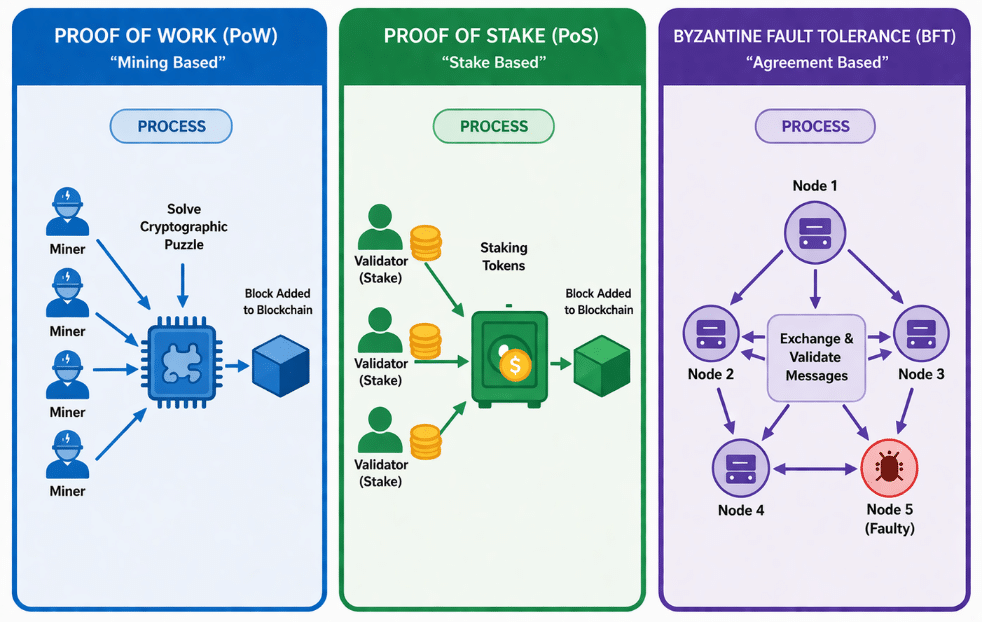
Miners compete against one another to be the first to solve a complex mathematical problem. The problem is solving for an arbitrary number, known as the nonce, which when hashed with transaction information using a cryptographic hash function meets certain requirements.
How PoW, PoS, and BFT compare with each other
| Feature | Proof of Work (PoW) | Proof of Stake (PoS) | BFT (Byzantine Fault Tolerance) |
| Performance | Slow transaction processing | Faster than PoW | Very fast consensus |
| Energy usage | Very high | Low | Very low |
| Security | Highly secure | Secure | Highly secure |
| Scalability | Poor scalability | Better scalability | Limited scalability |
| Decentralisation | High | Moderate | Low |
| Cost | Expensive | Lower cost | Low cost |
| Use case | Public blockchains | Public + modern blockchains | Private blockchains |
The working process can be summarised as follows:
- Transactions are collected into a block.
- Miners attempt to solve a cryptographic puzzle.
- The first miner to find the correct nonce broadcasts the solution.
- Other nodes verify the solution.
- The block is added to the blockchain and the miner is rewarded.
This mechanism ensures that adding a block requires significant computational effort, making it difficult for attackers to manipulate the system.
The advantages of PoW are:
- Highly secure and resistant to tampering.
- Proven and reliable mechanism (used in Bitcoin).
- Strong validation through computational effort.
- Open participation (anyone can become a miner).
- Maintains integrity of the blockchain network.
However, there are a few disadvantages too:
- Very high energy consumption.
- Vulnerable to 51% attack if majority power is controlled.
- Mining power often becomes centralised in pools.
- Slow transaction processing speed.
- Limited scalability for large scale applications.
Proof of Stake (PoS)
A consensus mechanism that utilises probability, Proof of Stake (PoS) replaces computational work with economic participation to reach an agreement among users. Miners are replaced by validation users or ‘validators’ who become eligible to create a new block based on how much of the cryptocurrency is held by them in the system as their ‘stake’. Validator statuses are changed periodically.
The process includes:
- Validators lock their tokens.
- Network selects a validator.
- Selected validator validates transactions and creates a block.
- Rewards are given, while malicious behaviour leads to penalties.
PoS has the following advantages:
- Very low energy consumption compared to PoW.
- Faster transaction validation and block creation.
- Better scalability and higher throughput.
- Economic penalties ensure honest behaviour.
- Reduced need for expensive hardware.
The disadvantages are:
- Wealth-based dominance.
- Less proven compared to PoW in long-term scenarios.
- Risk of centralisation among large stakeholders.
- Initial token distribution may be unfair.
- Potential security concerns in early-stage networks.
Byzantine Fault Tolerance (BFT)
The BFT consensus mechanism helps distributed systems work reliably and consistently, even when their nodes fail or process requests from a compromised or malicious source. To reach an agreement among the members of a distributed system, the BFT consensus mechanism requires that at least most of the participating nodes agree on the transaction to be validated. This mechanism helps to provide consistency and trust within a distributed network at the time a transaction has been committed.
The above-mentioned pros of using BFT are typical for a permissioned blockchain ecosystem in which all entities are known to each other. Because of the structured method of both communicating and validating between participants, BFT provides a high degree of reputation, rapid consensus, and a robust ability to tolerate fault in a distributed network.
The variants of BFT are:
- PBFT (Practical Byzantine Fault Tolerance)
• Most widely used BFT algorithm
• Works efficiently in small networks - IBFT (Istanbul BFT)
• Improved version of PBFT
• Used in enterprise blockchain systems - Tendermint BFT
• Combines BFT with Proof of Stake
• Provides fast finality and high performance
Case studies
Bitcoin
- Uses Proof of Work (PoW) consensus.
- Miners solve cryptographic puzzles to validate transactions.
- Highly secure and decentralised network.
- Limitation: high energy consumption and slow processing.
Ethereum
- Initially used PoW; later transitioned to Proof of Stake (PoS).
- Validators are selected based on staked tokens.
- Supports smart contracts and decentralised applications.
- Improved scalability and reduced energy consumption.
Hyperledger and Cosmos
- Use BFT-based consensus mechanisms.
- Designed for enterprise and permissioned environments.
- Provide fast transaction finality and high efficiency.
- Suitable for controlled networks with known participants.
Challenges and future scope
There are difficulties that all blockchain consensus protocols deal with including, but not limited to, lack of performance and scalability. While PoW and PoS can securely verify transactions, both are not as scalable as BFT-based approaches. However, BFT-based systems have their own set of challenges derived from high communication overhead and
the costs associated with maintaining several nodes.
Hybrid consensus models that combine, for example, Proof of Stake (PoS) and Byzantine Fault Tolerance (BFT) are the future. Other types of sharding solutions that provide more expansive scalability, increased performance levels, and a more sustainable approach for blockchain networks are also on the cards.