




























































Linux kernel versions are a sign of constant evolution, and bring with them subtle and steady improvements.
When the Linux kernel version changes from 6.x to 7.0, it naturally grabs attention. A new major version often sounds like a big leap. But in the Linux world, version numbers don’t always tell the full story. In February 2026, Linus Torvalds indicated that the next Linux kernel release could be version 7.0, with a release expected soon, based on the usual release cadence. Whenever such a version jump happens, a common question comes up: Is this a major turning point, or just another routine update?
Having worked closely with kernel changes over the years, I find this question interesting, not because of the number itself, but because of what people assume it represents.
A look back at kernel versioning
The Linux kernel has never followed strict, marketing-driven versioning. Its numbering reflects evolution, not milestones. In the early 1990s, Linux started as a small project. Version 1.0, released in 1994, marked the point where it became stable enough for broader use.
The long 2.x series (1996–2011) saw tremendous growth, including support for SMP systems, improved networking, the evolution of filesystems like ext3/ext4 and more. Interestingly, all of this happened without frequent changes to the major version number. Things became simpler from 2011 onwards. When the version number reached 2.6.39, it was reset to 3.0. There was no major redesign, just a practical decision to keep the numbering manageable.
The same pattern continued:
- 3.x became 4.0
- 4.x became 5.0
- 5.x became 6.0
Each transition reflected continuity, not disruption
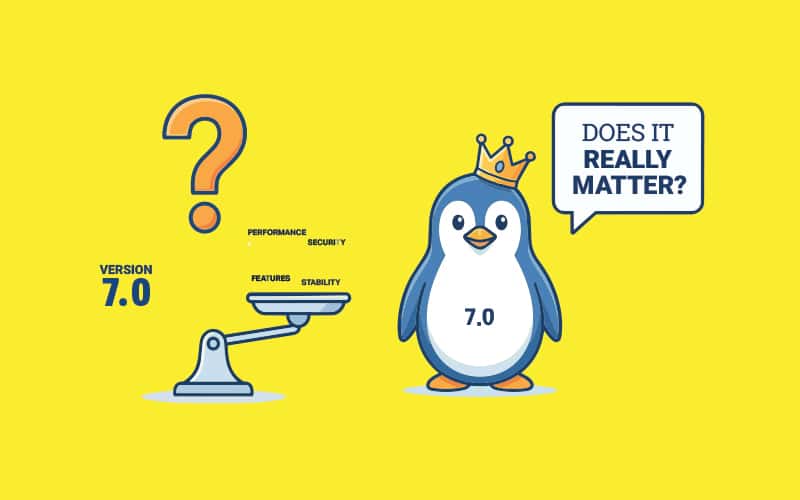
So, what does 7.0 indicate? In short, not as much as one might think. The Linux kernel does not use version numbers to signal breaking changes or major rewrites. A jump from 6.x to 7.0 does not imply instability or incompatibility. In practice, it is closer to moving from one release to the next. The real work happens within each cycle, patch by patch, subsystem by subsystem.
To understand this better, it helps to look at how Linux kernel versioning actually works.
Linux kernel versions follow an x.y.z format.
x (Major version): This is what changes from 6.x to 7.0. In reality, it is mostly a practical reset rather than a signal of major architectural change.
y (Minor version): This is where most development happens. Each increment (6.6 → 6.7 → 6.8) brings new features, improvements, and internal changes.
z (Stable/Patch version): These are bug fixes and security updates (6.6.1, 6.6.2), ensuring stability.
Unlike many software ecosystems, a major version bump does not imply breaking changes. As Linus Torvalds has often pointed out, version numbers are sometimes incremented simply to keep them manageable.
What does Linux kernel 7.0 actually bring?
Hardware enablement
Linux kernel 7.0 continues the kernel’s strong focus on supporting modern hardware:
- Early support for upcoming Intel and AMD architectures
- Continued improvements for ARM platforms, including Qualcomm Snapdragon
- Continued progress in Apple Silicon support
Performance and filesystem improvements
Performance tuning remains a continuous effort:
- Improvements in filesystems like ext4 and Btrfs
- Better handling of concurrent I/O workloads
- Enhanced performance for databases and storage-heavy applications
Rust in the kernel
Linux kernel 7.0 marks an important step where Rust continues to mature in the kernel, and is gradually being adopted and becoming a regular part of kernel development, especially for drivers to improve memory safety.
Security and core improvements
Ongoing refinements continue across core subsystems:
- Scheduler improvements for better responsiveness
- Security-related enhancements in CPU and kernel behaviour
- Continuous hardening of internal components
Instead of focusing on version numbers, it is more useful to look at:
- Core subsystem changes (memory management, scheduler, VFS, networking)
- Filesystem and storage stack improvements
- Security enhancements
- Hardware enablement
These are the factors that directly impact real-world usage. Recent kernel cycles have introduced meaningful changes in memory handling, security, and storage layers—often with far more impact than the version number itself.
One of the defining strengths of the Linux kernel is its development model. There are no sudden, disruptive jumps. No ‘all-or-nothing’ upgrades. Instead, the system evolves continuously, with contributions coming from across the world. This approach allows even complex changes to be introduced gradually, keeping the ecosystem stable and predictable.
Linux kernel 7.0 is not a revolution—and it does not need to be. It represents another step in a long journey of steady, incremental progress. The number may change, but the underlying approach remains the same.
For users, developers, and enterprises alike, the takeaway is simple: what matters is not the version number, but the improvements it quietly brings.
Disclaimer: This article expresses his views and not of the organisation he works in.