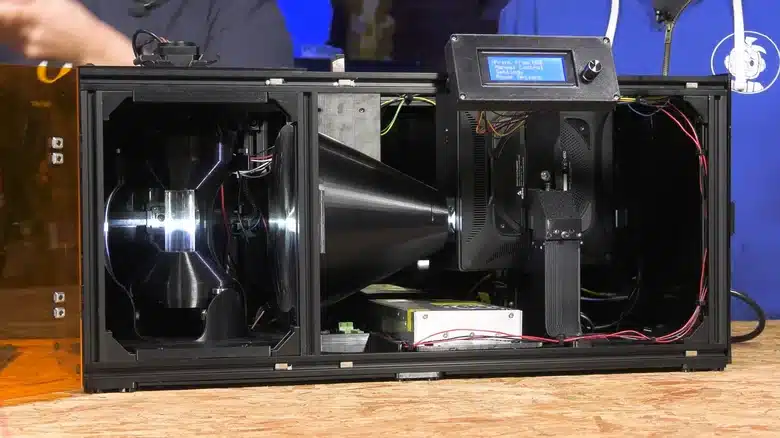
An open source volumetric 3D printing platform combines accessible hardware, community-developed software, and documented workflows to simplify the adoption of computed axial lithography for research, education, and prototyping.
OpenCAL is an open-source implementation of computed axial lithography (CAL), a volumetric 3D printing technique that forms an entire object in a rotating vat of photosensitive resin instead of building it layer by layer. Unlike conventional additive manufacturing methods, the process projects a sequence of computed light patterns into the resin, allowing objects to be produced within minutes without support structures or visible layer lines.
It was created to increase the accessibility of CAL technology via the distribution of full documentation of hardware, assembling guides, software, and designing tools. Using commercial off-the-shelf components, including a consumer projector and ordinary mechanical elements, this solution helps researchers, educators, and makers to build and adjust their volumetric 3D printer without any proprietary hardware.
OpenCAL comes with a companion software, Tomo – an open-source software tool that transforms 3D models into projection images required for the volumetric printing process. Derived from the VAMToolbox, the software calculates the lighting necessary to polymerise only the intended regions of the resin; recent updates have made it easier to operate the printer through graphical interfaces rather than command-line tools.
The project has also tackled the issue of material accessibility by collaborating with resin suppliers in order to produce special photopolymer formulations that are more readily available. Furthermore, there is a complete set of instructions on how to assemble the printer, prepare the resins, calibrate the printer, and post-process the models.
Through its combination of open-source hardware, software, and documentation, OpenCAL makes volumetric additive manufacturing more accessible to researchers, educators and makers.