
























































IIT Madras student Akshay Rukade, founder of ZiroEDA, has developed ZIRO Designer, an open-source browser-based tool for schematic capture and PCB design using KiCad-compatible files.
An engineering student from India has developed an electronics design software product aimed at making PCB development more accessible. Akshay Rukade, founder of ZiroEDA, has developed ZIRO Designer, a browser-based electronics design automation (EDA) platform that brings schematic capture and PCB layout workflows to web browsers. Unlike other software that uses a custom file format, this program supports working with the standard KiCad project file, thus making it possible for engineers to open, edit and save designs that can also be used with the desktop software. This project is licensed under the GNU GPLv3.0+.

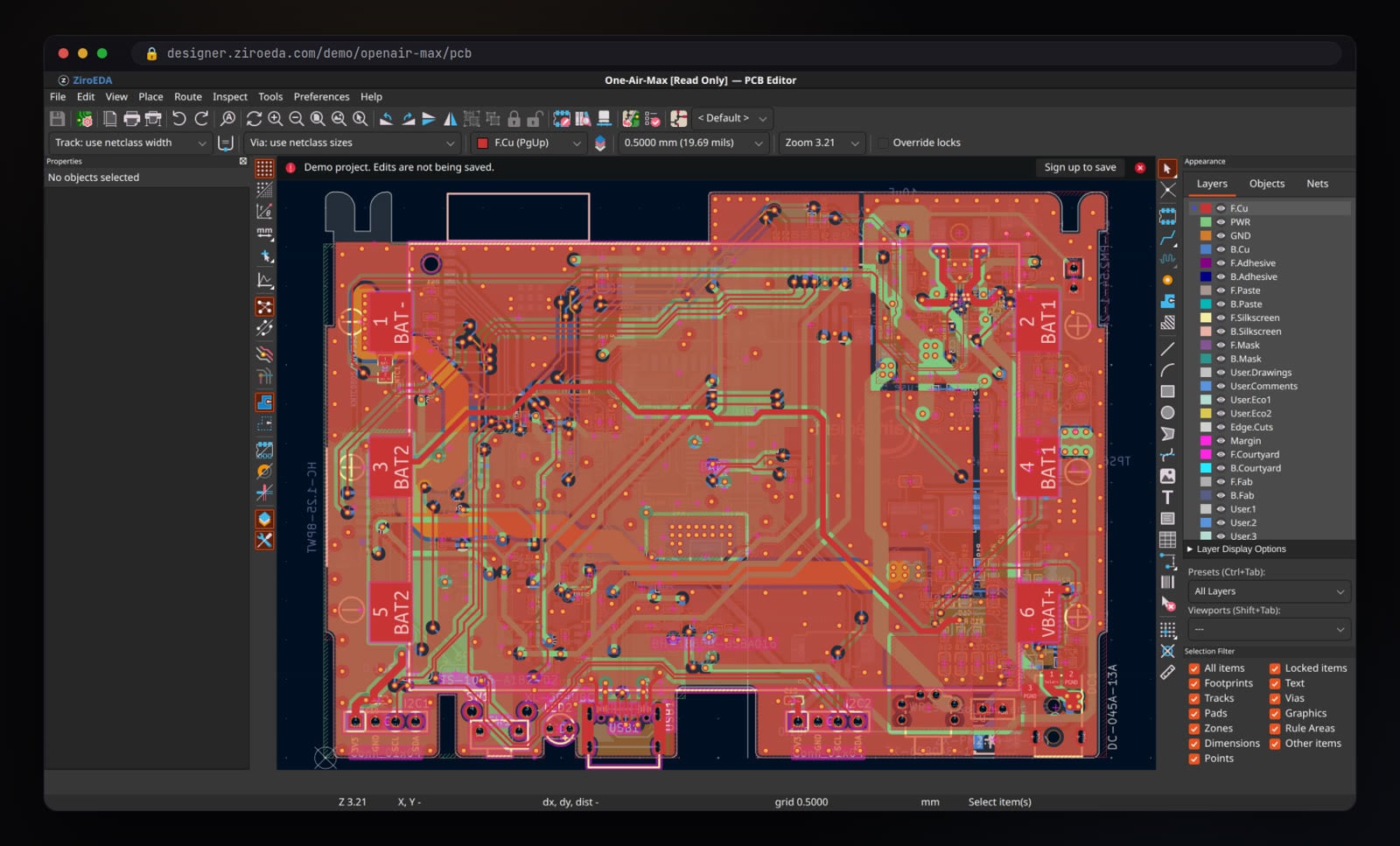
The features offered by ZIRO Designer software includes schematic editing, PCB designing, routing, ERC/DRC, copper zones, footprint mapping, 3D view, and Gerber file creation. This tool is implemented using TypeScript language, where WebGL provides 2D visualization and Three.js enables 3D visualization. The development of ZIRO Designer has been based on the KiCad design process, whereas KiCad command line tools will facilitate file comparison of generated files and desktop applications.
The useful thing about it is that one can launch a public KiCad project from the browser from Github. The design will be opened in read-only mode, but there will be a possibility to save it to your own account to be able to edit it further. The schematic editor can also be used collaboratively – one can draw a circuit while observing the cursor and selections of the other participant. It may be quite helpful for engineering students, educators, and developers of hardware.
For cloud projects, ZIRO Designer utilizes end-to-end encryption technology to safeguard project files before upload. The encryption technique used is AES-256-GCM, where access is controlled using the password-derived key and recovery key. The application is currently in public beta and requires an internet connection. While it offers several familiar EDA functions, it is positioned as a complement to desktop KiCad rather than a complete replacement for demanding professional design workflows.
Through ZiroEDA, Rukade is developing the platform as an open-source alternative in the electronics design software ecosystem. Its compatibility with native KiCad files also makes it relevant to the wider open-hardware community. ZIRO Designer represents an example of student-led entrepreneurship in India’s electronics engineering ecosystem, taking a technical idea beyond an academic project towards a software product.
For more information, click here.