





















































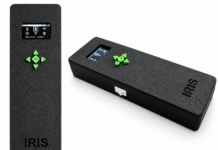

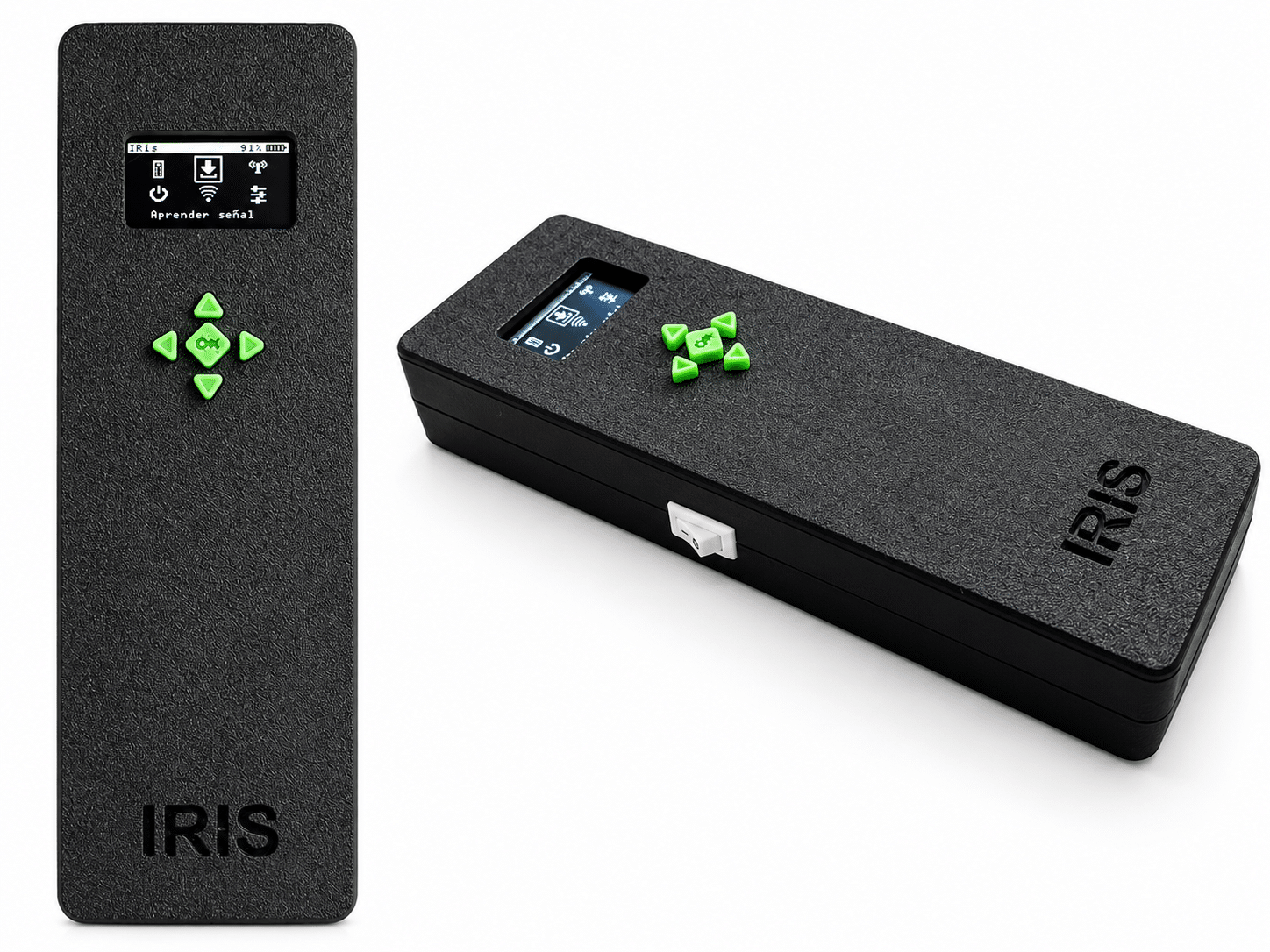

IRis is an open-source universal infrared remote that can learn, store and replay commands, with hardware designs and firmware available for customisation.
IRis is an open-source universal infrared remote built around an ESP32 allowing users to learn, store and replay commands from existing remote controls. The project has been developed by Nicolas Ruiz Neiman and it helps in capturing commands from other remotes and executing the same to control various devices.
The system uses a microcontroller that employs ESP32-WROOM-32 chip, together with a 1.3 inch OLED screen and five push buttons for navigating the menu. The input commands are received through an IR receiver of type TSOP38238, whereas the output commands are sent through two infrared LEDs controlled by a 2N2222 transistor. All components of the system are contained within a 3D printed box powered by a lithium-ion 18650 battery.
IRis decodes NEC, Samsung, Sony SIRC, RC5 and JVC protocols, storing their protocol, address and command information. IRis can also record infrared signals in their raw format if they cannot be detected in any known infrared coding scheme. Commands recorded can be grouped into virtual remotes.
The project will allow for access to the Flipper-IRDB database as well, offering the user a wide selection of existing IR codes. A Python utility converts LIRC files and Pronto hex codes into compatible .ir files. Other features include a ‘Be Gone’ mode that sends the power commands of remotes in a selected category, a loop mode for repeating button sequences, and a mode that transmits random commands with configurable pauses.
IRis is released under the GNU General Public License v3.0, with its firmware, hardware documentation, wiring diagrams, bill of materials and assembly instructions available on GitHub. The enclosure’s 3D-printable files are also available, while the Flipper-IRDB database used by the project is separately released under the CC0 licence. Pre-compiled firmware is also offered to make it easier for people to use it without compiling their own code.
For more information, click here.