


















































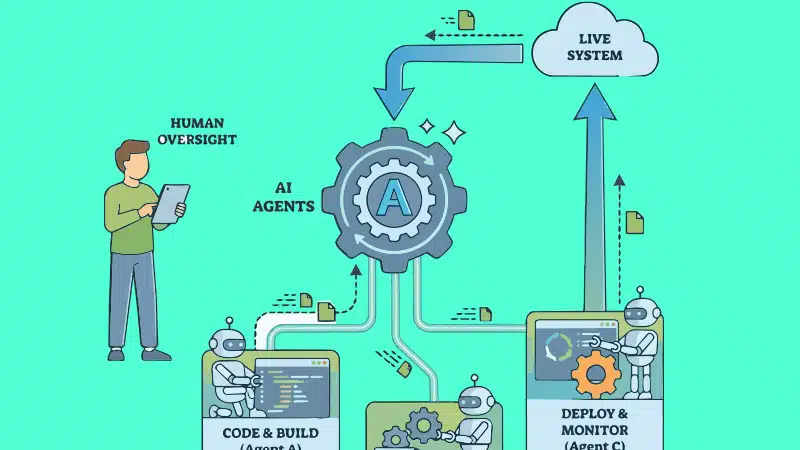

The complexity of modern-day digital infrastructure can no longer be handled by traditional DevOps. Agentic DevOps is the way forward.
DevOps fundamentally changed the way modern software is put together, tested, shipped, and cared for. It helped to replace separate teams, manual handovers, and long release cycles with automated pipelines, Infrastructure as Code (IaC), cloud platforms, containers, and continuous monitoring. But things have become a lot more complicated today with the use of multiple clouds, containers, microservices, APIs, databases, and all that distributed infrastructure. And as this complexity grows, automating the same predefined tasks isn’t enough. That’s where agentic DevOps is making its mark.
Agentic DevOps basically blends DevOps principles with generative AI and autonomous AI agents. Instead of using AI only to produce code or answer questions, these agentic setups can watch what’s happening, interpret what the issue is, plan out a sequence of moves, work with the existing technical tools, and then check whether the outcome is good. In other words, the focus is shifting from systems that just follow orders, towards systems that can grasp the end goal and figure out the right actions to take.
Table 1: The evolution of software operations
| Stage | Primary focus | Role of AI | Decision making |
| Traditional IT | Manual operations | None | Human |
| DevOps | Automation and CI/CD | Limited | Predefined rules |
| AIOps | Intelligent monitoring | Analytics and ML | AI-assisted |
| Agentic DevOps | Autonomous operations | Reasoning + Agents | Agent + Human |
| Autonomous platform | Self-managing systems | Multi-agent intelligence | Controlled autonomy |
From DevOps to agentic DevOps
The road to agentic DevOps has been built gradually. Traditional DevOps brought automation into how software gets shipped and how operations run. Then continuous integration and continuous deployment (CI/CD) helped teams build, test, and deploy apps automatically whenever changes showed up. After that, Infrastructure as Code made it easier to manage infrastructure using version-controlled configuration, instead of relying on more manual ways. Monitoring and observability then gave teams real-time visibility into how applications and infrastructure were doing, not just what they hoped was happening.
So yes, these improvements cut down a lot of the grunt work. But the core workflows stayed predefined. A pipeline could run through a sequence of steps very efficiently, but usually couldn’t figure out why a strange failure happened, or it couldn’t decide what to do when something entirely new showed up.
Agentic DevOps improves on this considerably. An AI agent can take in the available information, reason through a situation, interact with different systems, and carry out actions aligned to a specific objective. That creates a more dynamic way of operating, where the whole system is not locked into one fixed sequence of instructions.
Here’s an example of a traditional pipeline vs an agentic workflow:
Traditional CI/CD approach:
deploy:

steps:

- build

- test

- deploy

rollback:

if: deployment_failed

action: rollback
Agentic approach:
def agentic_devops(event):

context = observe(

logs=True,

metrics=True,

deployment_history=True

)

problem = analyze(context)

plan = create_plan(

objective="restore_application_health",

problem=problem

)

if requires_approval(plan):

request_human_approval(plan)

result = execute(plan)

verify(result)
Here’s another smaller code example:
@tool

def check_kubernetes_pods(namespace):

"""Check the health of pods in a Kubernetes namespace."""

return kubectl(

f"get pods -n {namespace}"

)

agent = create_agent(

tools=[check_kubernetes_pods],

goal="Investigate unhealthy application pods"

)
This demonstrates a key idea of agentic DevOps: AI + reasoning + tools.
Table 2: Traditional automation vs agentic DevOps
| Traditional automation | Agentic DevOps |
| Follows predefined rules | Works towards defined goals |
| Executes fixed workflows | Dynamically plans actions |
| Handles known scenarios | Can investigate unfamiliar scenarios |
| Limited contextual understanding | Context-aware reasoning |
| Requires predefined responses | Can select from multiple actions |
| Usually stops after execution | Verifies the outcome |
| Human handles exceptions | Agent can handle approved exceptions |
Automation and agentic intelligence
Automation and agentic intelligence seem similar but are not the same. Automation tends to follow instructions that already exist — the path is pretty much written ahead of time. An agent, on the other hand, aims at some goal and then figures out what steps are needed to get there.
Think about a simple deployment rule: ‘If the deployment fails, automatically roll back to the previous version’. That’s meant for automation because the trigger and the reaction are known ahead of time, and there are no surprises.
Picture a case where the deployment technically ‘works’, yet application performance starts to slip right after. CPU usage climbs, database connections begin failing, and users get hit with high latency. There may not be any single predefined rule to cope with this scenario.
So you move to a different operational loop: observe, understand, plan, act, and verify. First, the system observes what’s happening, then it builds an understanding of the situation, makes a plan, takes action, and finally checks whether the action actually delivered the desired outcome.
This is the real value of agentic DevOps — not just in doing tasks automatically, but in turning automation into something context-aware and goal driven.
The DevOps agent
At the centre of agentic DevOps sits the DevOps agent. You can think of it as an AI driven software component that talks to the tools and systems used — right from the idea to the release.
But a useful agent is more than just a big language model. It needs access to relevant information, plus some well-controlled tools. For example, it may read the source code sitting in a Git repository, look over CI/CD pipeline outcomes, query Kubernetes, or inspect cloud resources. It could also sift through monitoring signals, and work with an incident-management platform when things go sideways.
However, the agent must have context. Without it, an AI model may give answers that are technically correct, but operationally not a great fit. A production environment isn’t generic. It has its own architecture, its own dependencies, security rules, deployment steps, and business requirements. The agent should understand these limits first, before it starts processing anything.
All of this creates a kind of intelligent layer that stitches different pieces of the DevOps ecosystem into a single flow.
From intelligent assistance to autonomous operations
One of the most interesting aspects of agentic DevOps is the gradual shift towards autonomy.
Right now, a lot of developers and DevOps engineers already lean on AI assistants to knock out scripts, describe what an error message really means, draft infrastructure configurations, or come up with solutions that look plausible. Of course, the engineer still has the final say — reviewing the output and executing it.
In the next stage, AI will be able to carry out several connected tasks, with only slight oversight. For instance, an agent may be given the goal of investigating a deployment that failed. Instead of just explaining the error, it could gather the necessary details, reason through the failure, surface a few likely causes, and then put together a remediation plan.
Human-in-the-Loop
The idea of autonomous systems often brings concerns about safety and control, and honestly, that matters more than people think. In DevOps, these worries become especially important, because a wrong move can hit production systems, mess with customer data, weaken security, and even disrupt business operations.
An agent may be allowed to restart a development service on its own, but a change in the production infrastructure may still need a human sign-off. Likewise, an agent can automatically investigate a security alert, but it would pause for authorisation before it touches a firewall rule, or a production access policy, depending on the scope.
So you end up with this Human-in-the-Loop model, where people and agents collaborate. The AI deals with repetitive investigation and operational work, while engineers make the high impact calls.
The goal isn’t to remove humans from DevOps at all. It’s more to shift human attention towards the areas where judgment counts the most.
The rise of the multi-agent DevOps team
Agentic DevOps gets even more powerful when several specialised agents team up. A release agent obsesses over deployments and CI/CD, making sure version changes don’t slip. An infrastructure agent handles the cloud side and Kubernetes objects, all the way from namespaces to scaling decisions. The observability agent watches logs, metrics, and traces, looking for weird patterns. A security agent goes after vulnerabilities and policy violations that look small but aren’t. And an SRE agent zeroes in on reliability plus incident response when things start acting up.
Picture a production incident where application latency suddenly spikes. The observability agent catches the anomaly first, and then the deployment agent checks whether a recent release was involved. The infrastructure agent digs into resource utilisation, comparing current load with the baseline. Meanwhile, the security agent looks for suspicious activity, connections, or any strange authorisation behaviour. After that a coordinating agent bundles everything together, synthesizes the signals, and recommends what to do next.
This setup pushes DevOps closer to the idea of an AI-powered engineering team, not just automation for automation’s sake.
What agentic DevOps means for engineers
The emergence of agentic DevOps will also nudge the role of DevOps engineers. A lot of the repetitive operations work that used to pile up can increasingly be assisted or even handled by intelligent systems. Engineers may find themselves spending less time manually digging through logs, running routine commands, crafting repeat configs, and following common alert storms.
At the same time though, fresh duties will show up. Engineers will need to grasp how to design agentic workflows, equip the agents with the right tools, set up permissions properly, assess what the agents decide, keep an eye on how they behave, and build solid safety mechanisms that hold up when things get weird.
Table 3: The different levels of agent capability
| Level | Agent capability | Human involvement |
| Level 1 | Provides recommendations | Full |
| Level 2 | Executes low-risk tasks | High |
| Level 3 | Handles predefined incidents | Moderate |
| Level 4 | Plans and executes complex workflows | Selective |
| Level 5 | Operates autonomously within policies | Strategic oversight |
The road to autonomous DevOps
Agentic DevOps should not be treated like some sudden, full stop replacement for what we already do in DevOps. It is more like an evolution stacked on top of existing practices, and not a clean swap. CI/CD, Infrastructure as Code, cloud platforms, Kubernetes, observability, GitOps and security all stay non-negotiable. What AI agents add is a new intelligent layer that can interact with these pieces in a more proactive way.
You can think of the path as going from manual operations to automation, then to automation with smarter help, and finally towards something closer to controlled autonomy.
The end game is a software delivery and operations environment where systems can notice problems, grasp the surrounding context, pick a fitting response, perform only the actions that are approved, and then confirm the outcome.
Agentic DevOps is not only about fitting AI onto a pipeline. It is a wider shift in how software platforms get designed, and how they run day to day.