





















































The future of cloud computing rests on the lesser-known infrastructure processing units. Here’s why…
In the relentless race of modern computing, the spotlight is almost exclusively dominated by the heavy weights of processing power. If you read the headlines, you would assume that the entire digital world rests solely on the shoulders of central processing units (CPUs), graphics processing units (GPUs), and tensor processing units (TPUs). These chips are the celebrated rockstars of the artificial intelligence revolution. They are the brains orchestrating operating systems, the raw muscle rendering immersive digital worlds, and the complex matrix-crunchers training the next generation of massive large language models (LLMs).
However, beneath the glamour and the staggering teraflops of computational power, there is a quiet, profound revolution occurring in the networking racks and server chassis of the modern data centre. Behind every highly publicized GPU cluster and every hyper-efficient TPU supercomputer, there is a vital layer of invisible infrastructure keeping the entire ecosystem from collapsing under its own weight.
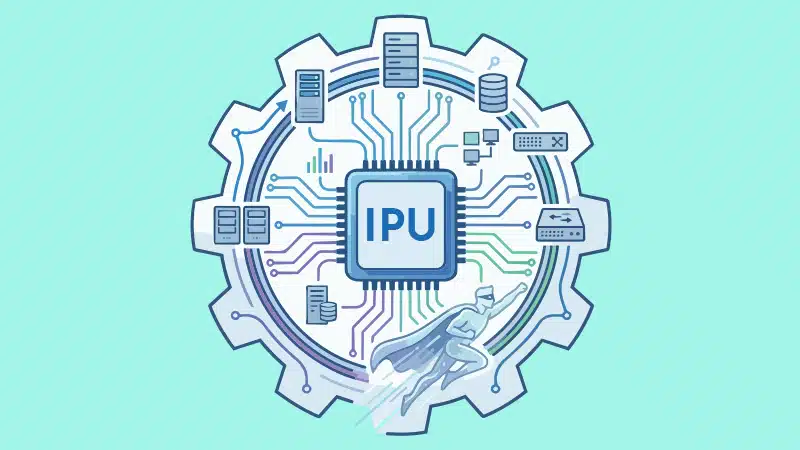
Enter the infrastructure processing unit (IPU) — the unsung hero of the data centre. While CPUs, GPUs, and TPUs receive all the attention, IPUs are the dedicated workhorses managing the chaotic, high-volume flow of data, securing the perimeter, and ensuring that the high-profile processors can do exactly what they were designed to do: compute.
The hidden cost of the cloud: The ‘data centre tax’
To understand why IPUs are becoming the most critical component in hyperscale architecture, one must first understand the fundamental bottleneck of the modern cloud.
In a traditional, CPU-centric data centre, the central processing unit is the undisputed orchestrator of everything. Not only is it responsible for running the revenue-generating workloads, it is also burdened with managing the underlying infrastructure.
As cloud environments have evolved from monolithic applications to highly distributed, microservices-based architectures, the volume of internal ‘East-West’ traffic within the data centre has exploded. To manage this, hyperscalers rely on software-defined networking (SDN), software-defined storage, and complex hypervisors. The problem is that running these virtualised infrastructure services requires a massive amount of computational power.
The infrastructure overhead tax
In a conventional cloud server, up to 30% to 50% of the CPU’s core capacity can be consumed by background infrastructure tasks. This includes managing virtual switches (vSwitches), routing network packets, encrypting and decrypting data, and managing storage input/output (I/O).
For a cloud service provider (CSP), this is a devastating inefficiency. If a server is equipped with a high-end 64-core processor, but 20 of those cores are busy just keeping the network and storage running, those are 20 cores that cannot be rented out to a paying customer. In an industry where revenue is directly tied to the utilisation of available compute, this ‘data centre tax’ represents billions of dollars in lost monetisation potential.
Decoding the IPU: What it is and how it works
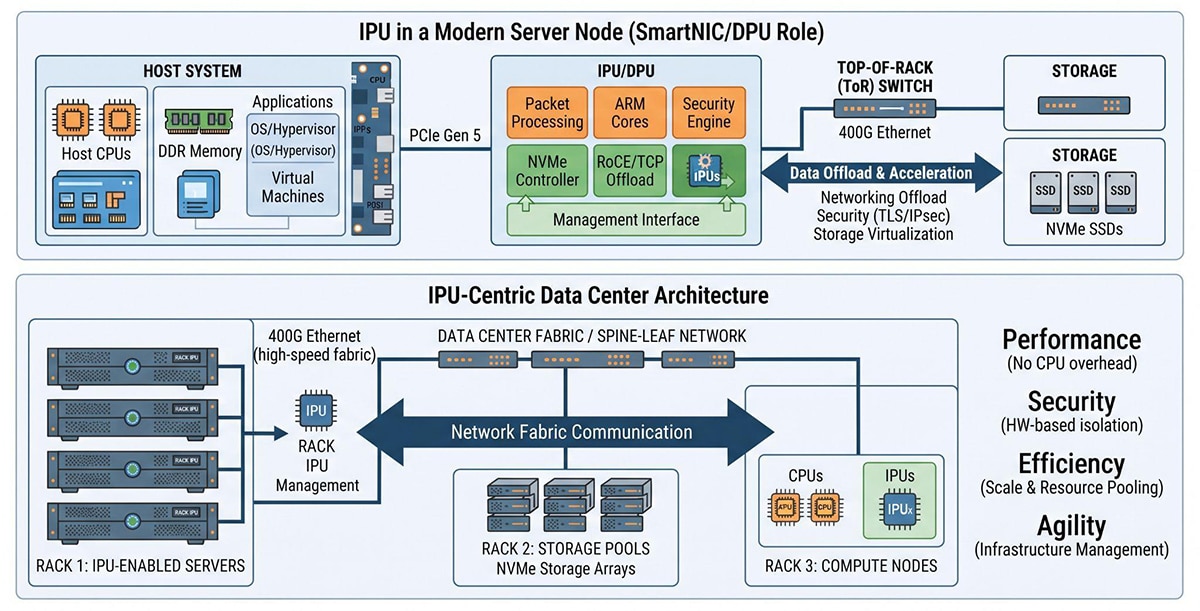
An IPU is a highly advanced, programmable network device designed specifically to intelligently manage system-level infrastructure resources. It intercepts the data before it ever reaches the CPU, acting as a dedicated brain for the data centre’s plumbing.
While earlier iterations of network cards (like standard NICs) simply moved packets from a cable to the host memory, and SmartNICs added basic offloading capabilities, the IPU represents a total architectural paradigm shift. It is essentially a specialised computer inside a computer.
A modern IPU typically integrates several key hardware components:
- High-speed network interfaces: Capable of handling line-rate speeds of 200Gbps, 400Gbps, or even 800Gbps.
- Programmable compute cores: Dedicated processors (often highly efficient ARM-based cores) designed to run the cloud provider’s infrastructure software independently of the host CPU.
- Hardened hardware accelerators: Custom silicon dedicated to executing highly specific, repetitive tasks at blistering speeds – such as cryptography (IPsec/TLS encryption), data compression, and packet routing.
- High-bandwidth memory: Fast, localised memory to prevent bottlenecks during intensive data manipulation.
By placing this powerful, specialised device at the edge of the server motherboard, cloud operators can securely shift the entire burden of a fully virtualised storage and network architecture away from the CPU.
The transformational impact of IPUs in the data centre
The integration of IPUs is not merely an incremental upgrade; it completely redefines how data centres are designed, operated, and monetised. Here are some specific, game-changing advantages that IPUs deliver to modern cloud environments.
Unlocking 100% compute monetisation
The primary financial driver for IPU adoption is CPU reclamation. By offloading the hypervisor, storage management, and networking stack to the IPU, the ‘data centre tax’ is effectively reduced to zero.
For the cloud service provider, this means that every single core of the expensive, power-hungry server CPU can be dedicated entirely to the tenant’s workload. If a user pays for a bare-metal instance or a massive virtual machine, they receive the unhindered, raw performance of the entire CPU. The IPU allows CSPs to achieve maximum density and profitability out of every square foot of their server racks, dramatically lowering the total cost of ownership (TCO).
Bulletproof security and air-tight isolation
In a multi-tenant cloud environment, security is paramount. In a traditional setup, the infrastructure software (the hypervisor) and the tenant’s application share the same physical CPU. If a malicious actor successfully compromises the hypervisor or exploits a side-channel vulnerability in the CPU cache, they could potentially access other tenants’ data or compromise the entire host system.
The IPU introduces a profound layer of physical and logical separation. Think of a cloud server as a luxury hotel. You want your high-paying guests (the tenant applications) to have a wonderful experience in their suites. However, you absolutely do not want them having the keys to the boiler room, the security cameras, or the plumbing systems.
With an IPU, the infrastructure control plane is entirely physically separated from the tenant data plane. The cloud provider’s security policies, firewalls, and management software run exclusively on the IPU. Even if the tenant completely compromises the host CPU, they cannot breach the underlying network or access the infrastructure management layer, because it is running on a separate processor. This creates an impenetrable root of trust.
Pioneering the diskless data centre
Storage management has traditionally been a rigid and localised problem. Servers have physical hard drives or solid-state drives (SSDs) installed directly within their chassis. This leads to stranded resources: one server might run out of storage while having excess compute, while the server next to it has unused terabytes of storage but a maxed-out processor.
IPUs solve this by enabling the ‘diskless data centre’. Through protocols like NVMe-over-Fabrics (NVMe-oF), an IPU can connect a server to a massive, centralised pool of storage located across the network. The IPU manages the complex routing and data compression so efficiently that, to the host CPU, this remote storage behaves as if it is a physical SSD plugged directly into its own motherboard. This disaggregation allows cloud providers to scale compute and storage completely independently, eliminating over-provisioning and drastically reducing hardware waste.
Feeding the AI behemoths
While GPUs and TPUs are the engines of the AI era, they are only as effective as the data pipeline feeding them. AI training requires pulling petabytes of unstructured data from storage and pushing it into the memory of parallel accelerators as fast as possible. If the network or the CPU bottlenecks, the incredibly expensive GPUs end up sitting idle, waiting for data — a phenomenon known as ‘data starvation’.
IPUs are the perfect traffic controllers for AI clusters. They handle the East-West network traffic with ultra-low latency, bypass the CPU entirely through Remote Direct Memory Access (RDMA), and ensure that data is encrypted, compressed, and delivered directly to the GPU or TPU memory banks precisely when needed. By keeping the accelerators fed at line rate, IPUs ensure that the multimillion-dollar investments in AI compute are fully utilised.
Comparing architectures: The paradigm shift
To visualise the sheer impact of the IPU, consider how the fundamental architecture of the server changes.
| Feature | Traditional CPU-centric architecture | IPU-accelerated architecture |
| Workload placement | Infrastructure and tenant applications compete for the same CPU cores. | Clean separation: CPU handles tenant applications, IPU handles infrastructure. |
| Server monetisation | 70% – 80% CPU utilisation available for billing. | 100% CPU utilisation available for billing. |
| Security model | Software-based hypervisor isolation; vulnerable to host CPU exploits. | Hardware-based air-gap; infrastructure control plane is physically isolated. |
| Storage strategy | Localised, physical disks prone to stranded capacity. | Diskless servers utilising pooled, network-attached NVMe via the IPU. |
| Data throughput | Bottlenecked by CPU interrupts and software switching. | Line-rate hardware acceleration (400Gbps+) with zero CPU intervention. |
Programmability: Moving at the speed of software
Hardware acceleration is not a new concept — application-specific integrated circuits (ASICs) have been doing it for decades. However, ASICs are famously inflexible. Once manufactured, their logic is permanently etched into the silicon. If a cloud provider wants to update a network protocol or deploy a new security encryption standard, an ASIC becomes obsolete.
The genius of the modern IPU lies in its programmability. By combining hardened, fixed-function accelerators (for tasks that will never change, like basic packet routing) with programmable cores and open software frameworks (such as P4 for data plane programming), IPUs offer the best of both worlds.
Cloud operators can customise their data pipelines, deploy advanced telemetry, and roll out new hyper-scale microservices through software updates that directly manipulate the IPU’s behaviour. This allows data centres to adapt to shifting AI workloads, new cybersecurity threats, and evolving cloud orchestration frameworks without needing to physically replace the hardware in millions of servers.
IPUs: The backbone of the next-generation cloud
We have officially reached the physical limits of the monolithic, CPU-does-it-all server architecture. As the world demands exponentially more compute power to fuel generative AI, real-time massive data analytics, and ultra-low-latency edge applications, the infrastructure must evolve to keep pace.
While the fascination will undoubtedly remain fixated on the raw intelligence of CPUs, the parallel processing power of GPUs, and the deep-learning mastery of TPUs, the true scalability of the cloud relies on an entirely different piece of silicon. IPUs are the dedicated guardians, the efficient traffic directors, and the tireless workers that allow the data centre to operate securely and profitably at a staggering, global scale.
The industry is waking up to this reality. The shift from compute-heavy nodes to heavily disaggregated, IPU-centric architectures is no longer just a theoretical roadmap — it is a financial and operational imperative. Because of their profound ability to reclaim revenue, harden security, and accelerate data pipelines, IPUs are incredibly important and are going to get a significant amount of investment from all cloud service providers in the next few years.