




















































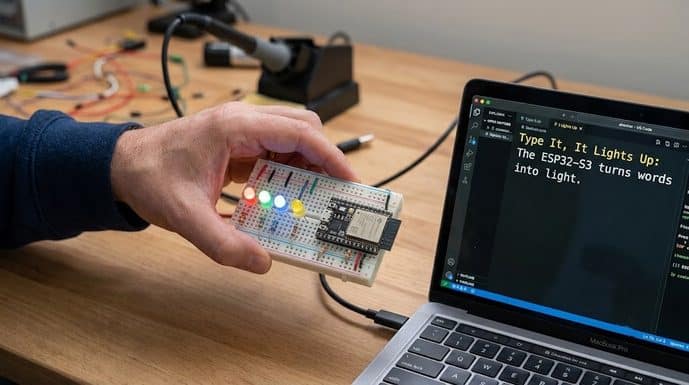

A 312K-parameter transformer turns natural-language commands into GPIO actions directly on an ESP32-S3, without Wi-Fi or cloud services.
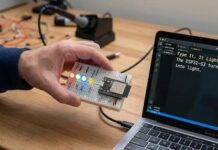
The open-source esp32-gpio-llm project brings a small language model to the ESP32-S3, allowing users to control GPIO pins using natural-language commands. The 312K-parameter transformer runs entirely on the microcontroller, with no Wi-Fi connection, cloud service or API key required. The project is released under the MIT licence, with its training, inference, firmware and hardware-control code available in the repository.
The model converts English commands into a compact command format that the firmware then translates into GPIO operations. Users can issue commands such as turning a pin on or off, blinking pins at a specified interval, controlling multiple pins and assigning names such as “desk lamp” to GPIOs. The model itself does not directly access the hardware; a separate firmware layer validates the requested pin and operation before execution.
The model occupies about 1.2MB of flash and uses around 302KB of PSRAM for its key-value cache. The project reports command latency of approximately 150ms to 1.5 seconds on the ESP32-S3. It requires an ESP32-S3 board with PSRAM, while the repository includes pre-built firmware images as well as instructions for building the system from source.
Safety is handled separately from the language model. The firmware maintains an allowlist of usable GPIOs and validates parameters such as timing intervals before allowing an operation. For example, a request for an unavailable GPIO or an interval outside the supported 50–10,000ms range is rejected rather than executed. The project reports 84.4 per cent exact-match accuracy on its held-out command set, while also documenting cases where the model produces incorrect or unsafe commands.
The repository also includes the tokeniser, training and export scripts, inference runtime, GPIO control code, test and verification components, and model data, allowing developers to inspect or modify the complete pipeline. The project incorporates code from other MIT-licensed open-source projects, including esp32-tinyllm and femtoclaw, with the relevant provenance documented in the repository. By putting a complete natural-language-to-hardware pipeline on a low-cost microcontroller, the project provides an open implementation for experimenting with on-device language interfaces for embedded systems.
For more information, click here.