






















































The platform combines an open-source runtime with hardware-based monitoring to give AI agents enforceable boundaries from development through deployment.
NVIDIA has introduced the NVIDIA Open Agent Safety Platform, an open software platform and reference system designed to add security controls around AI agents. It combines OpenShell, an open-source secure runtime, with Sentry, a reference design that uses hardware-level monitoring to control agent activity. The platform is intended to provide governance across the software, computing infrastructure and robotic systems used by autonomous agents.
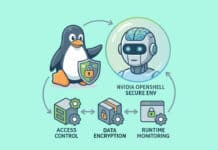
At the software level, OpenShell creates a security boundary outside the AI model and agent framework. It tracks agent actions and applies policies as the agent operates, allowing organisations to control access to tools, data, networks and other resources. OpenShell runs on NVIDIA Vera CPUs and is designed so that support can also be extended to third-party platforms based on Arm and Intel processors.
The platform’s hardware layer is provided by Sentry, an out-of-band watchdog designed to run on NVIDIA BlueField-4 DPUs. It continuously monitors agent behaviour independently of the agent itself. If an agent attempts to operate outside its defined software boundaries, Sentry can quarantine and stop it within milliseconds. Its security functions use NVIDIA DOCA to inspect requests and responses, verify agent identity, provide telemetry and enforce access policies.
NVIDIA is also working with organisations across AI, cybersecurity, enterprise software and robotics to integrate the technology into their systems. Anthropic is integrating OpenShell and BlueField with Claude Managed Agents, while Salesforce is using OpenShell with Slack to provide visibility into agent activity and human approval of additional permissions. SAP is integrating OpenShell with its Joule Studio runtime, and robotics companies including Figure, Gecko Robotics and Skild AI are exploring its use for physical AI systems.
The software, including OpenShell and its associated skills, is available through NVIDIA’s developer resources and GitHub. NVIDIA says more than 100 organisations are working with the platform’s technologies, while the initiative also contributes to the broader Open Secure AI Alliance effort under the Linux Foundation. The release positions agent security as a layer that can be independently enforced around AI systems rather than relying solely on the model or agent framework to follow predefined restrictions.