















































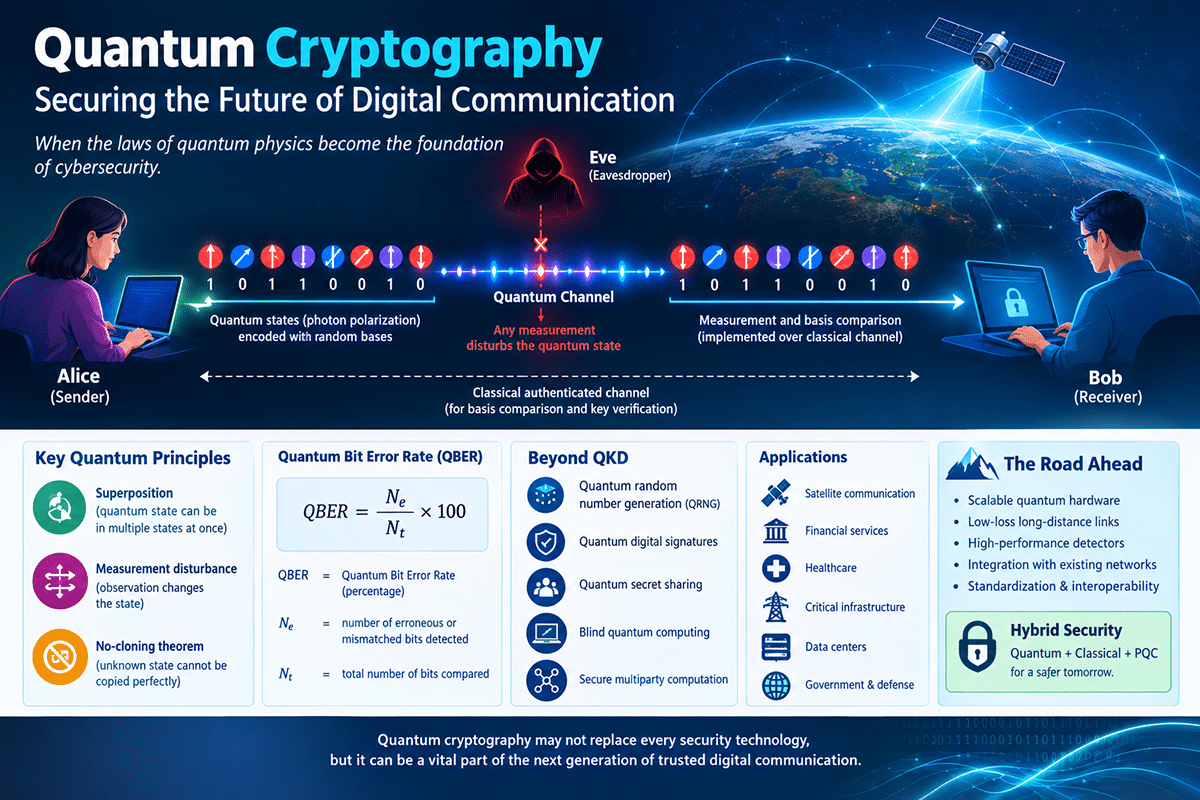

The digital world is entering an era in which the security of information can no longer depend solely on traditional cryptographic systems. Quantum cryptography is poised to become a significant component of future digital communication.
From online banking and digital healthcare to satellite communication and critical infrastructure, enormous volumes of sensitive information are transmitted every second. Traditional cryptographic systems have protected this information for decades, but the emergence of quantum computing is challenging many of the assumptions on which these systems are built. Quantum cryptography offers a fundamentally different approach: instead of relying only on mathematical problems that are difficult to solve, it uses the laws of quantum mechanics to detect eavesdropping and establish highly secure communication.
One of the most promising applications of quantum cryptography is Quantum Key Distribution (QKD). QKD allows two legitimate users to generate a shared secret cryptographic key while providing a mechanism to detect whether an attacker has attempted to intercept the communication.
From mathematical security to physical security
Most modern cryptographic systems use mathematical problems as the basis of security. For example, widely deployed public-key algorithms depend on the computational difficulty of problems such as integer factorization or discrete logarithms. A sufficiently powerful quantum computer, however, could use algorithms such as Shor’s algorithm to solve some of these problems much more efficiently.
Quantum cryptography takes a different path. It exploits fundamental quantum properties such as superposition, measurement disturbance, and the no-cloning theorem.
The no-cloning theorem states that an unknown quantum state cannot be perfectly copied. Consequently, an attacker cannot simply duplicate a quantum state, examine it, and forward an identical copy without potentially introducing detectable changes.
This leads to a powerful security principle: attempting to observe quantum information can disturb it.
How Quantum Key Distribution works
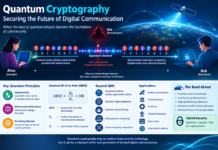
A widely studied QKD protocol is BB84, introduced by Charles Bennett and Gilles Brassard in 1984. In a simplified implementation, a sender, commonly called Alice, encodes information into quantum states of individual photons. The receiver, Bob, measures these states using randomly selected measurement bases.
For example, photon polarization can be used to represent quantum states. Alice may randomly select between two measurement bases and encode a sequence of bits. Bob independently chooses measurement bases when measuring the incoming photons.
After transmission, Alice and Bob communicate over a conventional authenticated classical channel. They publicly compare their selected bases but do not reveal the encoded bit values. Measurements made using compatible bases are retained, while incompatible measurements are discarded. The remaining sequence forms the sifted key.
If an eavesdropper, commonly called Eve, attempts to intercept and measure the photons, she generally does not know which measurement basis was used. Her measurements therefore introduce errors into the transmitted quantum states. Alice and Bob can estimate the resulting error rate and determine whether the communication channel has been compromised.
The role of Quantum Bit Error Rate
An important parameter in QKD is the Quantum Bit Error Rate (QBER). It can be expressed as:
…where:
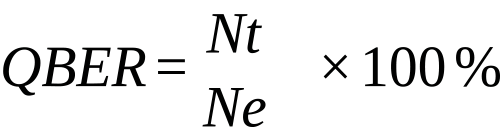
Ne = number of erroneous bits detected
Nt = Tool number bits compared
QBER = Quantum Bit Error Rate
A low QBER generally indicates that the quantum channel has relatively few errors, whereas a high QBER may indicate significant noise, hardware imperfections, or a potential eavesdropping attempt.
It is important to recognise that QKD does not automatically eliminate every cybersecurity risk. Practical systems must also address device imperfections, authentication, implementation vulnerabilities, detector attacks, and the security of the classical communication channel.
Quantum cryptography beyond QKD
Although QKD receives considerable attention, quantum cryptography is broader than quantum key distribution. Researchers are investigating several quantum-enabled approaches for secure communication, authentication, randomness generation, and secure computation.
Quantum Random Number Generation (QRNG) is another important application. Classical pseudo-random number generators rely on deterministic algorithms, whereas quantum processes can provide sources of fundamentally unpredictable randomness. High-quality random numbers are essential for cryptographic keys, authentication protocols, and security systems.
Quantum technologies are also being investigated for quantum digital signatures, quantum secret sharing, blind quantum computing, and secure multiparty computation. These developments could eventually create security architectures in which quantum and classical technologies operate together.
Quantum networks: The next frontier
The long-term vision extends beyond point-to-point QKD. Researchers are working towards quantum communication networks, potentially connected through quantum repeaters and quantum memories.
A future quantum network could enable the distribution of entangled quantum states across geographically separated locations. Such networks could form the foundation of a quantum internet, where quantum information is transmitted alongside conventional digital data.
Satellite-based quantum communication is particularly attractive for long-distance links. Terrestrial optical fibres introduce losses that make extremely long-distance quantum communication challenging. Satellites could potentially provide communication paths over much larger distances.
This technology could have significant implications for governments, financial institutions, defence organisations, healthcare networks, data centres, and critical infrastructure.
Challenges on the road to adoption
Despite its promise, quantum cryptography is not a simple replacement for existing encryption. One of the major challenges is hardware scalability. Quantum states are extremely sensitive to environmental disturbances, making reliable transmission and measurement technically demanding.
Other challenges include:
- Photon losses over long communication distances.
- High-performance quantum detectors and sources.
- Integration with existing communication infrastructure.
- Authentication of the classical communication channel.
- Cost and operational complexity.
- Vulnerabilities arising from imperfect real-world devices.
- Standardisation and interoperability.
- Need for specialised quantum networking infrastructure.
These limitations mean that practical quantum security will likely involve a hybrid architecture, combining quantum technologies with classical cryptography and emerging post-quantum cryptographic algorithms.
Quantum cryptography and post-quantum cryptography
Quantum cryptography and post-quantum cryptography (PQC) are related but fundamentally different concepts.
Quantum cryptography uses quantum phenomena to provide security, particularly for key distribution. PQC, in contrast, develops classical cryptographic algorithms designed to remain secure against both conventional and quantum computers.
This distinction is important. QKD requires specialised quantum hardware and communication infrastructure, whereas PQC can potentially be deployed through software and firmware updates to existing systems.
Therefore, the future of cybersecurity is unlikely to be purely quantum. Instead, organisations may adopt layered security strategies combining PQC, conventional cryptography, quantum key distribution, hardware security, zero-trust architectures, and AI-driven threat detection.
Quantum cryptography represents a major shift in the philosophy of information security. Instead of depending exclusively on the assumption that an attacker cannot solve a mathematical problem within a practical time, quantum communication can provide mechanisms for detecting interference based on the fundamental behaviour of quantum systems.
The technology is still evolving, and practical deployment remains challenging. Nevertheless, as quantum computers become increasingly capable, protecting long-lived sensitive information will become an increasingly urgent priority.
The coming decade may therefore witness a transition from classical cryptographic security towards quantum-aware cybersecurity architectures. Quantum cryptography may not replace every existing security technology, but it could become an important component of the next generation of trusted digital communication—helping secure the information infrastructure of an increasingly connected world.