





















































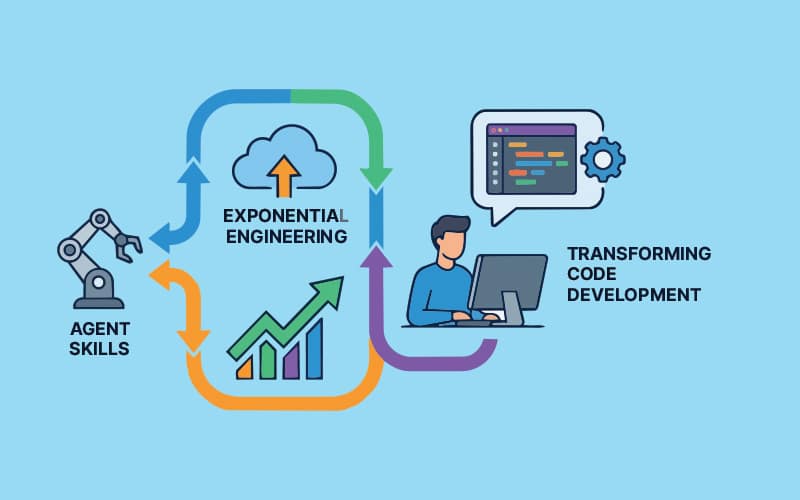

Artificial intelligence (AI) has evolved rapidly, enabling machines to perform increasingly complex tasks. Central to this advancement are agent skills and the concept of exponential engineering.
Agent skills refer to the discrete capabilities or specialised functions embedded within AI agents, allowing them to execute tasks that require domain-specific expertise. These skills can range from natural language processing and image recognition to coding, data analysis, and more. By equipping AI agents with targeted skills, developers enable them to tackle niche challenges efficiently, thereby enhancing their overall utility and adaptability.
Expanded definition and context
Agent skills are specialised abilities embedded within AI agents, enabling them to carry out specific, domain-focused tasks with precision and reliability. Unlike broad, generic machine intelligence, these skills target areas such as language understanding, pattern recognition, or code analysis. By integrating such skills, AI agents become adept at handling distinct technical challenges, making them more useful in real-world development environments.
The inclusion of agent skills in AI systems transforms the traditional approach to code development. With targeted skills, an AI agent can perform tasks like reviewing code, generating scripts, or locating potential vulnerabilities in software projects. This tailored expertise not only increases the speed of development but also raises the quality of outputs, as AI agents can consistently apply best practices and guidelines. As a result, developers can focus on creative and strategic aspects, while repetitive or error-prone processes are efficiently managed by skilled AI.
Consider an AI agent integrated with a code review skill. When a developer submits new code to a repository, the agent automatically scans the submission for bugs, style inconsistencies, and potential security issues. It then generates a clear report, highlighting areas that need attention and suggesting possible improvements. The developer receives this feedback promptly, enabling quicker corrections and more robust code before merging into the main branch.
Here is a sample markdown that demonstrates how to utilise a Code Review Agent Skill.
Step 1: Submit your code to the repository as usual, ensuring all files are properly committed and pushed.
Step 2: Activate the Code Review Agent Skill by using the designated command or interface. For example, in your markdown file, add @CodeReviewAgent review.
Step 3: The agent will automatically evaluate your code for potential issues, including bugs, style inconsistencies, and security concerns.
Step 4: Review the generated report, which outlines areas needing improvement and offers actionable suggestions for refinement.
Step 5: Implement the recommended changes and re-submit your code for a final review, ensuring all feedback has been addressed.
The following markdown demonstrates how to engage the Review Agent Skill in your development workflow. This example can be adapted for use in your project’s documentation or pull request templates.
## Code Review Request
@CodeReviewAgent review

**Description:**
- Briefly explain the purpose of the code changes.

**Checklist:**
- [ ] All files are committed and pushed.
- [ ] Unit tests pass locally.
- [ ] Code adheres to project style guidelines.
- [ ] No sensitive information is exposed.
**Areas for Focused Review:**
- List any specific files or areas you would like the agent to pay extra attention to.

---
The Review Agent will automatically scan the submission, highlight potential bugs, style inconsistencies, and security issues, and provide actionable suggestions for improvement.
This markdown ensures that the Review Agent Skill is triggered systematically, helping developers receive prompt and actionable feedback for higher quality code.
This workflow streamlines the review process, enabling developers to receive timely and constructive feedback, thereby improving code quality and reducing manual effort.
The integration of agent skills empowers AI systems to perform tasks that would otherwise demand human intervention or specialised knowledge. For example, an AI agent with coding skills can automate code reviews, generate scripts, or debug complex programs. This targeted expertise reduces manual effort and minimises errors, making AI a valuable collaborator in technical environments.
Exponential engineering in AI: Concept and significance
Exponential engineering refers to the practice of leveraging AI’s recursive and rapid improvement capabilities to accelerate code development and innovation. Through continuous learning and skill acquisition, AI agents amplify their productivity, enabling exponential growth in project outcomes. This approach not only streamlines development processes but also facilitates swift adaptation to emerging technologies and methodologies.
Role of agent skills in exponential engineering: Synergy and benefits
The synergy between agent skills and exponential engineering lies in their mutual reinforcement. As AI agents acquire and refine skills, they contribute to faster, more efficient engineering cycles. For instance, an agent adept at both coding and project management can oversee development workflows, assign tasks, and optimise resource allocation, all while improving through iterative feedback. This dynamic fosters a culture of innovation and scalability within AI-driven teams.
The GitHub Skill—functionality, workflow, and impact
The GitHub Skill exemplifies how agent skills transform code development. This skill enables AI agents to interact seamlessly with GitHub repositories, automating tasks such as pull request management, code review, and issue tracking. In a typical workflow, an AI agent equipped with the GitHub Skill can fetch repository data, suggest code improvements, and even merge branches upon successful validation. Such automation not only enhances productivity but also ensures consistency and adherence to best practices.
For instance, when developers push new code, the AI agent can automatically review changes, flag potential bugs, and provide actionable feedback. This reduces the turnaround time for code validation and allows teams to focus on more strategic aspects of development. The impact is particularly pronounced in large-scale projects, where maintaining quality and speed is paramount.
Agent skills in leading platforms
Several platforms have harnessed agent skills to redefine AI-driven code development:
Codex (OpenAI): Codex integrates agent skills to interpret natural language instructions and generate code across various programming languages. Its ability to understand context and execute specialised tasks, such as writing functions or debugging scripts, showcases the power of agent skills in practical scenarios. For example, a user can prompt Codex to draft a Python function for data analysis, and the agent will deliver a tailored solution.
Claude: Claude, developed by Anthropic, features agent skills that enable it to assist in code review, documentation, and automated testing. Its conversational interface allows developers to query code, request explanations, and receive recommendations for optimisation. Claude’s agent skills make it a versatile tool for collaborative coding environments, streamlining both technical and communication aspects.
OpenClaw: OpenClaw utilises agent skills to manage repository workflows, automate deployment, and monitor system health. Its agents can execute commands, resolve conflicts, and generate reports, making it an invaluable asset for DevOps teams. For example, OpenClaw can automatically detect failed deployments and initiate corrective actions, minimising downtime and ensuring continuous integration.
Popular open source agent skill libraries
The open source agent skill ecosystem has become one of the most important foundations of AI-driven code development. Earlier, AI coding tools were primarily prompt-response systems: a developer asked for code, and the model generated an answer. Modern agent skill libraries go much further. They provide structured mechanisms for planning, tool invocation, memory management, repository interaction, workflow execution, human approval, and continuous feedback. These libraries allow developers to build AI agents that can operate across software engineering pipelines—reading issues, analysing source code, executing tests, generating patches, reviewing pull requests, and even coordinating with other agents. In the context of exponential engineering, these open source frameworks are critical because they convert isolated AI capabilities into reusable, composable, and repeatable engineering skills.
Unlike closed automation tools, open source agent libraries give developers full control over orchestration logic, execution environments, model selection, tool permissions, observability, and integration with platforms such as GitHub, GitLab, Docker, Kubernetes, CI/CD pipelines, vector databases, and monitoring systems. They are especially useful for organisations that want transparent, auditable, and extensible AI workflows instead of black-box automation. The following are some of the most relevant open source agent skill libraries and frameworks currently shaping AI-native software development.
LangGraph: LangGraph, developed within the LangChain ecosystem, is one of the most widely used frameworks for building stateful and controllable AI agents. While LangChain popularised the idea of connecting language models with tools, APIs, retrievers, and memory systems, LangGraph extends this concept by introducing graph-based agent orchestration. This means developers can model an agent workflow as a directed graph, where each node represents a computation step, tool call, model invocation, validation stage, or human approval checkpoint.
Its features are:
- Stateful agent execution: Maintains persistent state across multiple steps, making it useful for long-running repository tasks.
- Graph-based workflows: Supports branching, loops, retries, and conditional execution.
- Human-in-the-loop control: Developers can pause, inspect, modify, or approve agent state before execution continues.
- Memory integration: Supports short-term and long-term memory for context-aware development workflows.
- Tool orchestration: Allows agents to call APIs, code execution tools, search systems, databases, and repository utilities.
- Production alignment: Suitable for building reliable, observable, and debuggable agent pipelines.
For GitHub-oriented agent skills, LangGraph can be used to design workflows such as issue triage, automated code review, dependency upgrade validation, release checklist automation, and CI failure analysis. Its main strength is deterministic control over otherwise non-deterministic LLM behaviour.
Microsoft AutoGen: AutoGen, originally developed by Microsoft Research, is an open source framework for building multi-agent AI applications. Its core idea is that complex tasks can be solved more effectively when multiple specialised agents collaborate. Instead of using a single general-purpose AI assistant, developers can define agents such as a planner, developer, reviewer, tester, security auditor, documentation writer, and execution controller.
In AI-driven code development, this multi-agent model is extremely powerful. For example, one agent can analyse a GitHub issue and produce an implementation plan. A second agent can generate code. A third agent can review the code for correctness and maintainability. A fourth agent can execute tests or inspect CI logs. This mirrors the structure of real software teams and supports recursive improvement, which is central to exponential engineering.
Its features are:
- Multi-agent collaboration: Enables multiple agents to communicate and solve tasks collectively.
- Role-based specialisation: Each agent can be assigned a specific responsibility, system instruction, and toolset.
- Human-agent interaction: Supports workflows where humans can intervene, approve, or redirect the conversation.
- Tool and code execution support: Agents can interact with external tools, scripts, APIs, and execution environments.
- Autonomous or supervised operation: Can be configured for fully automated or human-controlled workflows.
- Research-to-production pathway: Microsoft has also been aligning AutoGen concepts with broader agent framework initiatives.
AutoGen is particularly relevant for building simulated engineering teams. In open source projects, it can be used for automated bug fixing, design review, code migration, documentation generation, and test coverage improvement.
CrewAI: CrewAI is a lightweight open source framework for orchestrating role-based AI agents. Its design is developer-friendly and task-oriented. A developer defines agents, assigns them goals, gives them tools, and organises them into a crew that executes a set of tasks. This makes CrewAI accessible for teams that want structured agent automation without building a complex graph execution engine from scratch.
Its features are:
- Role-playing agent model: Agents are configured with roles, goals, backstories, and tools.
- Task-driven execution: Workflows are organised around explicit tasks and expected outputs.
- Tool integration: Supports external tools for search, file operations, APIs, databases, and automation.
- Sequential and collaborative workflows: Agents can work step-by-step or cooperate on shared objectives.
- Low barrier to entry: Easier to adopt for teams beginning with agentic automation.
- Useful for documentation and operations: Strong fit for release notes, project reports, triage, and knowledge workflows.
For GitHub Agent Skills, CrewAI can be used to create specialised repository maintenance crews. One agent can summarise open issues, another can detect duplicate bug reports, another can generate documentation updates, and another can prepare pull request summaries.
OpenHands: OpenHands is an open source AI software engineering agent platform designed to perform real development work rather than only suggest code. It evolved from the broader open source movement around autonomous software agents and provides an environment where agents can inspect repositories, modify files, execute commands, run tests, and reason over results.
This makes OpenHands highly relevant for AI-driven code development because it operates closer to how a human developer works. Instead of merely returning a code snippet in chat, an OpenHands-style agent can enter a repository, understand the structure, edit files, run commands, observe failures, and iterate until the task is complete. This execution-oriented model is essential for practical autonomous coding.
Features include:
- Repository-level operation: Agents can work directly with project files and source trees.
- Command execution: Supports terminal-like operations for building, testing, and debugging.
- Autonomous coding workflows: Can plan, implement, test, and refine code changes.
- Software Agent SDK: Provides composable components for building engineering agents.
- Benchmarking orientation: OpenHands has introduced benchmarking efforts such as the OpenHands Index to evaluate agentic software engineering performance.
- Cloud and local development alignment: Useful for both hosted and developer-controlled workflows.
OpenHands is particularly suitable for bug fixing, test repair, dependency updates, simple feature implementation, and repository maintenance automation. Its key value lies in combining reasoning with execution.
SWE-agent and Aider: SWE-agent and Aider are two important open source tools focused specifically on code modification and software engineering tasks.
SWE-agent is designed around the idea of using language models to solve real software engineering issues, especially those represented in benchmarks such as SWE-bench. It gives the agent a controlled environment to inspect code, run commands, edit files, and generate patches. It is useful for research and practical experimentation in autonomous bug fixing.
Aider, on the other hand, is a command-line AI pair programmer that works directly with Git repositories. Developers can ask Aider to modify files, refactor code, add tests, update documentation, or implement features.
Features include:
- Git-native development support
- Patch generation and repository editing
- Command-line developer workflow
- Test-driven iteration
- Useful for bug fixing and refactoring
- Strong alignment with open source contribution patterns
LlamaIndex and Haystack: LlamaIndex and Haystack are not only agent frameworks but also powerful retrieval and knowledge orchestration libraries. They are highly relevant for agent skills because software agents often need access to large volumes of project knowledge: documentation, API references, architecture notes, issue discussions, design documents, changelogs, and code comments.
A GitHub Agent Skill can use LlamaIndex or Haystack to build retrieval-augmented generation pipelines over a repository. This enables the agent to answer project-specific questions, identify relevant files, retrieve historical issue context, or generate documentation consistent with existing architecture.
Features include:
- Retrieval-augmented generation support
- Vector database integration
- Document indexing and semantic search
- Knowledge graph and structured retrieval options
- Useful for repository documentation and codebase understanding
- Integration with LLM-based agent workflows
Semantic Kernel: Semantic Kernel, developed by Microsoft, is an open source SDK for integrating AI models with conventional programming languages and enterprise workflows. It allows developers to define semantic functions, native functions, planners, plugins, and memory-backed skills. In enterprise environments, Semantic Kernel is useful because it connects LLM reasoning with strongly structured application logic.
Its features are:
- Plugin-based skill architecture
- Planner and orchestration support
- Integration with enterprise applications
- Memory and context management
- Support for multiple programming languages
- Useful bridge between AI agents and production software systems
Agent skills and exponential engineering are pivotal in shaping the future of AI-driven code development. By enabling AI to perform specialised tasks and continuously improve, these concepts drive efficiency, innovation, and scalability in technical domains. As platforms like Codex, Claude, and OpenClaw continue to evolve, the integration of agent skills will become increasingly sophisticated, unlocking new possibilities for developers and organisations alike.