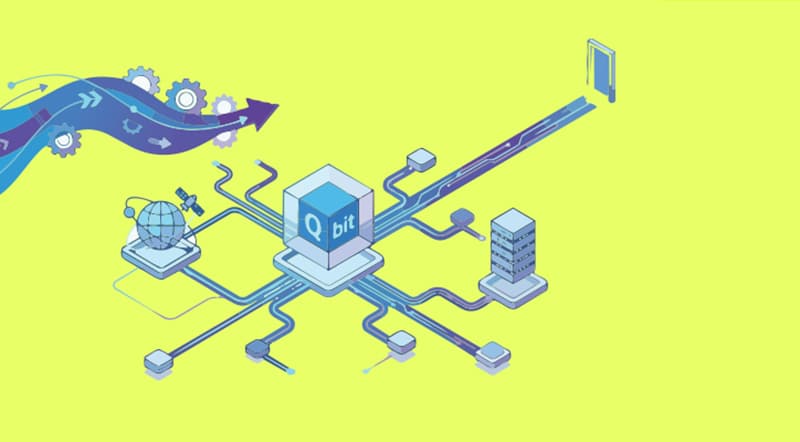
Envisioned as a global network that enables the direct transmission of qubits across vast distances, the quantum internet could totally transform communications.
Quantum networking represents a radical shift in the way information is transmitted, processed, and secured. Unlike classical networks, which rely on the exchange of bits, quantum networks utilise the principles of quantum mechanics, particularly the properties of superposition and entanglement, to enable communication with unprecedented security and computational capabilities. The significance of quantum networking lies in its potential to revolutionise data transfer, bolster cybersecurity, and unlock new paradigms in distributed computing. As researchers and technology professionals explore the possibilities of quantum communication, the prospect of a quantum internet emerges as a transformative milestone for the digital age.
From an engineering perspective, quantum networking is best viewed as a service for distributing non-classical correlations (entanglement) and, in limited cases, quantum states, using a tightly coupled quantum–classical control loop. Performance is constrained by channel loss, memory coherence time, detector noise, and synchronisation accuracy, which jointly determine achievable entanglement generation rate, fidelity, and end-to-end latency.
The vision: What is quantum internet?
The quantum internet is envisaged as a global network that leverages quantum entanglement and quantum states to transmit information securely and efficiently. A practical definition is that a quantum internet offers network-accessible primitives such as ‘entanglement as a service’ (deliver Bell pairs between nodes with specified fidelity and rate), quantum-secure key establishment, and time-synchronised quantum operations coordinated by a classical control plane. Consequently, capability must be described via metrics including entanglement generation rate (pairs/s), fidelity, secret-key rate (bits/s), and outage probability under realistic field noise. In contrast to the conventional internet, which is fundamentally vulnerable to eavesdropping and hacking, the quantum internet promises intrinsic security rooted in the laws of physics.
By enabling the direct transmission of quantum information—qubits—across vast distances, this network could facilitate new forms of communication, computation, and sensing. The transformative potential of the quantum internet extends to secure government communications, advanced scientific collaboration, and even the interconnection of quantum computers, thus redefining the boundaries of technological progress.
Entanglement distribution across networks
Entanglement produces correlations between measurement outcomes that are stronger than any classical model; however, these correlations cannot be used for superluminal signalling and become operationally useful only when combined with classical communication and agreed measurement settings. This property forms the backbone of quantum networking, enabling the distribution of entangled pairs across a network to establish secure links. Entanglement distribution is achieved through various methods, including photon transmission over optical fibres and satellite links. The ability to share entangled states between remote nodes allows for the creation of quantum channels, which are essential for quantum key distribution and other secure communication protocols. As entanglement is inherently fragile, maintaining its integrity over long distances remains a key challenge in quantum networking.
In fibre links, attenuation and noise impose hard scaling limits on direct transmission; in free-space and satellite links, pointing, atmospheric turbulence, and background light dominate error budgets. Engineering-grade entanglement distribution therefore relies on tight polarisation/phase stabilisation, spectral filtering, and precise time-tagging to preserve interference visibility at the detectors.
Quantum repeaters and network security
One of the primary obstacles in constructing large-scale quantum networks is the attenuation and decoherence of quantum signals over distance. Quantum repeaters are specialised devices designed to overcome this challenge by extending the range of entanglement and facilitating error correction. Repeaters are typically categorised as: (i) purification-based repeaters, which trade additional entanglement attempts for higher fidelity via distillation, and (ii) error-corrected repeaters, which encode logical qubits to tolerate loss and operational errors at the cost of substantially higher qubit and control overhead. The design choice depends on target distance, required rate, memory lifetime, and gate/measurement fidelity. Unlike classical repeaters, which simply amplify signals, quantum repeaters must preserve the delicate quantum states involved, often through processes like entanglement swapping and purification. The deployment of quantum repeaters not only enables longer quantum links but also enhances network security. Quantum communication is inherently resistant to interception, as any attempt to measure or tamper with a quantum signal disrupts its state and is immediately detectable. This property makes quantum networks exceptionally secure against traditional cyber threats.
Communication protocols: Sending qubits over distance
Transmitting quantum information, or qubits, across a network requires innovative communication protocols that address the unique challenges of quantum mechanics. Unlike classical bits, qubits cannot be copied due to the no-cloning theorem, necessitating the use of quantum teleportation and entanglement-based schemes. Quantum teleportation involves transferring the state of a qubit from one location to another via shared entanglement and classical communication. Protocols such as quantum key distribution (QKD) harness these principles to enable secure exchange of cryptographic keys. However, transmitting qubits over optical fibres or free-space links is subject to loss and decoherence, driving the development of robust error correction techniques and adaptive routing strategies to ensure reliable communication across quantum networks.
Early experiments and current projects
Pioneering experiments in quantum networking have demonstrated the feasibility of entanglement distribution and quantum communication over metropolitan and intercontinental distances. Notable achievements include the creation of quantum links between laboratories, the successful transmission of entangled photons via satellite, and the implementation of quantum key distribution in real-world settings. Current projects, such as the European Quantum Internet Alliance and the Quantum Internet Initiative in India, are working towards the establishment of prototype quantum networks and the development of scalable infrastructure. These initiatives bring together academic institutions, industry partners, and government agencies to advance the practical deployment of quantum communication technologies and lay the foundation for a future quantum internet.
Applications for secure and fast communication
The quantum internet holds immense promise for secure and rapid communication across a variety of domains. Quantum key distribution enables the exchange of cryptographic keys with absolute security, making it invaluable for banking, defence, and diplomatic communications. The interconnection of quantum computers via quantum networks could facilitate distributed quantum computing, allowing complex computations to be performed collaboratively across multiple nodes. Furthermore, quantum sensing and metrology applications benefit from the precision and sensitivity afforded by quantum correlations, enabling breakthroughs in scientific measurement and environmental monitoring. As quantum networking matures, it is poised to underpin a new generation of secure, high-speed communication systems that transcend the limitations of classical technologies.
Hurdles to building a scalable quantum internet
Realising a scalable quantum internet entails concurrently addressing challenges in physics, device engineering, and network architecture. The first hurdle is loss and decoherence: photons are absorbed in fibre (particularly around 1550 nm), while matter qubits (NV centres, trapped ions, neutral atoms, superconducting qubits via transduction) have limited coherence times and control errors. Unlike the classical counterparts, quantum states cannot be amplified or copied (no-cloning), thus the scaling relies on entanglement distribution with high-fidelity and verifiable quality-of-service (QoS). And that immediately gives us the second obstacle: quantum repeaters are not a single device but an integrated stack with one small cube on top of the other — memory, photonic interface, entanglement swapping, purification or error-corrected links and synchronisation — each with demanding constraints; none of them has any margin at all with respect to efficiency, dark counts, indistinguishabilty, or jitters in time.
A third challenge is heterogeneity: the networks of the future will be a hybrid of fibre, free-space and satellite links, connecting heterogeneous nodes. This calls for interoperable quantum link layers (entanglement generation protocols heralding multiplexing) as well as control-plane co-design to integrate classical signalling with quantum operations (feedforward, scheduling, buffering under memory constraints). Fourth, there is a substantial systems-engineering gap in benchmarking: a network must reveal metrics such as entanglement generation rate (EGR), fidelity, latency, and secret-key rate, in the presence of noise and adversarial behaviour. In addition, strong security requires more than ‘physics guarantees’: implementations need to consider side channels, device imperfections and denial-of-service threats, leading to techniques such as measurement-device-independent QKD, device characterisation and hardware-rooted trust models for quantum nodes.
The cost factor (capital expenditure)
Capital costs of quantum internet are dominated by such things as specialised photonic infrastructure, cryogenics, precision timing, and quantum-grade endpoints, not bandwidth. Low-loss fibre paths, wavelength-stable lasers, ultra-low-noise detectors (SNSPDs are often cryogenically cooled), and high-extinction modulators must be installed at the physical layer, and are expensive, particularly when extending (metro/backbone) networks to accommodate quantum channels in addition to classical traffic. Meanwhile, trusted-node QKD networks are available for deployment today but incur capital expenditure in secure facilities, tamper-resistant hardware, and operational hardening at every intermediate node — costs that increase linearly with distance and node count.
The long-term cost inflection is in repeatered entanglement. True quantum repeaters need quantum memories with long coherence time, high retrieval efficiency, and telecom-compatible photonic interfaces. Because these nodes often require vacuum systems, cryostats or ultra-stable environments, single-photon sources or entangled-pair sources, frequency conversion, and high-speed classical control electronics, their construction is not trivial. Networks also require precision time/frequency distribution (GPS-disciplined clocks might be too coarse for some synchronisation targets), as well as calibration and monitoring instrumentation to keep interference visibility and polarisation stability. Capital expenditure is also influenced by the deployment model: metro scale testbeds can collocate in ducts and data-centre footprints, whereas intercity links may need dedicated dark fibre or meticulously engineered coexistence with classical DWDM traffic to reduce Raman noise. Finally, maturity in manufacturing has an impact: the costs are high since many components (memories, detectors, integrated photonics) are manufactured in small volumes, with yield and packaging—particularly fibre coupling and cryogenic reliability—frequently turning out to be the secret cost drivers.
Future of quantum internet development
It is anticipated that near-term development of the quantum internet will be rolled out in stages, with functionalities being added as hardware evolves. Phase one centres on quantum-secure communications, mainly QKD (including measurement-device-independent variants) and quantum-randomness services, offered through metro networks and limited intercity routes. At the same time, a second line of research addresses entanglement-as-a-service: networks that allocate entangled pairs between end nodes with given fidelity and rate, allowing teleportation-based primitives and fundamental multi-node experiments (entanglement swapping chains, simplest quantum routing, and networked sensing).
A critical transition will be from ‘trusted-node’ scaling to repeater-based scaling, motivated by progress in quantum memories, integrated photonics, and error mitigation. Architecturally, the field is moving to a layered network stack, including explicit link-layer heralding, purification/encoding choices, and a control plane that schedules in the face of constraints (memory lifetimes, probabilistic link establishment, classical feed-forward latency). Multiplexing—temporal, spectral, and spatial—will be important to increase the rates of entanglement generation, and hardware-protocol co-design will define what are practical throughputs.
In the long run, the quantum internet is expected to link quantum processors for distributed computing and secure delegated computation, and enable quantum-enhanced sensing (clock networks, interferometric baselines, and correlated measurements). Success will require interfaces and metrics to be standardised, telecom-wavelength compatible node technologies to mature, and real-world operation to be demonstrated. The ‘end state’ is not one giant monolithic network but rather a federation of quantum-capable domains—metro, backbone, and satellite—that are integrated with classical infrastructure via well-articulated service-level objectives for entanglement and security.