






























































Conversational commerce will transform the way we shop online.
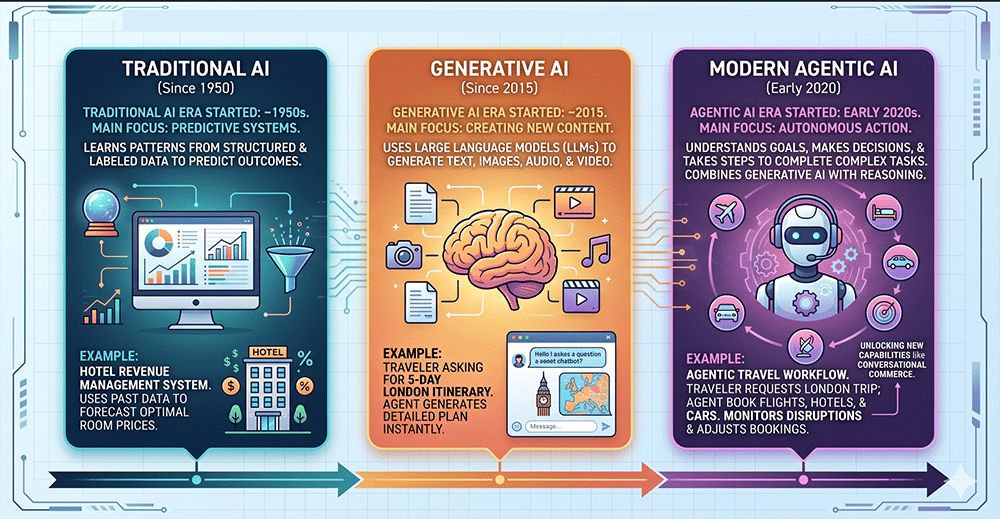
The AI/ML era started way back in 1950. Traditional AI systems learnt and identified patterns based on structured and labelled data, tried to find similar patterns, and predicted outcomes based on this learning. An example is the hotel revenue management system that learnt from past data to predict the price of a room.
The generative AI era started around 2015. As the name suggests, it is used to generate new content – text, image, audio or video. Generative AI learns from large data sets and relies on large language models (LLMs) to generate new content. An example is ChatGPT giving a detailed 5-day itinerary for a London trip to a traveller.
The modern agentic system era started in early 2020. Agentic AI systems are autonomous systems that understand the goal, make decisions to fulfil it, and take steps to complete the action. Agentic AI combines generative AI with reasoning to build a fully autonomous system that can complete complex tasks. For example, agentic AI can book flights, hotels and a cab for our London traveller. It can also monitor disruptions before or during the trip and adjust the bookings accordingly.
Agentic systems are unlocking significant capabilities that are transforming industries. One such innovation is conversational commerce.
What is conversational commerce?
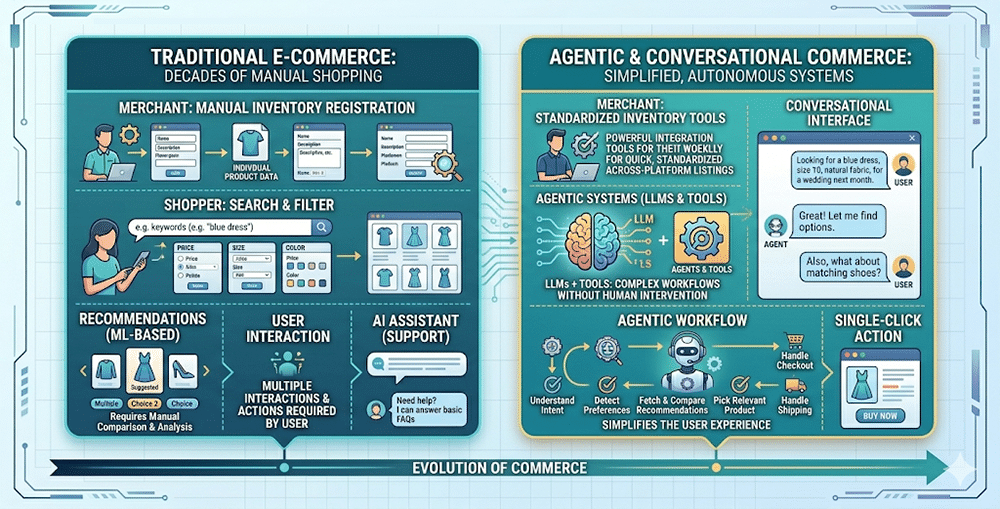
Traditional e-commerce platforms have been around for decades. They may have expanded their presence across a range of domains but the traditional shopping experience on these platforms has remained the same over all these years. Merchants register their inventory on each platform, shoppers search for what they want, and the platform returns results accordingly. Shoppers then apply filters to further narrow down the products to match their needs.
Machine learning (ML) based recommendation systems were built to suggest products based on shoppers’ purchase history. But shoppers still need to explore each of these recommendations, as well as compare and analyse them before making a purchase decision. Existing workflows need multiple interactions with the user. Many platforms have integrated AI-assistants, but their role is limited to support functions like fetching answers for queries, guiding users, etc.
Large language models (LLMs) and the availability of powerful tools have unlocked the possibility of creating agentic systems that can handle complex tasks and workflows without needing human intervention. GenAI and agentic systems have unlocked a revolution in the commerce space in the form of agentic commerce and conversational commerce. These have the potential to simplify the shopping experience for shoppers. And they are also a great help to merchants, who can now standardise the way their inventory is made available across platforms.
Agentic commerce involves agentic systems handling the shopping experience for users. AI agents understand the user intent, make use of tools to detect user preferences, and fetch recommendations. Agentic systems then compare these, pick the most relevant product, and handle the checkout and shipping instructions. This helps ship the most preferred and relevant products while simplifying the shopping experience for the user.
Conversational commerce takes this experience to the next level by enabling users to converse with the agentic system. They can chat with the agent while giving their inputs in natural language. The conversations can be refined and the inputs adjusted to pass the accurate shopping intent to the agent.
Simplifying the shopping experience
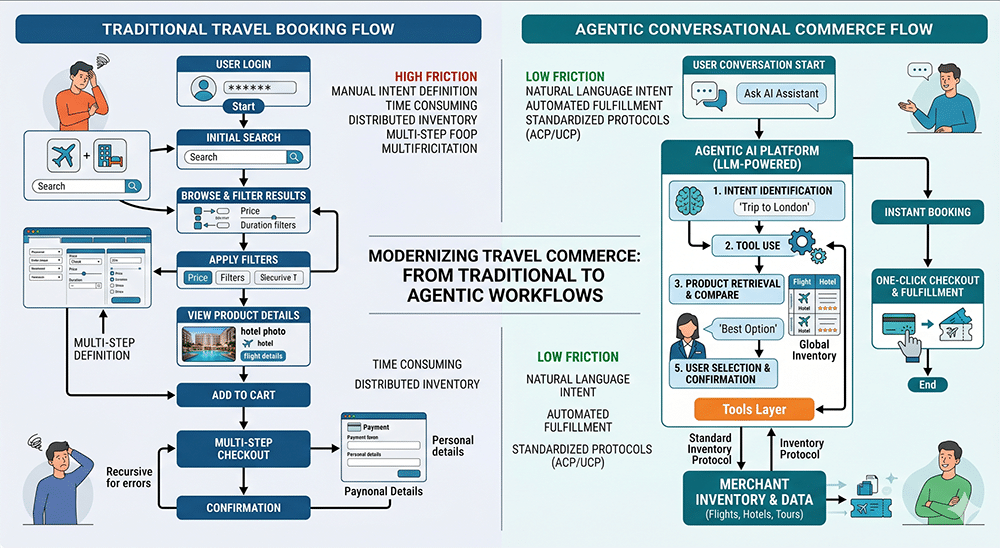
Let’s look at the typical shopping experience of a user on traditional commerce platforms. The user logs into the commerce platform and searches for a product based on their needs. The platform gives a list of products, including recommendations and advertised products. The user then applies filters to narrow down to the most suitable product, add it to the cart, and check out from the platform. This is typically a multi-step process.
Conversational commerce simplifies this whole shopping experience. Powered by conversational applications built over LLMs, agentic shopping provides personalised product recommendations and an instant checkout. With applications like ChatGPT supporting conversational commerce, shopping is integrated into the existing consumer AI applications itself. And product discovery by users happens in a natural free-flowing conversational style. The underlying agentic commerce layer picks the products from merchants registered using standard protocols. The agentic layer, with the help of tools, refines and identifies the user intent provided in the conversation, and retrieves the product data relevant for personalisation. It then uses LLM capabilities to compare the products from merchants, giving the user requirements to return the most relevant product recommendations back to the user. Once the user selects a product, the agentic layer makes use of the one-click checkout processes to take care of the payment, invoicing, and shipping workflows.
In short, conversational commerce brings the shopping experience directly to conversational assistants. In the travel and hospitality sector, with conversational commerce, flights, hotels or tour packages become products. A user can instantly book the product from a conversational AI assistant itself.
Protocols: Standardisation for merchants
In a traditional commerce world, every platform has its own process for enabling merchants to list their product inventory. And there are different workflows for curating the inventory, supporting the shopping, and checkout. These different flows across platforms create a big overhead for the merchants — they need to spend time and resources whenever they want to integrate with a new platform. This forces them to limit their availability only to one or a few platforms.
Imagine a scenario where a single standardised protocol supports every platform. Merchants can just follow that standard protocol and their inventory will be seamlessly available across all the platforms that support it.
The world of conversational commerce is trying to address this challenge by introducing these standard protocols in the agentic layer. Two major protocols have been proposed – OpenAI’s Agentic Commerce Protocol (ACP) and Google’s Universal Commerce Protocol (UCP). These open source protocols will enable merchants to be seamlessly available across a large ecosystem of conversational commerce platforms.
In the travel and hospitality sector, these protocols can help solve a major problem between distribution channels and suppliers. Typically, suppliers have their own mechanisms to distribute their inventory – be it flights, hotels or tour packages. To distribute that inventory across various channels like the Global Distribution System (GDS) is a major challenge. Suppliers and distribution platforms have to work together to make the supplier inventory available on those platforms. With standardised commerce protocols, this overhead is eliminated. Suppliers become merchants and make their inventory available as per the protocol. This inventory can then be made available seamlessly across all conversational commerce platforms that support this protocol.
Conversational commerce is not just about adding an ML tool or an AI assistant to the existing commerce platforms. It will revolutionise the whole experience of commerce for users, with new players and platforms changing the entire shopping experience and the associated workflows. Organisations that can assess the impact this will have on their business and pivot to the new ecosystem will dominate the new conversational commerce space.