


























































A compact wireless biosignal platform combines brain signal acquisition, Bluetooth connectivity, and open-source software to support hands-free gaming, neuroscience experiments, and brain-computer interface development.
Octopus 16 is a wireless biosignal acquisition platform designed to capture brain and physiological signals for hands-free computer interaction. Built for the XIAO ESP32-S3 and ESP32-C6 development boards, the compact device measures electroencephalography (EEG), electromyography (EMG), and electrocardiography (ECG) signals, enabling users to control compatible computer games and other applications without conventional input devices.
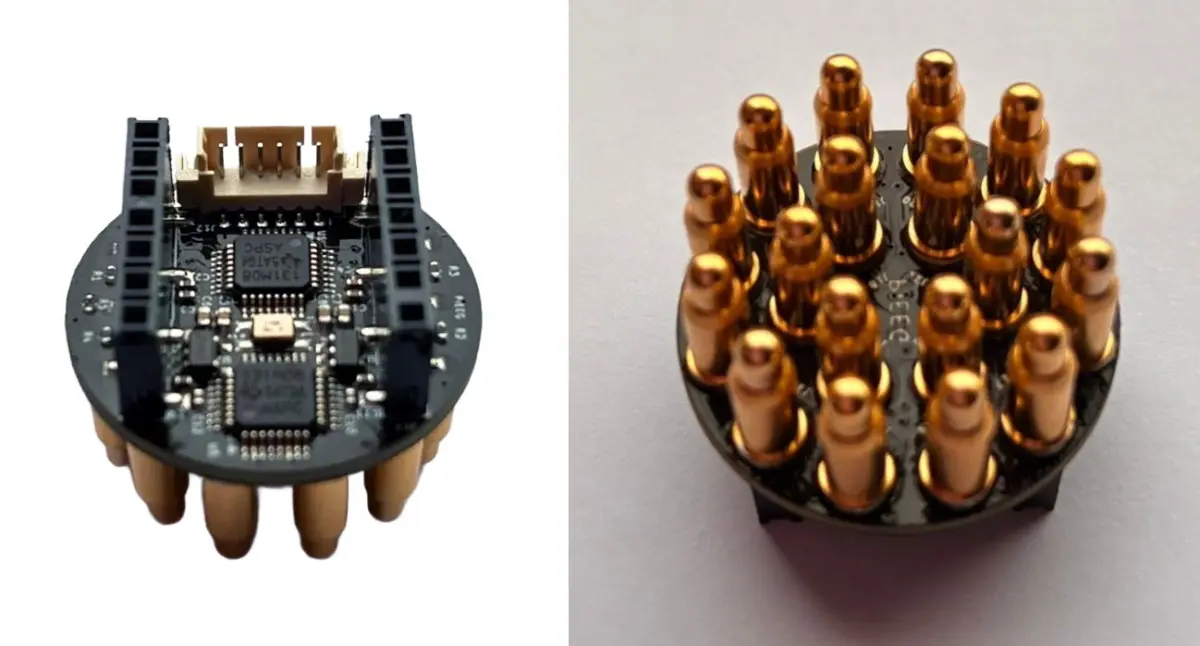
This board comes with two Texas Instruments ADS131M08 24-bit analogue-to-digital converters capable of 16-channel simultaneous sampling via a set of spring-loaded electrodes. Sixteen electrodes, alongside the ground and reference contacts, are used for acquiring biosignals with the help of adjustable gains and built-in filters that improve the signal quality. All hardware is enclosed in a circular casing, which directly connects to the XIAO development board.
When paired with a compatible XIAO development board, the system functions as a Bluetooth low energy HID game controller that communicates with the PiEEG open-source software suite. The provided software suite, which includes Arduino firmware and Python applications, along with documentation is released as open-source code. Developers can examine and modify the platform for creating their own brain-computer interface applications. There is also an online demo with a virtual eight-channel device to experience software without the hardware.
The demonstrations made by the developers reveal the use of the system for controlling the navigation through games based purely on brain signals. While the system is not intended to replace standard input devices such as keyboard and mouse yet, the development reveals the potential of using the low-cost wireless EEG systems in gaming, research in accessibility and human-computer interaction.
The combination of compact hardware, wireless communication and open source software creates an adaptable platform for biosignal acquisition and brain-computer interfaces studies.