
























































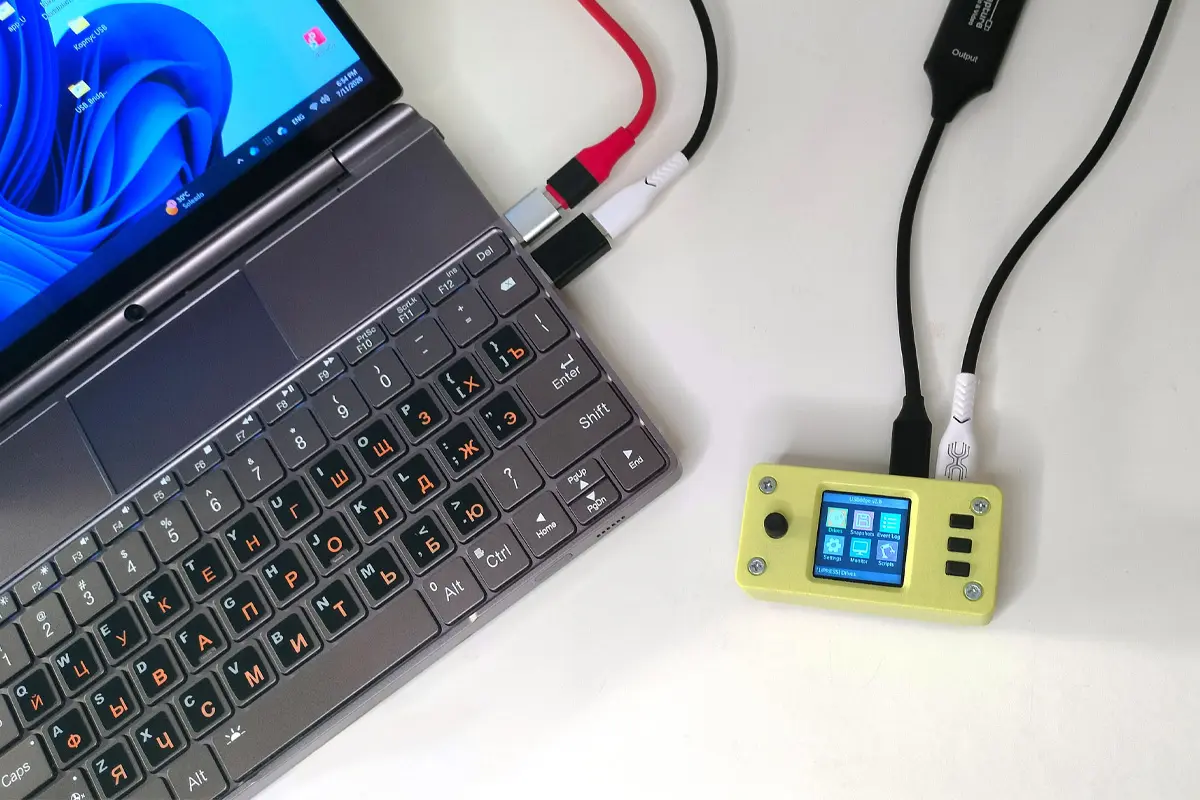

An open-source IP-KVM built around the Radxa Zero 3W, offering remote BIOS access, low-latency display control, virtual media and local optical character recognition over Secure Shell.
USBridge-KVM 2.0 is an open source IP-KVM designed for remotely managing and troubleshooting servers and PCs, including systems that have not yet booted or have become unresponsive. It provides out-of-band BIOS access, remote display and input control, virtual media mounting and hardware-level power management. The device is built around a Radxa Zero 3W and includes Wi-Fi 6, two USB Type-C ports, a Micro HDMI video output, a 240×240 IPS display and a MicroSD card slot.
For remote access, the device supports hardware UVC video capture of up to 1080p and uses Moonlight streaming to provide a reported latency of 25–50 ms. One of its key features is BIOS-in-Terminal, which uses offline optical character recognition to convert graphical BIOS and pre-boot screens into text that can be accessed over Secure Shell. Users can view, select and copy information such as BIOS error codes directly from a terminal.
The open source hardware works with USBridge-Remote, a cross-platform client available for Windows, macOS, Linux, Android and iOS. It manages hardware-level kernel-based virtual machine (KVM) functions and software-level remote desktops with Wayland support, without requiring commercial software-as-a-service subscriptions or cloud registration. A zero-install web client is also available, while two-way clipboard synchronisation supports the transfer of text, images and files between host and target machines.
The BIOS-in-Terminal system also supports AI-related functions. Its locally generated optical character recognition output can be accessed by AI models through the Model Context Protocol, allowing models such as Claude to interact with the KVM. Starlark scripts can also be used for automation. For hardware-level drive emulation, the device supports ISO, VDI and VMDK images, allowing users to install or recover an operating system remotely without connecting a physical USB drive. Btrfs snapshots with a Read-Write Overlay mode can preserve the original image while storing changes as data deltas.
The project’s GitHub repositories provide the Gerber and 3D files, along with documentation related to KVM operation. Schematics, PCB design files, bill of materials and source code are planned to be released after the crowdfunding campaign. USBridge-KVM 2.0 is being offered through Crowd Supply with a $33,000 funding goal. The $219 kit includes the KVM unit with an SLS-printed PA12 nylon enclosure, an external USB HDMI video capture dongle, power-management module with jumper wires, USB-C cable and pre-installed MicroSD card. Worldwide shipping is included, with deliveries expected to begin on March 21, 2027.